Pelvic Floor Basics: Why Kegels Are Only Half the Story


The Hole Shebang Podcast – Episode 83 Transcript
Pelvic Floor Basics: Why Kegels Are Only Half the Story with Lauren Ohayon
Introduction
Kristen Parise: Welcome to The Hole Shebang. I’m your host, Kristen Parise. I’m a pelvic health physiotherapist who is on a journey to learn everything I can about pelvic health, fitness, mindset, and finances. I love to share what I learn with my clients at my clinic, Blueberry Therapy. But what I hear every day is: I wish I knew this information sooner.
So if you are ready to brazenly and unashamedly dive into the truth about peeing and pooping, pain and sex, and a whole lot more, and you want to feel empowered, healthier, wealthier, and wiser – you are in the right place. Let’s jump right into it.
We have been sold a story about our pelvic floors that is deeply flawed. Squeeze, lift, tight, and repeat. And it does not hold up when you actually understand how the body works. Lauren Ohayon is the founder of Restore Your Core®, a movement method that has helped thousands of people reconnect with their core and pelvic floor through breath-led, reflective movement rather than outdated tightening protocols.
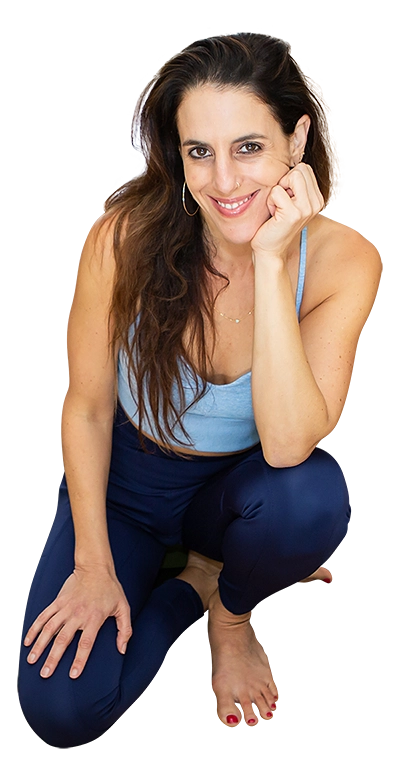
She’s a movement educator with over 25 years of experience, specializing in pelvic floor, core, and low back recovery. And she brings this incredible blend of journalism-trained storytelling and deep anatomical knowledge to everything she teaches. In this episode, Lauren reframes the pelvic floor as a dynamic, responsive structure – not a squeeze muscle – and walks us through exactly how to connect with it using breath, body awareness, and simple daily practices.
We talk about why emotional stress accumulates in the pelvic floor, how five minutes of mindful movement can change your brain, and why the language practitioners use matters more than most of us realize. This conversation will change how you think about your body.
Well, hold on to your shebang, listeners, we are back and I am so excited to meet someone who I have been a fan of for a very long time. Welcome, Lauren Ohayon to the podcast.
Lauren Ohayon: Thank you. You said my name correctly. We didn’t even practice that.
Kristen Parise: You know, I listened to a few podcasts before because I wanted to make sure I nailed it.
Lauren Ohayon: I know, my name is confusing. I don’t know why.
Kristen Parise: Yeah, it is. It is wonderful to have you here. And I would love for our listeners to know a little bit about you and what drew you to the movement space.
Lauren Ohayon: Yeah. So I’m a longtime – I’m not a pelvic floor physical therapist. I’m a longtime movement teacher with a strong specialty and expertise in the pelvic floor, core, and low back area. I actually trained to be a journalist, and my whole life I wanted to be Barbara Walters, Christiane Amanpour. I had grown up around the world and so I just had a very international background, and I just saw myself as flying around the world covering, like, anything.
And so I studied journalism at NYU. But I was also a longtime mover and dancer and had been doing yoga very seriously for many years. So I had taken a yoga teacher training course in college and then found myself on a year traveling around the world, and everywhere I went, I would start teaching movement, like to the youth hostels. I would just put up a sign and be like, I’m going to teach a class in the morning on the grass. It was so fun, and I realized that the art of storytelling could come through movement too. And what I love about journalism – which is really the storytelling and the life that’s happening – is actually available in a movement setting too, if you open up to that.
And so I really just started teaching a lot of movement, mostly yoga, then Pilates, and then kind of a mixing of yoga and Pilates. Never felt right for me to really teach yoga in the traditional sense – a lot of Sanskrit, I speak English, I didn’t really feel comfortable praying to gods that were not my gods. But I loved the mindfulness of yoga and the art of attention and focus and the blend of doing challenging things while maintaining quiet focus.
And then I had three children, three kids in three years. I also sustained a really serious back injury in my 20s. I started studying anatomy like crazy. So by the time I had my kids, I had been studying years and years of anatomy and biomechanics. I had been dealing with my own recovery from back injury, and I was just really interested in pregnant people and the postpartum body. And the things I was hearing were crazy and weird. And I was like, none of this makes sense, but everyone’s repeating it anyway. So I’m going to start creating my own method.
And I did, and I brought it online only because I was selfish and I wanted to travel the world. And I was like, I need a program that I can take with me everywhere. I can’t be tied. And so the program Restore Your Core® is over ten years old. We’ve had thousands and thousands of members, and it kind of grew into something I never expected. But that is the long version of where I come from – movement, storytelling, injuries, and then this desire to empower other people on their process with all of that.
Kristen Parise: And the output of that – the Restore Your Core® program – is how I connected with you. So as a young pelvic health physiotherapist, a couple of my clients came through and they were doing really well. And I said, so what have you been doing? They said, I saw this program online, Lauren, Restore Your Core®, and it’s like genius. And so that is exactly how I connected – actually because of the program.
Lauren Ohayon: That’s amazing. Thank you for saying that. That makes me happy.
Kristen Parise: Yeah. And the other thing that made me happy was, in listening to some of your other podcasts, you talked about movement and the importance of movement – how you were still planning on being a journalist and dancing in your room at night to kind of integrate the day. And funny story, I often start the morning with like a silly song that I love, dancing around just to kind of get my energy up. So it made me feel like, oh, I’m really going to like this woman.
Lauren Ohayon: I love that. I think as humans, though, if you look in the ancient cultures, movement and dance and storytelling were literally how we evolved as people. I think it’s really in our genetic coding to be in our bodies more. And I think life and evolution in modern society has put us so much in our heads. But our genetic coding, like even when we were millions of years ago as single-cell organisms, we survived because we could feel and sense – we were all body. Even as our nervous systems developed, we were still all body. Early man was all body. They huddled together for safety. They climbed and ran. They were so much more in their bodies. And we are so in our heads. But I think our genetic coding is really about being in our body.
Kristen Parise: And we see that. I see it where people come in and they’re starting to say they have something wrong with their back, but you’ve watched them walk in and their foot is turned out to the side and their shoulder is doing these funny things and they’re completely disconnected. You must see that.
Lauren Ohayon: Yes. I mean, I see people with all those patterns who have no pain, right? I see so many people these days. What I notice more is the emotional patterning they’re coming in with. Like all of what you just said, but it all kind of has this tension beneath it that’s really a nervous system tension too.
But yes, of course. One of the things that Restore Your Core®, the online program, does is try to blend all the alignment things – like here are things to know about alignment and form in your feet and your pelvis and your shoulders. And then the other operating mode is like, here’s how to not get too vigilant about those elements. Here’s how to drop into your body. So it’s like, how do you notice patterns in your body without judging them and becoming crazed?
I was always very anterior – I was a dancer, so I was very anteriorly pelvic tilted. My back was very arched and my ribs were very flared. And I still have that pattern to some degree. But I remember for years how many practitioners tried to demonize my pattern. Everything became about like, your tilts are bad. And so I try very much with my clients to approach it like: how can we have awareness to our patterns without then feeling like that’s the very thing that’s screwing us up? Because there are also millions of people with the same pattern and no pain.
The Pelvic Floor Is Not a Squeeze Muscle: Reframing How We Think About Pelvic Floor and Core Health
Kristen Parise: It’s such an important point. And I mean, I think one of the things I also see – when you’re talking about the emotional load – is that people are carrying incredible tension through their pelvic floor because of emotional stress. And I know you spend a ton of time talking about pelvic floor issues, core-related issues. Can you talk to our audience a little bit about where you started diving into pelvic floor focus specifically, and then also maybe some easy things that people can do to help them connect with their pelvic floor?
Lauren Ohayon: I love that. So I think that the story we’ve been sold about our pelvic floor is very flawed. It has a lot of holes in it – no pun intended.
Kristen Parise: The Hole Shebang.
Lauren Ohayon: Yes. And it also has a lot of patriarchal mythology. Right. So there’s this idea that the tighter your pelvic floor, the better – because that would feel good on a penis. And then there’s this idea that therefore, when something is problematic in the pelvic floor, it must be that your floor muscles are not strong enough. And the way to find strength is to do tightening exercises.
But that does not hold true for any other body part. No other part of our body is that true for – and yet it is considered true for the pelvic floor and the core. I like to use analogies to help people understand. Like when you go to open a door, you don’t have this consultation with your arm about how to get the task done. It’s automatic. A word that I use a lot in my work is ‘reflexive.’ So you’ve got this ability to just reflexively do things, and the core and pelvic floor are no different. They literally are designed to react and reflexively do what their job is – just to reflexively support you.
And because the core and pelvic floor are not reach-and-pull body parts – right, the arm is like reach and pull, the leg is kick and stride – the pelvic floor and core do none of those things. They are deep internal support. They are pressure managers. So we have to start looking at the core and pelvic floor as really part of a deeper system that includes the breath and the spine, and that responds to upper body and lower body tension and mobility patterns. And the pelvic floor is really a site of shock absorption and force transmission.
As you move through your day – you reach, you pull, you stride, you kick, you step – all of that force is coming into your body. That’s what the human body is doing: managing gravity and managing force. So we’re doing this shock absorption and force transmission. And the core and pelvic floor are beautifully designed to absorb shock and to send it through your body in a more even way.
However, if we are kind of tight and tense, or if we’re hunched over or in a big arched pattern, or some people are really curled under in their pelvis – like a scared dog presentation, that curling under – those things will affect how force moves through your body. It’s just physics 101.
So the way that I love to contextualize the pelvic floor to people is that it’s not a squeeze muscle. You can stretch your imagination and feel like you’re squeezing it, right – we can all tighten it up and it feels like a squeeze. But it’s really supposed to be like a gauge. It’s really supposed to be in response to, yielding and lifting and engaging and releasing as needed. So it’s this dynamic bowl that changes tension according to what you’re doing. And it’s in this constant relationship to the core and pelvic floor.
So it’s this very alive, dynamic muscular-ligamentous space. But it’s not like a squeeze, lift, tighten. When we fall into that paradigm, I think we do ourselves a huge disservice. Our core is not squeeze, lift, tighten. It’s support, compress, release, yield. The pelvic floor is no different. And the pelvic floor is really a mirror of the breath. And we would never say that inhale and exhale is about squeeze, lift, tighten. So why do we do that with the pelvic floor? They are mirror diaphragms. And diaphragms don’t squeeze, lift, and tighten. They react and respond and engage and release as needed according to the task at hand.
So when people ask me, what is the pelvic floor? – the pelvic floor is this really dynamic structure at the base of your pelvis that’s designed to handle forces going through you like coughing, sneezing, running, lifting, stepping, picking up a baby. All of that involves forces. Even us just sitting here talking to each other – our bodies are dynamically shifting very, very minimally and subtly. But it’s happening. We’re talking, we’re breathing – the pelvic floor is receiving all of that.
Kristen Parise: And for those of you who are listening to this at home and not seeing Lauren – she is moving the entire time she’s rotating through her core. Her hands are mimicking the lift and the movement of the diaphragm and the pelvic floor, which is fun to watch.
Lauren Ohayon: Do you put this on YouTube as a video?
Kristen Parise: Captions of it will come on.
Lauren Ohayon: Yes. Yeah, yeah, I never know. So then I’m like, you know. No, it’s great. Yeah. And so one of the very best ways, I think, as an introduction to kind of feel – you asked how can people connect to their pelvic floor – is there are certain functions that we can do in the structures around the pelvic floor that will get the pelvic floor to do its reflexive movement.
So for example, people don’t realize that our clitoris can nod. Like the head. Right. And so sometimes I ask my clients – a great way to connect, because if we don’t give them all these other areas to map into, we’re then relying on lift, squeeze, and tighten, which again, you can stretch your imagination and feel that’s what you’re doing, but it’s kind of a disservice.
So instead, why not let the pelvic floor move in reaction to those structures? So the pelvic floor will move – it will do its thing – when you nod your clitoris. It will do its thing when you try to wag your tailbone. People don’t realize there’s a tiny joint and a lot of pelvic floor muscles are attached to it, so the tailbone can move. The sitting bones can widen and narrow.
If I’m sitting here rocking my body back and forth like a cat and cow, moving my pelvis into a tuck and untucked position, my sitting bones are widening and narrowing, so the pelvic floor is getting stimulated and moving. So sometimes I ask people just to connect to the movements of the structures all around and notice what they feel in the tension and tone of their pelvic floor.
And then sometimes I ask them to do things with their hands on their abdominals. One of my favorite techniques is to sit with your feet flat on the floor and make sure you’re sitting on your sitting bones and not rocked backwards like you’d be slouching on a couch. Just sit right up on your sitting bones, which there’s a sitting bone on either side of your anus. So just kind of position yourself so you’re sitting right on those. And then to put your hands on your belly button area and lower, and to exhale like you’re blowing out 100 candles.
As you exhale and you blow out 100 candles, your core musculature will naturally engage inward, will naturally corset and compress. And as that happens, your pelvic floor, for many people, will also come along for the ride. The pelvic floor will rise. The whole dome of the floor will lift. So there’s this lifting action – for sure, right? But it’s happening with the breath. So if we can get the breath and the core to do their thing, the pelvic floor lifts. It just goes with it. And then when we inhale and we release, the pelvic floor also will release.
And so sometimes I ask people to even sit and put one hand under their perineum – the space between your vaginal entry and your anus. You just slide it right under. And to do the same breathing pattern, and to notice if you can feel your pelvic floor in response. Don’t force it, don’t try to make it happen. Just see if there’s that lift.
A lot of people struggle with that. So then I ask them to bear down, because the only way to get a sense of your pelvic floor is sometimes to exaggerate into things that we don’t necessarily want – patterns that we don’t want to do all day, but they help with feeling. So I’ll tell people: bear down, feel like you’re pushing out a baby, a poo, a stool, a fart. Just bear down. And when you bear down, can you feel how your hand gets more full with pelvic floor stuff? Can you feel how your perineum fills? So now you can feel what bearing down feels like. Can you feel that as you exhale and blow those candles, there’s this lifting instead? And people at that moment are like, now I felt my pelvic floor. And they suddenly feel that dynamic relationship between breath and the floor above.
Kristen Parise: I do love that. I think, you know, a number of things that you have said just resonate so much. Because it is this mysterious muscle that people cannot connect with very well, lots of times. And I often have them sit on like a squishy or Pilates ball to do exactly what you just said – to do those deep breaths, to do that bearing down, to feel as you blow out: can you feel the change in what’s happening on the ball? And that can be a nice little feedback tool as well.
And I also really like the analogy of being reflexive or automatic. And I often say to people, you know, as I go to reach for my water bottle – that heavy water bottle – even before I reach, we know that that pelvic floor is working automatically. It’s just there. It’s doing what it needs to do to keep you from falling off your chair. And yeah, those analogies are really amazing.
Lauren Ohayon: Another analogy I love is: imagine you’re about to eat like a pizza or a cake, something you love, something delicious, or even an apple. Your mouth starts to prepare even before you put the food in. You start salivating. You may not even be aware of it because we do it so much. But your body prepares for that action of the food needing to be chewed and swallowed and tasted and felt and all of it.
And so our bodies have this entire life, all these tentacles that are used to gather information. And the entire time we’re not aware of it – it’s beneath our subconscious – and yet our body is constantly preparing for action and taking in information in order to determine what’s next. Which is incredible.
Kristen Parise: It’s so incredible. And when you think about how much information comes into our body that is conscious versus unconscious – when you look at the studies, it’s like 10% is conscious at most.
Lauren Ohayon: Oh yeah. Or you’d be in a mental hospital. We don’t have the mental capacity for that. Yeah.
Kristen Parise: And I like the analogy of wagging your clitoris. And so I do a lot of talking with people about what their anatomy is and how important the pelvic floor is for feeling pleasure – on your own, with a partner, with multiple partners, whatever that looks like. How do people respond to that as a cue when you give that one?
Lauren Ohayon: I think a lot of people have this initial sticker shock, but then they’re so relieved that it’s like that. They’re relieved that they’re holding space with someone who’s not afraid to talk about these things, and who clearly is just trying to neutralize the shame – to take away the clutching-my-pearls energy.
Because I think so often we are around practitioners who use language that dissociates us as the client. And in their desire to help their clients, sometimes practitioners talk to clients like they’re speaking to another practitioner – they get all jargon and anatomy. And the truth is that clients’ eyes are glazing over and they’ve left the room.
Whereas if I like to see the body as a Ferris wheel – like you are an adventure park and there are all these adventures you can have in your adventure park – clients are interested and engaged and curious. When you talk like, hey, it’s not just a party trick, but can you wag your clitoris? They’re like, oh, actually those words make sense to me. I can try that. As opposed to like, think about your ischiocavernosus down to your rectum. And it’s like, I don’t want – so I think it turns people off to seeking help when the language being utilized is so dissociative. It’s like, not designed for them.
So I always try to think of ways and analogies and metaphors and adventures in the body that make it so that you want to engage with your body. Make it interesting. And ultimately, people are interested in this terminology. I think also people who hang out with me know that this is my terminology. I mean, I was literally on the phone to a friend who didn’t mind that she was on speaker around my daughters, and she called me the other day and she was like, oh my God, sex with the new man is killing me, what is happening? And my daughters were in the room and they all know – by now they can basically answer this question because they’ve heard me talk about vaginas, pelvic floor, vulvas, sex in a very – we’re not talking about something shameful. No need to giggle in the locker room.
My oldest daughter, who’s at university now, wants to start a podcast for sorority girls who don’t enjoy sex. Because she basically calls me every week in front of another group of sorority girls, asking me to teach them how to enjoy sex. She’s like, mom, I think I’m just going to start the podcast myself. I was like, you should. You should actually start a podcast teaching 19 and 20-year-old girls in college how to find pleasure.
And so I think that people who hang around me know that it’s not just my work – my whole life is about demystifying the body and empowering people to feel safe. Because when you can talk about these things openly, it just makes you feel more safe in your body. That’s my passion – for people to feel more safe in their bodies.
Kristen Parise: We totally align there. And I think that’s, you know, brazenly honest is where I like to stay. And my two boys, same thing. Like, I have models of all kinds of things. And actually, just in the last few months, I had given a talk and I had left some of the stuff on the dining room table – there’s like three vibrators and a model – and my younger son was bringing over his girlfriend. And after a while he’s like, I don’t know if the clitoral model needs to be on the kitchen table, mom. Yeah, I love it – it’s the best.
Lauren Ohayon: It is amazing. And you see what these kids– I know that like there are movements of people who think that you then raise sex-hungry kids. My three daughters are the exact opposite, and I don’t really like to talk about them publicly, so I won’t. But I will say the opposite is true, and I have three examples of that. Like a mother who is educating them and giving them permission to explore – and explore and seeing how having all that information and that permission makes it no longer something to do as a form of rebellion. It’s just – it’s amazing how education is the protection we all really want for our kids. It is the protection, not fear-mongering.
Kristen Parise: Yeah, it empowers them to say no, to give consent only when they are prepared to do so. I think education is incredibly important. And it’s interesting in the clinic too. I have this book directed probably at like 12-to-16-year-old girls about menstruation and their bodies and consent. But I pull it out for a lot of my adults who, somewhere along the line, have missed a ton of this education.
Lauren Ohayon: Most of them have not had this education.
Kristen Parise: Yeah. Totally agree.
Lauren Ohayon: And it’s interesting because the more I talk about it with teenage girls, the more I see so many teenage girls are having these issues. Like people are always like, it starts after you’ve had a baby or around menopause. I’m like, really? You should have a conversation with a lot of 14-year-old girls because they’re leaking when they jump already, and tampon insertion is painful for them. And many 19 and 20-year-olds have never had an orgasm. And I am seeing it constantly.
I mean, I get girls between 14 and 25 DMing me regularly. They’re like, hi. Some of them call me Miss Lauren. Hi, Miss Lauren, we know that you’re so sex-positive and empowering. So I hope it’s okay that I’m DMing you. But I have this boyfriend and– I get it all the time. These young girls my daughter’s age. And I feel so honored that they came to me. I’m like, oh my God, I feel honored that you’re speaking to me about this.
And then one of the girls’ moms reached out to me. And she was like, I just want to say, my daughter finally told me that you’ve been in touch with her. And I just wanted to say thank you. You’ve really given her so much hope and help. And I wish every young girl had access to this information. Yeah. People think it’s a problem that starts in your 30s. It’s not.
Kristen Parise: It can start so much younger.
Lauren Ohayon: Yeah.
Emotional Stress, Pelvic Floor Tension, and Simple Daily Practices for Connection
Kristen Parise: One of the things that I am always chatting with all my clients about is the impact of emotional stress and anxiety on the pelvic floor, on breathing, and on constipation. And I see very young kids with constipation. And the literature shows us that a lot of those kids, if they’re girls, will go on to have pain with use of tampons, pain with early intercourse. So I love the focus that you have on the emotional piece. You know, if you could say anything to those girls right now, what would you be saying?
Lauren Ohayon: Well, for the ones who are having painful intercourse – that they’re not going to be able to fix it during intercourse itself, and that work with themselves is a must. And that it’s important to know that they’re not broken and that their anatomy is not wrong and that they haven’t done anything to bring this on themselves. But that a lot of times life’s tension accumulates in our pelvic floor, and it’s literally just a coping mechanism. Tension and tightness is kind of a coping mechanism. Gripping, holding breath, sucking in your belly to fit into jeans, wearing clothing that’s too tight.
And that I usually tell them: simple practices, every day, can make a world of difference. And you don’t need three hours a day. But committing to 5 to 10 minutes a day of specific exercises that are designed to help you drop into your body – not like a checklist in your head, but actually exercises where you’re dropped in, connecting and feeling your body – so that as you arrive in life situations, your body is already talking to you and you’re actually hearing it. You’ve trained yourself to listen to your body.
Most of us are so out of our body, we have not trained ourselves to listen to our body. So by the time our body talks to us, it’s actually screaming at us. But there are all these things that the body is telling you that you could be hearing way sooner if you had a practice that helped you quiet, focus, listen. And I love weightlifting and cardio and all that stuff, but it actually requires a practice that’s a little bit slower and more mindful – like a mindful movement practice that starts to train your brain.
The same way that if you see a yoga mat, your body thinks ‘stretch, inhale.’ If you see an apple, you salivate. If you see a bed, you think sleep. So it’s like you’re priming, cueing a Pavlovian response in yourself. And so if you can create a movement practice where the net outcome is you sense, feel, and are more aware of your body – you can be in a lot of life situations where your body is like, get out of here, or this is not right, I’m tense, I’m stressed. And you can attend to it in that moment. You can complete the stress cycle.
And that’s really important – we are all under low-grade chronic stress all the time. And we are not completing the stress cycles. And it doesn’t take more than like five minutes a day to do a practice that not only brings your awareness to your body, but then helps you complete that stress cycle. The combination. Yeah, that’s what I would say. And I wish I had like, here’s three things you can do if you’re feeling pain and tension. No, it’s like, I don’t have the three simple quick TikTok list. But the practices are not that complex either.
Kristen Parise: And if I mean, I asked you to kind of speak to younger women, but I mean, the information you gave is so good for everybody. If somebody had that mindful movement practice, are there a couple of things you really love for people to do? What does that look like?
Lauren Ohayon: No, it’s a great question. The first thing is being willing to be with your breath during that mindful movement practice. So a simple one can be this – you’re sitting down wherever you are in the world listening to this right now. If you reach your arms away from your body, that’s a physiological inhalation cue. Your body will physiologically inhale as you reach your arms away.
So one simple thing is: you can do that. I can say lift your arms up and you do that, and you’re not aware of your breath. Or you can change the cue and say, I’m going to inhale my arms up, so it doesn’t become about the movement of the arms. It becomes about the inhalation. So now go ahead – use your inhale and let the inhale reach your arms up. And the same thing goes for the exhale: don’t just drop your arms since you know that’s the destination. Actually exhale and let that bring your arms down. And there’s a variety of ways. So if you do like five of those, you have shifted states completely.
Cat and cow is another one – hands and knees. Or if hands and knees is not accessible, use a chair. Just standing with your hands on a chair. Inhale to arch your back into a cow. Exhale to curl. But again, you don’t go for trying to get the movement done. You go for letting the breath take you there. It’s a very different script. So you inhale and on that inhale, reach your body. You exhale and you let that exhale curl and flex your body. And you do that five times.
And then it’s nice to do like a rotational movement – so an inhale where you would reach your arm open and twist your chest, and then exhale where you come back. And what you notice is after a minute, or even from the outset, your body is trying to be efficient. So it stops really getting the breath to lead. And it leads from physical – it leads from destination. Which is fine. And you offer yourself compassion and you’re like, oh, funny – I just was no longer in the trust-flow state. Let’s get back to that. So you don’t judge. You also learn to stop judging yourself. And you do a move and you go back to inhaling your way there, exhaling your way out of it.
And when you’ve done a practice like that even five times – like once a day, five days in a row or five days not in a row – you change your brain. Like you’ve actually changed. And then you go to work out. Suddenly you find yourself dropping into that focus state, and you spend more and more time in focus state throughout your day and less and less time in reactivity and ‘I’m not paying attention’ state.
Now in order for us to get life done, we have to be in that ‘I’m not paying attention’ state sometimes. We are master compartmentalizers and it’s how we succeed in life. So sometimes you have to just compartmentalize and get the task done and go, go, go. And you’re not really kind of in the feeling. That’s life. But you can take five minutes out a day and do something different where it’s actually feeling, sensing, awareness. And you will start to see it starts to dribble into your life more and more. And the times that you’re just in rote behavior, you actually start doing more focused, mindful behavior even throughout mundane tasks. Putting on your shoes – you’re like, oh, let’s just be present with this. Brushing your teeth.
Because we’re so well trained to be everywhere but here. And so when you can really be here – with what you’re doing – your stress levels go down markedly. And stress is the number one cause of pain and inflammation, not tissue damage. So if we can help our clients just be – not only be less stressed but have more awareness – there’s that combination. It’s really powerful. Cultivating mindfulness.
Kristen Parise: Being mindful, feeling safe in your body. And we know that results in better emotional regulation. I mean, there’s so much powerful research to say a few minutes of these mindful or meditation practices are profound over the lifespan.
Lauren Ohayon: Because I know people who’ll be like, oh yeah, I do a puzzle every night. It’s really relaxing. And I’m like, but are you present with it? And they’re doing it and listening to a podcast and watching YouTube and watching TV. And it’s great – doing a puzzle is a great task that can be mindful. But most people are multitasking all day long.
They’re cooking and watching a movie. I get it. I walk on the treadmill a few times a week because I live in Miami, where it’s flat, and I like to hike. So to keep my body in hiking form, I do incline walking on a treadmill. And for a long time I used to read a book while doing it because I find the treadmill abhorrent boring. But I realized – I read research that showed that visual stimuli, like combining tasks with too much visual stimulation, actually leads to more distraction. And actually taking your eyeballs out of the equation and using your ears more – so walking on the treadmill and listening to an audiobook is actually better for your brain, concentration, and stress levels than walking on the treadmill and reading a book. Who would have thought? I was being like, yeah, I’m reading – how amazing is that? Who has time to read anymore? And then I read this research that showed that, actually, because our eyes are our main form of receiving information, it’s just too much. So listening is better. There’s all these tiny little tweaks that can make you a little more present or a little bit more brain-promoting.
Kristen Parise: Yeah, I totally hear you on that one. And I am very guilty of doing a million things at once. I listened to a podcast recently that said it’s really good to just be a little bit bored. And I don’t do well with bored. So I’m trying – I’m trying to have moments where I don’t have radio, podcasts, something going on, so that I can just be. And it’s one of my goals this year, actually.
Lauren Ohayon: Yeah, taking a walk is a good way to do that. I think even though you’re walking, you’re not that bored. But I’m with you. Like being bored is definitely a goal of mine. I’ve been hearing all these neuroscience people being like, it’s good to be bored. Yes.
Closing: Where to Find Lauren, and Final Thoughts
Kristen Parise: So this has been so fun and so much amazing information for our listeners and for myself. I’m going to use ‘let your breath take you there’ as a cue. I really like that.
Lauren Ohayon: It really changes it. And what I have my clients do is I have them do it both ways. So I have them do it just like – just do the movement. And then I say, now do it from the breath leading you. Let the breath drive it. Let the breath initiate it. Let the breath take you. So the movement is secondary to the breath. And they really then see the difference when we do it both ways.
Kristen Parise: Fabulous. So thank you very, very much for being on The Hole Shebang. If people want to engage with you and learn more about you, where can they find you?
Lauren Ohayon: My website is restoreyourcore.com and my Instagram is just my name, @thelaurenOhayon. I have YouTube, I have everything. But just find me somewhere – you’ll find me somewhere on one of those places.
Kristen Parise: And for Canadians listening, Lauren is in Toronto. Fair bet she has a very good friend in the Toronto area.
Lauren Ohayon: Yeah, catch me at a workshop.
Kristen Parise: And so I’m wrapping up all of these podcasts with a question about a theme song. So if you had to choose a theme song for your life or career, Lauren, what would it be?
Lauren Ohayon: So I had to really sit on that one. I think it would probably be the song ‘Just Breathe’ by Pearl Jam, which I listen to on repeat. And I think because it just really speaks to presence and mortality and presence. It’s like a reminder just to be in this world.
Kristen Parise: I literally have that song. I have a Pearl Jam-like remix. I listened to it this morning. So fabulous.
Lauren Ohayon: Yeah, it’s such a great, beautiful song. It’s hard to get bored of it.
Kristen Parise: So thank you so much for being on The Hole Shebang. Thank you. And I hope you have a wonderful day.
I hope you enjoyed listening to this episode of The Hole Shebang as much as I enjoyed making it. Please take a minute and share this episode with a friend, or leave me a review. For more information about what’s coming up next on the podcast or how to work with me, please head on over to Blueberry Therapy. Here you will find the show notes and a whole lot more about the services and products available through Blueberry Therapy. Hope you have the most amazing day and see you back here soon!
Get more actionable info, inspiration and exclusive offers delivered to your inbox.
*No spam, just quality content and support