
Resources

Best Post Hysterectomy Exercises for a Stronger Core
4 Min Read
If you’re preparing for a hysterectomy, it’s normal to have questions about when and how to safely return to exercise. This article will provide you with guidelines for strengthening your core and pelvic floor post-hysterectomy for a smoother recovery.
Table of Contents
Your recovery process should include post-hysterectomy exercises
Hysterectomy is the surgical removal of the uterus and is used to address a multitude of issues ranging from endometriosis to cancer to gender-affirming surgery.
The advice about returning to activity post hysterectomy varies widely. It can depend in part on the kind of procedure you’ve had–partial, total, or total plus removal of the ovaries and fallopian tubes. Hysterectomies may be performed via an abdominal incision, intravaginally, or laparoscopically.
In general, most guidelines will restrict your activity and lifting for about 6-8 weeks, though this will vary depending on your medical provider and the reasons for your hysterectomy. Some doctors may refer you to a physical therapist as part of your recovery plan. Once you’re cleared to resume exercise, adding targeted movements to strengthen your core and pelvic floor muscles can help you recover and return to your normal activities. Read on for guidelines on exactly how to strengthen your core post-hysterectomy. Remember to check in with your doctor before beginning these exercises or any other exercise program.
Hysterectomy and Its Impact on Core Strength
There are a few different factors to consider as you recover from your hysterectomy. The type of hysterectomy you have will affect how long your recovery takes.
If your hysterectomy included any abdominal incisions, even small ones, you may find that your recovery time is longer than you might expect: this extended recovery is necessary for your muscles and fascia to reconnect. In all cases, the removal of an internal organ means that other organs will shift to fill that space. You can prepare for surgery by ensuring that your core and pelvic floor feel strong and well-coordinated. Doing this will make your recovery easier by providing a baseline you can aim for after your surgery.
All abdominal surgeries take some time to recover from. You will likely find yourself feeling quite exhausted as you heal. Listen to your body, and be patient with the process.
There are many benefits of core strengthening exercises post hysterectomy: while your internal organs shift, ensuring your core and pelvic floor muscles can support them is crucial. Your core works synergistically with the rest of the muscles in your body to help you move every day. As you recover from your hysterectomy and get back to your regular activities, you may initially find that you feel much weaker than you expected. Strengthening your core will help provide a solid foundation for all of your activities. A strong, well-coordinated core will reinforce the abdominal wall to support your internal organs.
Preparing for Exercises After Hysterectomy
Wait until you’ve been cleared to exercise after your surgery. You can do body scans in bed or from the couch, and restorative positions like psoas release may feel good if getting in and out of those positions doesn’t strain you.
What not to do: Don’t push too hard. Excessive intra-abdominal pressure is a major factor in hernias and pelvic organ prolapse. Part of the reason for the restrictions on lifting that you’ll have after surgery is to prevent these complications from happening. A good post-hysterectomy exercise program will help you manage intra-abdominal pressure so you can eventually get back to lifting heavier loads.
You’ll be moving a fair amount just to get yourself in and out of bed regularly, so you can use those moments to get curious about how your body feels when you move–what feels strong? What muscles can you feel supporting you? Are you holding tension in particular areas of your body? How are you breathing as you do these movements? Bringing gentle awareness to these sensations will help you as you begin your recovery.
In order to create a safe and effective exercise routine, make sure you have a time and a place for it, even if that means a corner of your living room at 6 am. Set yourself up for success by noticing what you need to have on hand to perform your exercises. Do you need to have your mat laid out the night before, or are you more likely to move if you have to roll it out just for your exercises? Make sure to have any props you need and water nearby. Know what your body prefers: do you need to eat something before you move? Or do you move better on an empty stomach?
Best Exercises After Hysterectomy for a Stronger Core
Before engaging in these exercises, make sure you have clearance from your doctor. As you move, notice what feels like a yes and what feels like a no to your body. You can always come back and try again another time. The key here is to start moving gently and increase loads gradually.

Exercises beneficial for post-hysterectomy recovery
The following exercises are helpful for reconnecting to your core and pelvic floor muscles after a hysterectomy. Most of these exercises are gentle and easy to scale back: remember to do less if you’re feeling excessive discomfort, unexpected pressure or pain. Some mild discomfort is possible as you heal but contact your doctor immediately if you experience acute pain.
1. Pelvic Tilts are a great way to begin isolating the movement of your pelvis:
- Come to lie on your back with your feet flat and your knees bent
- You can bolster your head with a folded-up towel or blanket if you like
- Begin to tuck and untuck your pelvis gently, as if you’re bringing your pubic bone towards your nose and then away from your nose
- Keep tilting your pelvis forward and back until you feel it moving easily
- Optional: add in some side-to-side tilts:
- Come back to a neutral pelvis
- Imagine that you’ve got a clock on your pelvis, with 12:00 and 6:00 at your navel and your pubic bone
- Tilt your pelvis side to side, from 9:00 to 3:00
- Come back to neutral and tuck and untuck again a few times
- Let your movements be gentle and easy
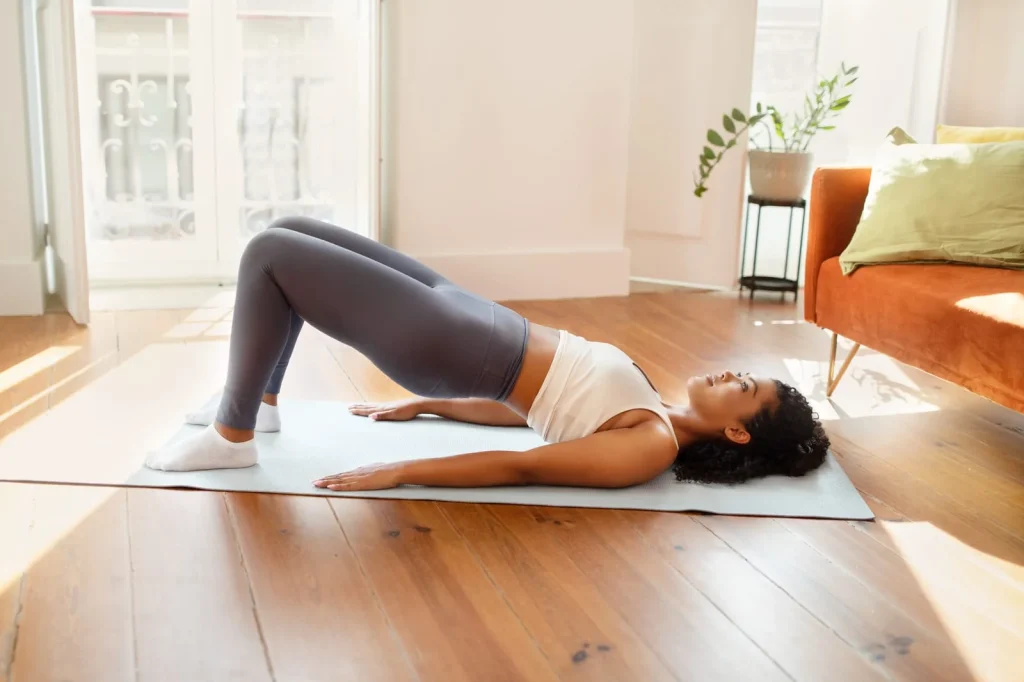
2. Bridge is an essential exercise for practicing glute engagement:
- Lie on your back with your feet flat and your knees bent
- Press through your feet to lift your pelvis away from the floor
- Pause and hold your pelvis up in the air
- You may feel your hamstrings and or glutes engage as you move
- Don’t try to force a big arch in your back
- Don’t clench or squeeze your butt to perform this movement
- Slowly lower your pelvis back down to the ground
- Repeat this exercise several more times
3. Cat-Cow stretch is a great way to mobilize your spine and gently engage your core with your breath:
- Come on to all fours.
- Begin by finding a neutral spine and pelvis
- Tuck your pelvis: bring your pubic bone toward your nose and round your back like a cat moving one vertebra at a time
- Untuck, thinking about lifting your tailbone back behind you. Again see if you can move one vertebra at a time, slowly extending your spine
- Instead of thinking about letting your rib cage drop, think about lifting your collarbones up in front of you like you’re showing off a beautiful necklace
- Then gently lift your chin: think about staying long through the back of your neck
- Repeat this movement as many times as you like going back and forth between curling in and extending the spine.
4. Modified Plank:
You can modify most plank poses by moving your upper body farther from the floor. I’m giving instructions below for a wall plank, an option to move from all fours toward a full plank, and an option to use your forearms instead of hands:
- At the wall, reach your hands out straight from your shoulders and step your feet back to a comfortable distance
- Exhale like you’re blowing out 100 candles on a cake and feel your core gently engage in response to your breath and to the load of your body
- Hold for a few breaths
- Gently walk your feet toward the wall and bring your arms down
- All fours: Come onto all fours with a neutral pelvis and spine
- Exhale to blow out candles
- Stretch one leg straight behind you and place your foot on the floor as if in a plank
- Hold for a few breaths, then switch sides and repeat
- Forearm plank: Begin on all fours
- Bring your elbows down to the floor and press your hands into the mat with forearms parallel to each other
- Walk one leg and then the other leg back behind into a plank
- Hold for a few breaths, then relax
5. Heel Slides are an easy way to begin training your core to respond to various loads
- Come on to your back with your knees bent and your feet flat
- You can bolster your head with a small folded-up towel or blanket
- Inhale, then exhale as if blowing the seeds off a dandelion as you
- Slide one heel away from you along the floor
- Draw the heel back in to meet the other leg
- Repeat 6-8 times on one side
- Switch sides
6. Seated Ball Squeeze is another way to practice gentle core & pelvic floor engagement while strengthening your inner thighs:
- Sit on a chair with a Pilates ball between your thighs
- Inhale, and then as you exhale, squeeze the ball together with your legs
- Do not bear down or push down on your pelvic floor as you squeeze
- Release the squeeze
- Repeat about eight times
7. Supine Toe Taps can be scaled up by taking the non-working leg off the ground. The version here keeps the non-working foot on the floor to load the core more gently.
- Come to lie on your back with your knees bent and your feet flat
- You can bolster your head with a folded-up towel or blanket
- Begin with your breath: inhale with a three-dimensional rib breath, and exhale like you’re blowing out candles
- As you exhale, slowly bring your right leg up with your shin perpendicular to the ground
- Be careful not to shift your hips side-to-side as you lift your leg
- Inhale, then exhale to gently tap your right toe on the ground and bring your leg back up
- Repeat 8 times on the right side, then switch sides
- Once you’ve mastered this movement, you can alternate legs for a bit more challenge
Integrating these exercises into everyday life
The best advice I can give you for integrating post-hysterectomy exercises into your everyday activities isn’t anything about scheduling or managing your time. It’s this: You deserve to feel good in your body. And taking time to do these kinds of exercises is worth doing because you will feel better in your body when you do them. Recovering from surgery is hard and takes a long time, often longer than you expect. But making that recovery appropriately active and intentional goes a long way toward improving your outcomes. Practical ideas:
- Set aside time on your calendar to exercise
- Create a designated movement space in your house so you’re not looking for all your props when it’s time to move
- Start with small steps: Maybe you just try one exercise every day for the first week
- Build on your successes and add on to what you’re doing gradually
Be kind to yourself, and remember that just showing up on the mat is an accomplishment.
Final thoughts on post-hysterectomy exercises for core strength:
Recovering from a hysterectomy isn’t a simple process of getting out of bed and feeling like you did before your surgery. It is a healing journey that may take several weeks, even months. The good news is that your ongoing health and wellness are worth the effort it takes to participate in your recovery. Reconnecting with your core as you recover is key to getting back to doing the things you love. Remember to start slowly, and learn to listen to what your body is saying. Remind yourself that healing isn’t linear and that your body can get stronger. When you’re beginning to feel a little bit stronger, you might want to look into my program Restore Your Core® for a comprehensive recovery plan.
Disclaimer:
The information provided on this website is for educational and informational purposes only and is not intended as medical advice. It is not a substitute for professional medical advice, diagnosis, or treatment. Always seek the advice of your physician or other qualified health provider with any questions you may have regarding a medical condition.
FAQ
The best post-hysterectomy exercises for core strengthening help to engage and strengthen the core muscles effectively. A whole-body approach to core strengthening is appropriate, as you may develop some compensation patterns during your early recovery phase.
Yes, exercises can aid in pelvic floor recovery post-hysterectomy. You will want to focus on exercises that help you coordinate your core and pelvic floor with your movements and breath. Be sure to check in with your medical provider before beginning any exercise program, especially post-surgery.
Start slowly and gradually increase the frequency of performing these exercises. Eventually, aim to incorporate these exercises into your routine at least 3-5 days per week.
Signs of overexertion during exercise include experiencing sudden acute pain, feeling excessive discomfort, or noticing a sudden increase in bleeding. It’s crucial to listen to your body and stop exercising if you encounter any of these signs. Always consult with your medical provider if you have concerns.
There are surprisingly few studies on whether exercise reduces post-hysterectomy complications. However, anecdotal evidence from the many people who have used Restore Your Core® as part of their recovery process indicates that strengthening your core and pelvic floor muscles helps support the internal organs as they find their new configuration post hysterectomy. Strengthening these muscles can aid in preventing complications such as hernias and pelvic organ prolapse.
It’s essential to wait until you’ve been cleared by your doctor to start exercising after a hysterectomy. Recovery time varies depending on factors such as the type of hysterectomy and individual health conditions, but most people are cleared to begin exercise around 6-8 weeks post-surgery. Once you’ve received clearance, you can gradually begin incorporating gentle exercises into your routine.