






Lauren Ohayon is the creator of Restore Your Core® (RYC®), a comprehensive and sustainable whole-body fitness program that empowers women to achieve ideal pelvic floor / core function and be strong, long, mobile and functional.
If you work with runners, you have undoubtedly worked with a runner who has experienced leaking urine while running, even if they haven’t explicitly discussed it with you yet. This article will give you a starting place to acquire the knowledge, strategies, and tools needed to effectively support clients, enhancing both performance and quality of life for athletes.
Start your healing today with this free workout
While many athletes struggle with urinary incontinence, not nearly enough of them seek help. A survey of 803 study subjects found that 16% of participants experienced urinary incontinence during running. Yet the vast majority (70%) of these people did not seek help for the issue. If you’re a fitness professional, coach, or physical therapist working with runners, you should be aware of the prevalence of this issue, so that you can help them address it.
The impact of urine leakage on runners’ performance may take many different forms: some people may even quit their sport from the discomfort and inconvenience. Addressing urine leakage in your clients who are runners has the potential to not only improve their performance at running, but also increase their overall quality of life.
Try 18 minutes of healing, nourishing movement – the RYC® way
The primary type of urine leakage affecting runners is stress urinary incontinence–the involuntary leaking of urine when the pelvic floor experiences a heavy load and is unable to manage it. This leaking can happen due to coughing, sneezing, jumping, etc., but is of higher prevalence in female athletes, especially in high-impact sports such as volleyball, running, and weightlifting.
Other types of urinary incontinence are:
Because running requires a higher impact than walking, there are many elements that can have a larger impact on the body as a whole and the pelvic floor specifically.

The running gait cycle consists of the following phases:
The single-leg impact nature of running requires the runner to manage both balance and force, to a much greater extent than with walking. The pelvic floor must also support the increased forces of running. High-impact activities, in general, exacerbate urine leakage by placing loads on the pelvic floor that exceed what the pelvic floor muscles are capable of withstanding. Athletes who participate in high-impact sports tend to have overactive pelvic floor muscles, often in response to the demands the sport places on the body. Part of the function of the pelvic floor muscles is to manage intra-abdominal pressure in conjunction with the rest of the core system. When an event, such as a run or a weightlifting PR, causes an increase in intra-abdominal pressure, leaking can occur.
A further contributing factor to leaking during running, in particular, may be an overall alignment of the body. If a runner leans backward while running instead of leaning slightly forward, the pelvis is unable to adequately support the weight of the torso as the runner moves. The foot lands too far ahead of the center of mass, and the force of impact is much higher than if the foot lands below the center of mass. This restriction of movement in the pelvis also affects the upper body and core; a lack of pelvic stability may inhibit a runner’s access to an effective contralateral arm swing, and may also affect their ability to engage their core, diaphragm, and pelvic floor effectively.
Ideally, your intake process should include a few questions directly addressing pelvic floor function, such as the following:
Of course, not every pro in every situation can be so direct, but we can make it easier for our clients to talk about these issues by modeling direct, shame-free, compassionate language. Let’s normalize conversations about bodily functions when we’re working with people’s bodies. If your client is reluctant to discuss these kinds of questions, you can also look for the following as you assess them:
Once you have a sense of whether your client is leaking and why, it’s time to work on some strategies. It is always a good idea to refer your client to a pelvic health specialist for any diagnosis or strategies (such as internal pelvic muscle release) that may be out of your scope of practice. But there’s plenty you can work on right away.
Enjoy a free, pelvic-floor & core healing whole-body workout today
Runners, like all athletes, can benefit from cross-training. Targeted exercises to improve their core and pelvic floor function are an excellent way to counteract the impact of running on the whole body.
A note on form: The best form for your running client is one that is sustainable for them in the long term. You might find that working on the areas where their movement is restricted helps their body find a more effective form over time. However, there are a few training tricks you can offer in order to help their body learn faster.
One of my favorite tips is simple: have your runners walk and run uphill. Doing so will naturally shift their posture forward enough to engage the glutes and help them access a posterior-driven push-off. Once they can experience it uphill, see if they can transfer the movement to a less steep incline and then to flat surfaces.
As I noted above, you will also want to make sure that your client’s arm swing appropriately complements their stride.
Many runners will present with tight hips, and a correspondingly overactive pelvic floor. You’ll want to assess your client’s hip mobility, balance, and stability through a variety of movements, such as single-leg squats. Looking at their standing alignment and where their pelvis tends to hang out when they’re *not* running can be another place to gain insights into their patterns. You’ll also want to check their core engagement technique and breathing patterns.
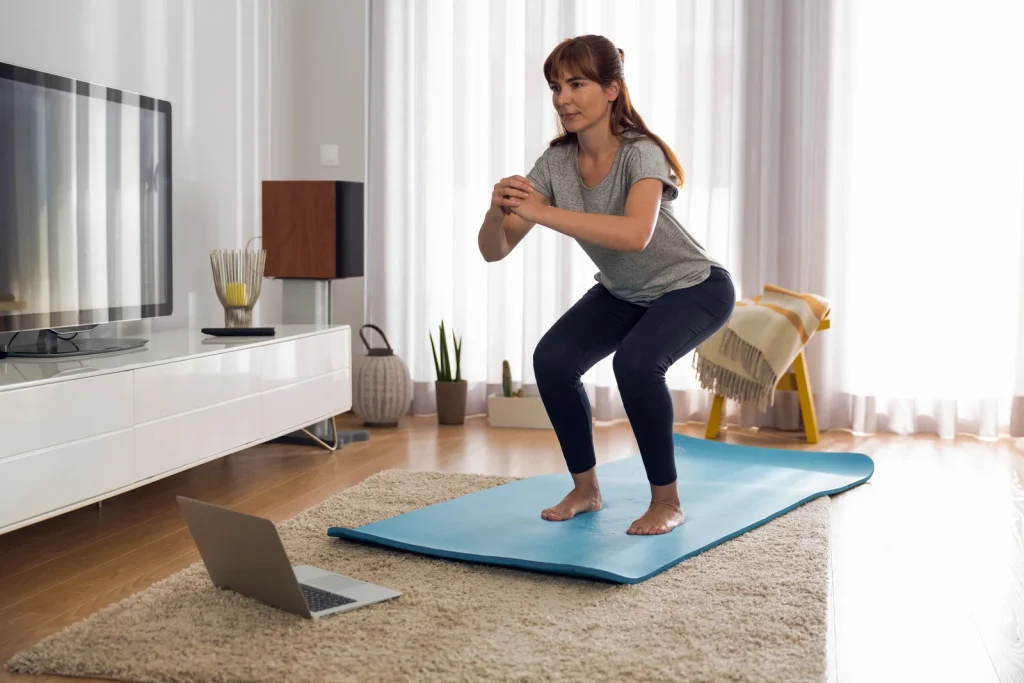
Ask questions and get curious as you have them move through something like this squat progression:
What you’ll see, often, is they struggle to maintain a neutral pelvis, or one side where the hip wants to swing farther out as the weight shifts. You might also notice a shallow breathing pattern, or a tendency to bear down as they’re in the single-leg position. Thankfully, this assessment is also a corrective that your client can practice regularly. They can build on this squat exercise with the additional exercises below.
Make sure that you also encourage your client to do mobility and release work–here are a couple of examples of videos I might suggest working into their weekly rotation.
The first step toward training your pelvic floor to be strong in a dynamic movement system is lowering the load. This might mean taking some time off from running in order to rehab the pelvic floor, either via PT or with a program like Restore Your Core®. Taking time off is one of the hardest things for my clients who run to do, and it’s understandable. But, it’s important to begin by training the body to handle a variety of movements and tasks without harmful compensation patterns. The good news is that walking is a great way to increase and maintain pelvic floor health, and your clients who crave intensity may find that they love walking uphill to get those endorphins flowing.
I love the following progression of exercises to help train the body to manage load better while running. These four exercises help provide a bridge between rehab and getting back to running. For those of you who prefer to watch, this is a video version. How long your client should perform these before testing out their pelvic floor on a run is going to vary depending on your client’s body. When in doubt, slow down.
I usually recommend that clients perform 10 reps x 3 sets. Have them practice the first exercise for a few weeks until it’s easy, then progress to the second, etc.
Access your free workout and start healing your core and pelvic floor today

Your client’s issues with leaking pee while running may not resolve with exercise alone, although there is robust evidence that exercises can vastly improve pelvic floor function while running. It is always worth making sure that any other issues that could be contributing to the leaking have been addressed by your client’s healthcare providers.
Constipation, excessive caffeine intake, or even drinking too much water right before running can contribute to leaking urine while running, so make sure that your client is aware that these can also be factors to address.
While urine leakage is incredibly common, and while it’s becoming more normal to hear it discussed openly, your clients may need you to model being direct and open to this conversation. You can make this easier by using anatomical terminology for all the body parts involved (“vulva” instead of words like “hoo-ha” or “privates,” for example).
You can also acknowledge that sometimes talking about our bodies can feel awkward or silly–that’s not your client’s fault, but the fault of a culture that tells everyone that their body is only worthy of love if it meets specific, unrealistic expectations. When you model this kind of shame-free tone, you encourage your clients to communicate more openly. At the same time, if your client has a trauma history that makes this kind of conversation difficult, you might check in with them about what does work. They are the experts on themselves.
In an ideal world, we would talk about pelvic floors the same way we talk about hamstrings: as parts of the body that sometimes need a little extra help working the way we want them to. Especially for athletes, let’s normalize the importance of addressing urine leakage for the sake of their performance and long-term pelvic health.
Approach the topic with sensitivity and empathy. Start by normalizing the conversation around pelvic floor health and urinary incontinence. Encourage open dialogue by assuring confidentiality and offering support. Use educational materials and resources to provide information about the causes, management, and treatment options for urine leakage.
Signs of urine leakage in runners may include a sudden urge to urinate, a feeling of pressure or discomfort in the bladder, involuntary urine leakage during running, and frequent urination. Additionally, runners may experience dampness or wetness in their underwear during or after exercise.
If a client experiences urine leakage while running, advise them to stop and take a break if needed. Encourage them to empty their bladder before resuming exercise. Suggest wearing absorbent pads or specialized undergarments designed for urinary incontinence during workouts. And as always, encourage them to consult a healthcare provider for further evaluation and guidance.
The Restore Your Core® Method has helped over 10K people heal, and that number is always rising. We will give you the tools and knowledge to combat the status quo and help your clients effectively address their pelvic floor issues.
If you’re serious about truly mastering the pelvic floor and guiding clients to safely and effectively access it and heal through movement, this is the training where you get it all.
The nervous system influences pelvic floor muscle tone in ways that are often underestimated in standard rehabilitation approaches. A chronically dysregulated nervous system can keep muscles in states of hypertonicity or underactivation that resist direct exercise intervention. Breathing patterns, postural habits, and movement experiences that feel threatening or effortful can all contribute to nervous system states that interfere with healing. Addressing this layer – through somatic approaches, breath work, and movement that builds safety and body literacy – is a core component of the RYC® Method and one reason practitioners often find their most complex clients begin to shift after training.
General anatomy courses teach structure. Movement-based professional training teaches how structure functions during real movement, load, and daily life – and more importantly, how to assess and work with functional patterns as they actually present in bodies. The most effective pelvic floor training for movement professionals builds assessment skill, clinical reasoning around movement patterns, and practical tools for guiding clients toward genuine body literacy. That combination – assessment depth, whole-body integration, and client-centred technique – is what the RYC® Pro Training is built around, and it’s what differentiates it from courses that teach exercises without teaching how to see the body that needs to do them.
Online delivery has become the norm for many professional training programmes, and for practitioners working with pelvic floor and core dysfunction, the key question is whether the training includes enough live, embodied practice – not just information delivery. The RYC® Pro Training includes live Zoom calls, live clinic observation with real clients, hands-on practice requirements, and a structured implementation pathway designed to support practitioners in applying tools from early in the programme. More than 500 professionals across 80+ countries have completed it online and reported meaningful shifts in how they work and what their clients experience.
Disconnection from the pelvic floor is one of the most common – and most underaddressed – presentations in postpartum clients. It can be rooted in physical factors like altered pressure mechanics or nerve sensitivity, but it’s also frequently connected to cultural shame, birth trauma, or nervous system dysregulation. Professionals equipped with somatic awareness tools, body-mapping techniques, and nervous system frameworks can meet clients in this experience and create a genuinely felt pathway back to connection. Programs like RYC® Pro Training specifically train practitioners in these approaches – including the RYC® Somatic Mapping Techniques and the ICCP protocol – because the conventional “flex and contract” model simply doesn’t reach this population.
“There is no thank you big enough for Lauren Ohayon existing and thinking and helping so many of us. Every time I do something I never thought I’d do again she is part of the reason why.”
Laura Gregg
Try a FREE workout
with Lauren
*10K+ women healed and healing
Please check your email inbox in a few minutes.
Enjoy a free, pelvic-floor & core healing whole-body workout today
*No spam, just quality content and support
Please check your inbox soon.
Try a FREE workout
with Lauren
*10K+ women healed and healing
Please check your email inbox in a few minutes.