Core Strength Myths & Cues

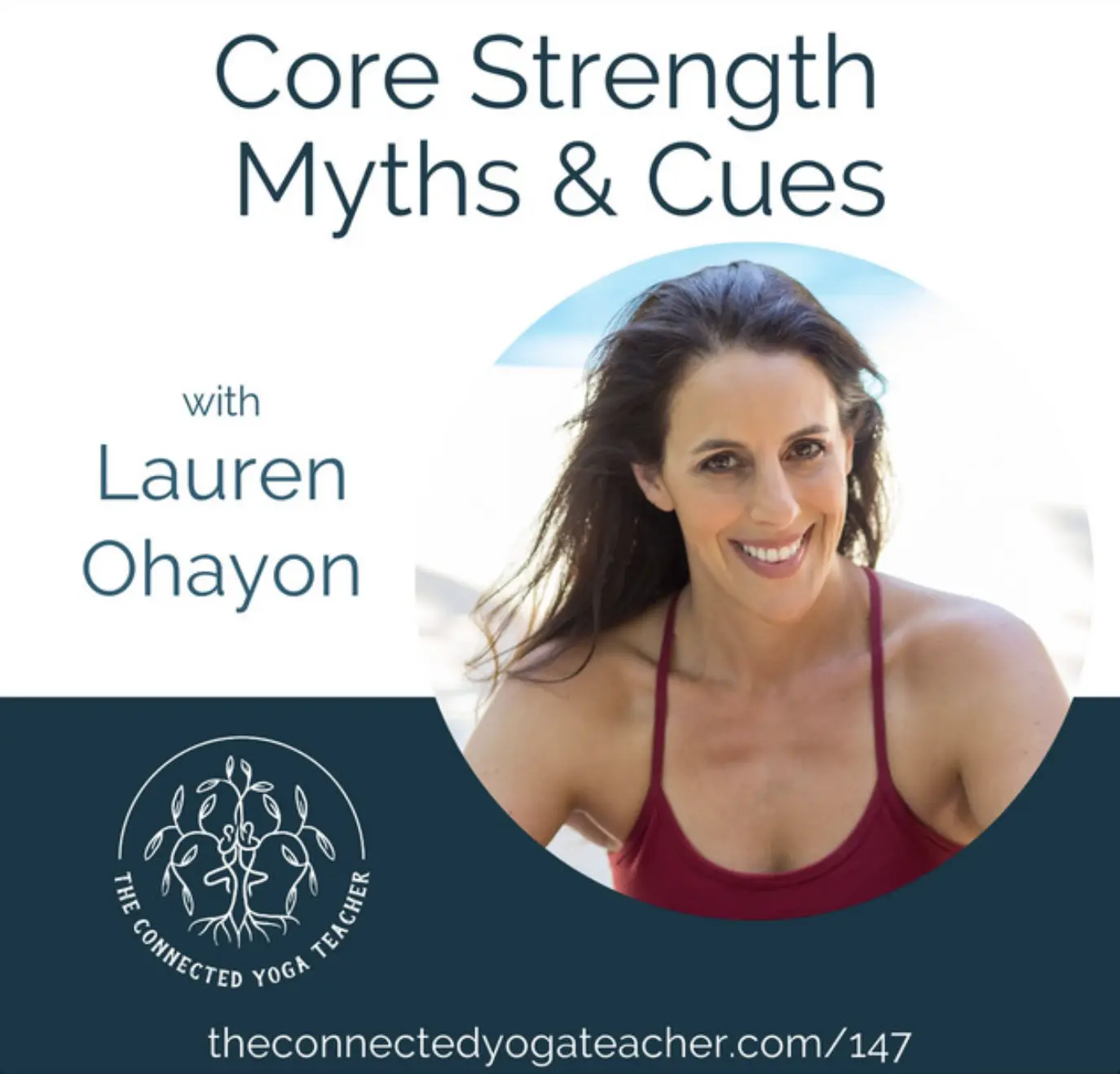
The Connected Yoga Teacher Podcast – Episode 147 Transcript
Core Strength Myths & Cues with Lauren Ohayon
Introduction and Sponsor Message
Shannon Crow: Today’s episode has been brought to you by Schedulicity, and also by the Pelvic Health Professionals membership. If you are interested in learning more about how you can bring pelvic health to the yoga students that you’re working with, you will want to check out our membership. Make sure you’re on the waitlist because there’s an early invitation to join going out on December 30th for everyone that’s on that waitlist.
Visit PelvicHealthProfessionals.com for more information. And while you’re there, check out our growing resources page. Anyone can view those articles, podcasts, and more. Stay tuned – in a few episodes I am going to be talking with my good friend Amanda McKinney about the behind the scenes of starting a membership. So a lot of you have been asking me about what it’s been like to start a membership, and we’re going to share as much as possible in that episode.
And today’s episode goes along really nicely with the topic of pelvic health. So this is episode 147 of The Connected Yoga Teacher Podcast.
Welcome to The Connected Yoga Teacher Podcast
Shannon Crow: Hello and welcome. I’m your host, Shannon Crow. I’m a mom of three, a yoga teacher and a trainer and consultant who works for yoga teachers. And this podcast was created for you so that you can connect to information and inspiration every single week and feel supported. Because I know what it’s like as a yoga teacher.
It is crazy how we have this whole business around knowing anatomy and how the body works, and all of the different yoga poses and movements and breath practices. And on top of that, also running a business. This week we’re tackling a topic that a lot of you ask me about.
The Problem with “Engage Your Core”
Shannon Crow: It is myths around core strength. I’m sure at one point, either as the student in a yoga class or as the teacher, there has been talk about, quote unquote, “engage your core.” And some people are even conditioned to think that they should do this all the time. In actual fact, doing this is not as amazing as we think, and it can be limiting to our function and our movement.
The thing is, while many people in the fitness world assume that all core exercises are created equal, this isn’t the case. In reality, the core is a system of pressure and volume, and we want to balance out the pressures to reduce stress and strain on the core wall. So the exercises we lead should also reflect this.
Lauren Ohayon is an expert on the subject matter. In this interview, she busts through some of the other myths around building core strength. We also dive into what the core really should be doing and when, as well as discussing the issues of intra-abdominal pressure and conditions like prolapse and diastasis.
All of our show notes are ready for you at TheConnectedYogaTeacher.com/147. And there you can find all of the links if you want to continue to learn a little bit further. If you want to hear other podcasts that relate to prolapse or diastasis, we will make sure to link to those as well in our show notes.
Listener Review
Shannon Crow: Before we get right into this episode today, I first want to give a shout out to a podcast listener, Katie. Thank you so much for taking the time to leave a review, Katie.
Katie said: “First of all, I can’t rave about this podcast enough. A few months ago I completed my yoga teacher training and during the midst of it, I met someone very special. Once completing my training, I packed my things and moved back to Ontario to follow my heart and pursue yoga not only as a lifestyle, but also as a career. Two weeks ago, I spoke to a business consultant who guided me in the direction of teaching yoga privately instead of in a studio setting. At first, I thought he was crazy, but after listening to the last two podcasts, I feel as though this is something to seriously consider. Thank you for your honesty and always showing up for us listeners. Every week I look forward to hearing guest speakers share insightful, truthful, and personal stories.”
Thank you so much, Katie. I love how you were questioning this and then someone else told you and then listening to the podcast you thought this is actually a possibility. We have some great episodes on teaching one-on-one yoga. If you are ever looking for a topic, we have so many episodes now and we have an amazing search tool, so you just go to TheConnectedYogaTeacher.com and look for the little search icon at the top. And you can search a specific word and it will come up with whatever episodes that relate to that.
So leave your review if you haven’t done that yet, either in our Facebook group or in iTunes. I try and read each and every one here on the podcast. It takes me a little bit to catch up sometimes, but I’m getting through them.
Hot Tip from Schedulicity
Shannon Crow: Before we hear from Lauren about the core, let’s hear our hot tip of the week from Schedulicity.
Schedulicity Representative: Hi, connected yoga teachers. This is Jamie from Schedulicity with the hot tip of the week. Our marketing team was inspired to take a yoga class this week, and in the meeting that followed, we noticed that we all felt more energized, happy, and engaged. It’s extraordinary how yoga can benefit and challenge people of all different types and fitness levels.
At Schedulicity, we know that yoga teachers see a huge variety of students, and keeping track of their individual needs can be daunting. That’s why we have included a place for notes on your clients’ profiles. This way you can keep track of injuries, health concerns, or other challenges. You can also tag your clients with keywords. These keywords can be used with our email marketing feature to send messages to specific groups. Keeping track of your clients in this way can help you stay connected and mindful, as well as providing them with marketing content tailored specifically to their interests.
Meet Lauren Ohayon: Core and Pelvic Floor Specialist
Shannon Crow: Thank you so much, Team Schedulicity. Okay, connected yoga teachers, let me introduce you to Lauren Ohayon, who is the founder of Restore Your Core®, an online program for women with pelvic floor and core dysfunction.
Lauren has over 5,000 women in her online programs, over 60 trained Restore Your Core® teachers, and three Facebook groups serving over 21,000 women. Lauren is internationally recognized for specializing in core and pelvic floor issues, and has 20 years of experience teaching yoga, Pilates, and functional movement.
In addition to this, Lauren is also certified as a Restorative Exercise Specialist in Neuro Kinetic Therapy and in Anatomy and Motion. With her comprehensive exercise programs that are designed to be effective, safe and sustainable, Lauren focuses on helping people exercise well and more efficiently to gain core strength and ideal pelvic floor function.
Welcome to The Connected Yoga Teacher Podcast, Lauren. It’s great to have you here today.
Lauren Ohayon: Thank you. I’m so excited to be here.
Shannon Crow: I know I’m super excited to get to talk with you in person. A lot of people have told me that I need to connect with you in terms of anything pelvic health, core, and just as a really cool yoga teacher. So it’s great to meet face to face.
Lauren Ohayon: Thank you. Thank you for having me.
Lauren’s Work with Core and Pelvic Floor Dysfunction
Shannon Crow: Tell us, what is the work that you do and who do you do it for?
Lauren Ohayon: So the primary work that I do is around my program called Restore Your Core®. Restore Your Core® was started as an online program for women with core and pelvic floor dysfunction. And I quickly saw that there was a really big need for in-person attention. And people were asking me to do workshops, and then people were asking me to lead teacher training, which I had led in the past as a yoga teacher.
So now Restore Your Core® is both an online program taught by me, but it’s also an in-person program taught by – we have over 70 teachers worldwide. And we do two trainings a year. So that’s what I’m known for.
The women who – it’s mostly women, although I do have a lot of men, but it’s mostly women – the women who find me are really looking for answers for their common core and pelvic floor issues like sneeze pee, leak pee, abdominal separation, which is called diastasis recti, as well as prolapse, which is where the organs of your pelvis fall out of place and slip down into your vaginal canal. So that’s what most of the people finding me are struggling with – one of those issues. Or actually, they often go hand in hand.
Shannon Crow: Right. Okay. So when did you start doing that work, focusing on pelvic health and the core?
Lauren’s Journey into Pelvic Floor Work
Lauren Ohayon: Yeah. So I started pelvic health and the core – I had kids 13 years ago and I had three kids back to back. I literally had three kids in less than four years. Wow. And yeah. And I was very lucky – I did not have, I did not end up with any core or pelvic floor dysfunction.
However, I was teaching a lot of yoga at the time as well as Pilates, and I was very interested in the moms, of course, after I had my own kids. And many of them were struggling with these issues. I had been trained as a Pilates teacher at that point for many years, and as a yoga teacher as well. So I just started creating kind of a method of working with women in person.
I started the online program in 2015, late 2015, and I started with a Facebook group, a free group actually called the Restore Your Core® Community, which now has 17,000 women in it. But I started just by giving free advice and very quickly saw that, like overnight, I had hundreds of new joiners. People were recommending the group all over the place. I was making free videos every day. And then I was like, there’s something here, I should just make a program. And I did. So we launched in 2015-2016.
Shannon Crow: Oh that’s amazing. And now you have over 70 teachers teaching. Is it sort of under your umbrella of Restore Your Core®?
Lauren Ohayon: Yeah, it’s all under the umbrella of Restore Your Core®. I do offer a few other online programs that are not Restore Your Core®, but they are core and pelvic floor-based. But yes. And the 70 teachers – we just started the teacher training like two years ago, two and a half, and we do two trainings a year and we only take 20 people per training. And so it’s really nice. It’s a really amazing group of women teaching this work.
Shannon Crow: That’s amazing. I love to see any information on pelvic health shared.
What Is the Core? Understanding Core Anatomy
Shannon Crow: So when we’re going to dig in and talk about the core here today, let’s start with – what is the core and what is the core not?
Lauren Ohayon: And it’s not the air that we breathe. So the core – the core is really a system. I think we have been very trained, although it seems to be unraveling, but a lot of the anatomy training that is out there very much sees the body as like a set of muscles. And this is where one begins, and this is where one ends, where in fact, our body is really kind of a whole system working together. And all the muscles are kind of blended with each other.
And there are systems, and the core is one of those systems that, to me, is affected by our peripheral body. So our arms and our legs. However, the primary part of the core would be:
- The front core wall – which would be the abdominal wall
- The posterior core – which would be the spine
- The bottom of the core – which would be the pelvic floor
- The top of the core – which would be the diaphragm
So you’ve got this kind of container. However, the diaphragm is very much – the upper body affects the integrity of the core and the lower body affects the integrity of the core. So we could make the argument that your core is really the integrated function of your whole body.
Shannon Crow: Right? I know sometimes when I’m teaching about the core, then I think, well, that’s related, but that’s also related. And I’m thinking, I’m talking about the whole body.
The Challenge of Defining the Core
Lauren Ohayon: Yeah. And then when you say that, though, people get annoyed, I think. So I think people want us to whittle it down a bit because for those clients who are injured, telling that it’s a whole body issue can feel very big. Like suddenly resolving it feels enormous, right? Whereas when you say, well, it’s just this and this, it’s like, oh, I can bite that off.
So sometimes I don’t talk about – we’re talking to yoga teachers here, right? So that’s different. But I don’t always describe it as a whole body issue because I don’t want people to feel like the mountain is too high.
Shannon Crow: That is so good to know. I often will talk about the core four, and I love how you outline those four spots. And I get even more specific. So I’d love to know your thoughts on how I was taught and teaching, because I think there’s always room to learn. I love how you said it’s a system working together, and that we really want to define things anatomically like this is where this muscle begins and that ends. And it’s not really like that in the body.
But I often look at it as the top being the diaphragm, same bottom being the pelvic floor, the back being the multifidus or the multifidi muscles, and then the front being the transversus abdominis. Am I getting really super specific in those? When you say the spine and did you say the abdominal…?
Beyond the Transversus Abdominis: All Core Muscles Matter
Lauren Ohayon: I don’t think you’re being super specific. I think that’s one way of looking at it. I look at the core wall as a whole, so I look at the obliques and the transversus abdominis and the rectus abdominis as part of the core wall. And I think that what’s happened is the obliques and the rectus abdominis have gotten a very bad reputation.
So for yoga teachers who are not as anatomy savvy, the obliques are the muscles, kind of like the side muscles, your pocket – your side pocket muscles. And the rectus abdominis, the six-pack muscles, run up and down vertically from your pubic bone to your ribcage. So just to kind of give some idea of where those are, because we’re throwing out a lot of names – maybe some teachers are less aware.
But I see those muscles that are villainized a lot in our world. I see them as really important pieces of the puzzle to healing. And so I prefer – generally speaking, the focus needs to begin with an injury. We need to talk a lot about the transversus dominance. But the rectus abdominis is one of our primary muscles of flexion in the body, and they’re one of our primary muscles of stability and support as well.
So the obliques are so important for bringing us – the rectus puts us in and out of the sagittal plane and the obliques put us in and out of the rotational and the coronal plane. And when we’re talking about the core system, it’s a three-dimensional core system. And those muscles are part of that three-dimensional core system.
If I’m talking too much anatomy, tell me and I’ll speak in more generalized terms.
Shannon Crow: But no, this is great. Well, I really want to come back to this. What you said – a lot of the time, and I think I’m guilty of this, is looking at the six-pack abs or the rectus abdominis muscles. I have been like, okay, let’s forget talking about those all the time because I feel like – yeah, because it was swaying so much in like, I need to build my six-pack abs. And I felt like everyone was forgetting that there are more abdominal muscles that are really important to the core. But what you’re saying makes me think, wait a second – don’t throw those out. Those are still very important to our movement.
Finding Balance: Superficial and Deep Core Muscles
Lauren Ohayon: That’s right. And I was very much in the same boat with you. And for years it was all about the TVA, the transversus abdominis. And I was all about – those are the muscles we need. Function over fitness, you know, like, who cares that you look like you have a six-pack? We want to build the deeper, more stability – the transversus attaches around to the back to the lumbar fascia, creates so much more stability and support.
But actually, you can’t have spinal movement without your six-pack, you know? And not only that, your obliques are so important. The problem is that, yes, both of those muscles are more – both sets, which is actually three muscles – are both very superficial and as a result they are bigger. And so they tend to take over more. And I think that’s why they’ve been the bad guy. Like, oh, my six-pack is overworking, there’s no deep core. My superficial core is doing all the work, and my deep core is not doing enough work. As opposed to like, well, why don’t we look for balance in all those muscles, right? So why don’t we look for them to work as an integrated team? Because they all need to do a job.
Shannon Crow: Oh, I love this. And I love the wording that you just used – superficial versus deep core. So that’s a great way to say that’s all of our core here. And here are the layers that are more so on the outside of us and deeper inside. This is good.
Understanding Multifidus and Posterior Core Muscles
Lauren Ohayon: Yeah. Which is where I think the philosophy comes about that the superficial ones are more readily available to utilize so they can compensate. They can compensate for the deeper muscles, which is where I think multifidus – it’s like, well, the rectus takes over and multifidus doesn’t have a chance to work and we need to get our multifidus working.
Whereas I – circling back to your answer of like, do I talk about multifidus? I don’t talk about multifidus the way a lot of people do, because I feel like the multifidus is part of an integrated system in the posterior body. And when our spine is functioning well and our whole system of stability and balance is in good form, then that includes everything. The multifidus, the erectors, you know, everything, the quadratus lumborum – all of the muscles in the back should be operating, operating not just one set.
The multifidus, being the deeper – the smallest kind of deepest layer of support muscles in the back. And I think that they get neglected. But when we train our body the right way, all of it should be involved, right?
Shannon Crow: It’s not like they would just be working on their own and everybody else is on vacation, right?
Lauren Ohayon: That’s right, that’s right.
Teaching Movement Patterns vs. Muscle Names
Shannon Crow: And we do get super specific with this, don’t we? Like some of us – raising my hand here, even though we’re just audio – geek out on the anatomy part of it, get really excited about it. And then also, I think sometimes we make things a little more black and white than variations of gray.
Lauren Ohayon: And I think it’s important to have body intelligence as a teacher. So to know where to be specific and to understand the workings. But I think it’s important as a teacher, also – our clients don’t care about their multifidus. Like, you know what I mean? Like we have to know also how to present this information in a way where it’s digestible and interesting, because ultimately, what we want is for them to be on a healing journey. But we also want to be successful teachers, and people won’t come back to us if all we do is kind of go on and on about this body part and that body part. Does that make sense?
Shannon Crow: That makes total sense. Yes. And so I can see where this language would come in about this core system and the back of the core, the front of the core, the top, the bottom. And that we don’t need to – I mean, some students will like to go into the anatomy piece of it, but for others, you’re right, they don’t really want to go into this.
Seeing the Body in Patterns
Lauren Ohayon: And I can say as someone – I’ve spent years studying and teaching anatomy and biomechanics, and I can say that I forget muscle names the second it comes in, it comes out. Right before I teach an anatomy class, I go and do a refresher in my own mind because I forget it. And the way I look at the body personally is patterns.
So I see the body in terms of patterns, and I teach teacher trainings in terms of patterns. In my teacher training manual, I have the muscles outlined. However, when I’m teaching, a lot of my training is about learning to see the body – learning to assess, to get a visual, a really strong, powerful visual assessment of who’s in front of you.
I don’t use muscle names for that, but it’s just a pattern. In which way is their hip shifted? Which way is their spine going? Do they prefer flexion? Do they prefer extension? Where are they more extended or are they more – you know what’s happening in the sagittal, the coronal and the transverse planes? Are they dominating in one plane more than the other? Oh, this shoulder is hanging out more in the coronal plane to the left. Do you know what I mean?
So it’s more about a pattern. And I have been able to help a lot of my clients heal from their injuries just by helping them find center by utilizing these patterns as opposed to ever needing to name one muscle.
Shannon Crow: Oh, that’s so amazing. I was just working with a woman yesterday, and I just said to her, like, let’s just take a look at one hand versus the other hand for a moment. And that’s exactly – this building this awareness, me taking a look at the way her hands were. And I don’t even need to share my observations. I wanted her to really see and feel it in the same way. That’s great.
Lauren Ohayon: Yeah.
The Problem with “Engage Your Core” as a Cue
Shannon Crow: So I want to dig into – because I’ve been to many classes, not just yoga. I’m not going to just pick on yoga, although I don’t go to a lot of fitness classes, but I’ve been to a lot of classes where someone told me to engage my core. So I want to get into this cue because you had sent me a thing that said, you know what? Not all the time is this phrase helpful. And sometimes it can be limiting to function. So do you want to dig into that a little bit?
Lauren Ohayon: Yeah. So I think there’s this idea of – yeah. Well we hear it all the time and I actually don’t do a lot of yoga anymore. I do a lot of fitness. So I swing the other way. I was very deeply into yoga. Now I’m really into fitness. But no matter where I go, I hear that catchphrase: engage your core, engage your core.
And I think that means different things to different people. But I think what a lot of people are doing when they engage their core is just pulling their stomach in. So if you were to put your hand on your belly right now, like maybe your belly button, and just very strongly pull that in as strong as you can, just pull it away from your hand – I think that’s what a lot of people do when they hear the phrase “engage your core.” I think they tighten it right there.
And there’s nothing wrong with that because you’re tightening. However, what I like to train – what I’m training for in my programs is a functional core, right? So not how something looks, you know, not getting you a six-pack core, but how is it functioning as a system because it has a job to do within your body.
The Core Should Be Reflexive and Automated
Lauren Ohayon: So in core function, one of the main elements of core function is that our core is designed like any other muscle in our body to be reflexive, automated. When I go to open a door, I don’t tell my bicep to engage to pull the door open. I don’t tell my tricep to engage to shut the door. Why are we constantly cueing the core? Very interesting.
I don’t cue any other muscle really in the body except for sometimes people cue “squeeze your glutes.” It’s another one that drives me crazy. Like if you’re in hip extension, your glutes are going to ideally be functioning. And if they’re not, you squeezing them is not going to bring about function, in my opinion. And the same goes for the core.
If the core is not functioning, if it’s not turning on to do a move – which, by the way, muscles are never on and off, so take that with a grain of salt. No muscle in your body is ever on or off – but if your core is not kicking in, you know, as quick to the moment, doing its job, supporting you, whatever it’s not doing, other muscles are compensating, right?
Tightening it is not going to teach it to get there, in my opinion. Just like engaging your tricep – yeah, the door would get shut, but you’re not really – there’s not a teachable moment happening here.
The Candles Breath: A Better Way to Engage the Core
Lauren Ohayon: So I don’t mind the cue “engage your core.” I like when people understand that to build a reflexive, automated core – the way every other muscle in our body is automated – you want to train it within the system that it lives. And it lives very much dependent on the breath system. You’ll see that in the breathing system.
So for me, “engage your core” means to do a very specific type of breath. Your core will naturally pull in with that. And then if you want to give it a little bit of extra oomph, then you can add some extra muscular tension to it. Like you can tighten it more. But the first step is getting your breath to automate your core because they work together as a system.
Shannon Crow: Could you lead us through that breath? How you might?
Lauren Ohayon: Yeah, yeah. So easy. We do it all the time. So imagine you have a birthday cake with 100 candles on it, and it’s in front of your face, and you take an inhale. And actually put your hand on your belly as you do this right there where we were before. Hand on your belly button, if that’s fine.
And as you exhale and blow out those candles really long and really slow, you can even hiss it out as you hiss – you ideally would feel that your core pulls in away from your hand. It does the exact same thing we did before when I said to you, pull your core and tighten it. Does yours do that, Shannon?
Shannon Crow: Yes. Yeah, I’m noticing it. And I like this as the breath. In things that I teach. So I’m so curious – why does that work? Why, when I make this hissing sound or blowing out all these hundred candles, slowly through pursed lips, why does my core engage?
Understanding Compression and the Transversus Abdominis
Lauren Ohayon: So, wow. How do I explain this in a simple way? The core is a compressive muscle. What you’re really feeling happening is your deep core, right? So we’re not doing a crunch. So the rectus abdominis is not very active right now, and we’re not really doing a side bend here. We’re not rotating. We’re really still.
So the muscle that would be dominant here would be your compressive muscle. And the transversus abdominis wraps from the front to the back like a corset. And as you exhale, you decrease – well when you do the exhale this way, in this specific way, you are decreasing volume. And you’re decreasing volume. The muscles that create that compression are your deep – the transversus – six-pack muscles compress, which is where you often hear them referred to as a corset.
I don’t know if you’ve heard that, but like tighten your corset or – if you look at what they look like, they’re shaped like a corset and they wrap around and attach to your spine via your thoracolumbar fascia. So they’re really like the corset of the midline. And as you do that exhale, you’re decreasing space, decreasing volume, decreasing volume. You are compressing so your compressor muscles are working.
Shannon Crow: That’s amazing. So we could instead of saying engage your core, we can ask everyone like, blow out all these candles on the birthday cake or make this hissing sound breath. You’re so correct.
The Danger of Bracing: Increasing Intra-Abdominal Pressure
Lauren Ohayon: But here’s what happens in the ideal world, yes. However, a lot of us, what we do when we engage our core is we actually brace our core. So I’m going to have you feel that now. Put your hand on your stomach and imagine that someone is about to – this is kind of awful, but just imagine it – someone’s about to punch you or kick you in the stomach. What would you do? You would probably brace, meaning do a push out. You would probably tighten and push your stomach out.
Shannon Crow: Oh, right. Oh, that’s a very different thing then.
Lauren Ohayon: Now what you just did there was you increased intra-abdominal pressure. And abdominal pressure is not a bad thing. However, excessive abdominal pressure can lead to core and pelvic floor dysfunction. And what we do know is that for people who already have core and pelvic floor dysfunction, we want to decrease pressure a lot. So strategy is really important.
How you blow your candles out matters. And I can show you how you would also – doing the breath that way increases pressure and you actually overuse your obliques and your six-pack for that. So remember I said they’re not villains? In that kind of a breath, they’re kind of the villain.
So if you go back and you do that long slow exhale, and as you do that long slow blowing out the candles or as you call it, I think you said the S – the S breath – you want to think about your lower abdominals specifically drawing backward in and in and up. I say up, but some people struggle with the up. So drawing your lower abdominals to the back wall. And that ideally would not have you braced or increase that abdominal and internal pelvic floor pressure.
The Tampon Test: Demonstrating Pelvic Floor Pressure
Lauren Ohayon: So you like pelvic health. This might be of interest to you. I have clients – I hope this is not TMI, but I have some clients place a tampon at the entrance to their vagina, and they have them do exactly what I just said. Do a long, slow breath where they are being kicked in the stomach in slow motion – that slow push your core out into your hands move. And 100% of the time the tampon falls out.
Shannon Crow: Right? Because of the pressure.
Lauren Ohayon: Pushing down there. Which, as you can imagine, since you know so much about pelvic floor health, that is not ideal on the pelvic floor, that bearing down aspect. We should do that when we push a baby out or we defecate or even fart, or cough, sneeze and laugh to some degree. However, it’s not what we should do when we take an exhale and engage our core. And a lot of our clients are misinterpreting the cue “engage your core,” and they are increasing pressure in both their core and their pelvic floor. Does that make sense and is that helpful?
Shannon Crow: Makes total sense. What I might add here is that sometimes people think, well, if I have pelvic floor dysfunction, that must mean I need to pull my pelvic floor up. And same thing – there’s just a lot happening there. And I love how you – let’s bring it back to you said we’re not telling our arm like engage the bicep, do this in the arm. We just do it. No one’s telling us how to open the door. Do you have some idea then why we’re getting so off track in terms of the breath and how this core is working? Like, why? Why is it even going the other way?
Why We Lose Core Function: Sedentary Lifestyle Theory
Lauren Ohayon: You know, it’s so easy to speculate. And there are so many theories. One prevailing theory that I like, but I’m careful with – I’ll kind of explain. The theory is that we become very sedentary by age five, right? And so we go to kindergarten and we sit all day and we stop using our bodies dynamically. We stop using our bodies three-dimensionally.
Our core is very responsive because it encompasses both the appendicular and the axial body. So it’s both about the arms, the legs – this is the whole body. So our core is very responsive to our movements. And when we start spending more time in sitting, just the same positions all the time, for years and years, our core doesn’t get that input anymore. Everything changes. And so we just use our bodies in a less varied way is one way of saying it.
What I don’t like about this theory – so I do love the theory, and I do believe that we just become very stuck in our movement patterns. What I don’t like about this theory is I hate blaming people for their issues. I hate making people feel bad, right?
Shannon Crow: Right. Because age five, we’re pretty – we have to follow along with the system of society. Yeah, that’s right. It makes me want to go back and enroll my kids in Forest School.
Movement Variety Throughout the Day
Lauren Ohayon: And that’s what a lot of my colleagues do for sure. I agree. And I raised my three daughters knowing all of this. And they’re going to very traditional – but it is what it is. I tend to think that we won’t be that affected by our choices. Do you know what I mean? Like, they’ll be fine and they’ll figure it out and it’ll all be okay.
But so I think that maybe our movement history has something to do with it. And then when we do work out or we start hitting the gym – most of us hit the gym in our 20s – then I think we’re doing it like an hour a day in this very specific environment. Again, there’s no reflexive anything being taught for the most part. So it’s very confining. It’s like you’re just doing it an hour a day, but the rest of the day you’re going and sitting. So again, your body is not getting that.
Maybe it’s great. Working out is great. I love it, but I do encourage people to maybe add variety – sit on the floor more, change up their workstations, maybe sit to stand more, change their positions throughout the day, use their body more. Park far away if you go to Target. Maybe carry more things in your arms and use less bags. Just a variety of ways that your daily movement can become more dynamic.
Shannon Crow: This is good. I mean, we hear people talk about this all of the time – to find variety in the movement and to not get stuck in that pattern. And we definitely can do this in a yoga class or in a fitness class or at the gym, like you said, or in the movements that we do just for our daily life, like how we walk, or maybe we’re always walking on really even surfaces. So yeah.
The Porta Potty Analogy: Stress and Body Holding Patterns
Lauren Ohayon: Right. Yeah. And there’s an interesting analogy that I use, that I learned from one of my teachers, Leslie Kaminoff, and it’s this idea that if you walk into a porta potty, it will likely smell really bad, and you hold your breath in response to that, right? So you don’t think about it. You don’t say to yourself, Shannon, now you’re going to hold your breath for the next 50 seconds and then you’ll be fine. You just hold your breath.
And when stuff stinks in our daily life, we also hold our breath. We also change the way we use our bodies, especially going through puberty, in teenage years. We make these postural changes to accommodate whatever it is that’s happening in our life.
Shannon Crow: Oh, right.
Lauren Ohayon: So when the porta potty is our life, we can sometimes change how we relate to it without realizing it. So I have a lot of clients who have a lot of core and pelvic floor dysfunction and they are chronic belly grippers and pelvic floor grippers. And the work that we do is to, A, become aware that – for them to become aware of that – and then B, to start to create new, healthy patterns.
Shannon Crow: Oh, I love this. I felt this for a long time before I found yoga. Well, I didn’t know – I wasn’t aware of it until I started doing yoga of the tension that I was holding in my abdomen. So I love this. Our life as a teenager is not always supportive. Not always, but often. Always in the pretty rocky times.
Lauren Ohayon: It can be. And so we have to have a lot of compassion for ourselves, for life. Sometimes it doesn’t matter. I tell my clients it just doesn’t matter. A lot of my clients will say, oh, my pregnancy did me in. And it doesn’t matter. I mean, we can focus on the past or we can just kind of be in the present and see what we can do to resolve things or make them better.
Core Strengthening Exercises and Modifications
Shannon Crow: So what are some of your favorite core strengthening poses or movements? What are some of your go-tos to share with people who might be new to doing something with the core?
Lauren Ohayon: So are we talking about a population of clients who have a core and pelvic floor issue, or are we talking about any – like a yoga class with no injuries, for example?
Shannon Crow: Could you do an example of both?
For People with Core and Pelvic Floor Dysfunction
Lauren Ohayon: Yes. So with clients who have a core and pelvic floor issue, we are really looking to reduce intra-abdominal pressure. That pressure I just went through a few minutes ago where you tighten your core by pushing it down and out. And to help them, whatever exercises they are doing, to make sure they’re not – and I call this the ribs, the bulging, the bearing down and the breath holding.
So whatever, if somebody is injured, I’m putting them through very rudimentary poses, starting with the candles exercise and then progressing into even poses on their hands and knees, like lifting one arm up, one knee up, lifting up the opposite arm and knee, finding that axial stability, finding that they can do that with the candles breath.
Plank is a really hard move. A lot of people do that by bearing down and bulging their abdominals. So building up to a pose like plank, which requires a lot of core strength and stability. And poses on their back, even something simple like sliding one leg away – lying on your back, knees bent, feet flat on the floor and sliding one foot away, like a heel slide, sliding one foot away and dragging it back. And it’s kind of more of a Pilates move, but can be really valuable.
It’s so easy to do that by cheating, by arching your back up and down, by pushing into the floor, by even flattening your back to the floor. I hear that cue a lot in classes – to flatten your back to the floor, which I don’t agree with that cue. So, you know, maintaining that neutral spine, letting your leg be really heavy and then seeing if you can just get your leg in and out without anything else being affected, will require deep core stability, that compression. Again, we want to kind of compress as we do that. So using the S breath, the candles breath – those are really basic moves that I start my clients off with.
Standing Poses and What to Avoid
Lauren Ohayon: If they can do that, they can do a lot of the yoga moves, like standing poses are great. The Warriors and the Triangle – those poses are great for people with pelvic floor dysfunction. We want to avoid big, deep backbends, for example, and poses that will put a lot of strain on the front wall of the abdominals.
For People Without Dysfunction
Lauren Ohayon: And then as far as core exercises for people who do not present with core and pelvic floor dysfunction, I’m not a big fan of an excessive amount of six-pack exercise. Navasana can be really six-pack – really recruiting these external abs, although it can be done in a way where you don’t. So I like to play around with challenging poses to see – even like a kettlebell swing which is not a yoga pose, but like something intense like that – to see can you recruit your abs in a healthy way? Well, healthy is subjective, but in a functional way, right?
Boat Pose Variations for Core Health
Shannon Crow: So talk to me a little bit about Boat Pose, because I just shared a video with our Pelvic Health Professionals group today. So I love that you’re covering Boat Pose in a way. Can you tell me some of your variations for this that it’s not all about six-pack abs?
Lauren Ohayon: Yeah. So the first variation that I like to think about is – are you sitting on your sitting bones or are you more in spinal flexion, which would put you pretty squarely on your sacrum? And I don’t think either one of those is right or wrong. I think you have the least amount of potential compensation being on your sitting bones. I mean, after all, we are designed to sit on our sitz bones. And the path of weight from the head to the sits bones is pretty clear when we’re on our sits bones.
And when we rock back onto our sacrum and we are in flexion, it’s not bad because I’m not into good and bad. It just puts a lot more strain on certain parts of the body, and it makes it easier for you to overuse your six-pack.
Progressive Boat Pose Modifications
Lauren Ohayon: So I actually – starting point is I like people to be sitting on their sitz bones, which for a lot of people, because of tight hamstrings, will require that they sit up on a block or two. If you have a bigger butt – which mine is, a wider butt – you might want not two blocks one on top of the other, but side by side just to give room for your booty.
And then you’re sitting on your sitz bones. And the first variation is where you walk your feet a little bit further away from you, so your feet are not so close to your sits bones. Your arms are straight up ahead of you and you’re just lifting one leg up at a time.
I always have people start by bulging their abs. I always teach people the “no” before I teach the “yes” because you don’t know what a yes is if you don’t know what a no is, right? So rather than just throwing out a cue, I tell them what I don’t want.
So yeah, we exhale and – on the exhale, so we start with an inhale and we then move into an exhale of that candles breath. One hand is actually on their stomach. They feel their hand move away from their stomach. And as they lift the leg up, does their hand feel – does their stomach bulge into their hand? And if it does, they’re not ready to go anywhere. Forget about being on your sitz bones. Forget about moving on. Forget about advanced stages. You need to learn to sit here and lift one leg up.
And I often tell them, try not to bear down into the other leg. So I have people actually, instead of having their feet flat on the floor, I have them put their heels on the floor, their feet are flexed, and then try not to dig into that heel.
Progressing the Challenge
Lauren Ohayon: So, the further and further you walk your legs away from you, actually, the harder. So legs too close to you is going to be quite easy and it’s going to over-recruit your hip flexors. Heels right under your knees is a little bit too easy. Heels like two inches away from your knees is a really good spot. Heels really far away like nearly an extended knee – that’s a challenge. Like a big, big challenge. So that would be like a more advanced stage. And we’re still sitting on the blocks, right?
So you would progress that by having them come off the blocks. You would progress that by having them – the next level, when they can do the legs almost straight and get their core engaged, then you move them into the rocked back position, the posterior tilted position of their pelvis.
I never have anybody do that with fully extended knees. I find that really unsafe. It’s loaded flexion. I don’t love loaded flexion, so I will have them regress it quite a bit. Are you following me with all these variations?
Shannon Crow: I am and I really appreciate that you’ve talked to – I know it’s so much harder in audio. But it is great to get those variations and so many of these things I just talked about today. But I love your spin on this with the three Bs, because that’s really helpful. Like I often say, make sure you’re breathing. Also let’s look for doming or invagination at the linea alba. And then are you bearing down. And the fourth one I add in is like do you like this? Is this the core strengthening one that you want to pick? Oh I like that. So can you go over the three Bs again?
The Three Bs: Bearing Down, Bulging, and Breath Holding
Lauren Ohayon: Yeah. So bearing down is where you push – and you don’t have to do it with a lot of force. I showed it before – imagine someone’s kicking you and you push out your stomach. You can actually – I do have a lot of my clients do this, male and female – put their hand, over your pants is fine, but to put their hand right on their perineum.
So if you don’t know where that is, it’s the kind of thick skin between your vaginal entry and your anus. To put their hand right on there, covering their vaginal entry – and again, over your yoga pants is fine. But if you exhale and slowly push out like you are pushing out a baby or a poo or something like that, your hand will get full. Most of us will feel our hand getting full – the sensation there is that there’s more load there, more pressure, right?
That’s great if you want to push out a baby. It’s not great for how you get your exercises done, your core recruitment strategy. That’s not ideal. And so I often will start with, that’s what bearing down feels like – just that pushing out. And when you bear down, you inevitably push on your core wall too. It’s impossible to isolate the two out.
Feeling Bulging
Lauren Ohayon: And then the bulging is where you – the easiest way to feel bulging is to lie – I know you’re talking to yoga teachers, but you can imagine it. And you might even feel the reactive force. But if you lie on your back – so everybody listening, if you’re not driving a car, lie on your back, straight legs completely flat, like you’re about to do Shavasana, rest pose, and then put your hands on your belly, both of your hands on your stomach, and at the same time, lift both of your legs off for an inch.
And what you’ll feel is your stomach pop into your hands. That’s bulging. The same thing goes if you’re sitting up on a chair and you push and you lift both of your feet off the floor at the same time. Generally speaking, your abdominals will push into your hands. That’s one way to recruit your core. It’s not super functional.
Breath Holding
Lauren Ohayon: And then breath holding is simply just tightening, not breathing and breath holding. So those are the three Bs.
Shannon Crow: Oh that’s so good. That simplifies it. I love it. Thank you so much. And bracing.
Lauren Ohayon: Sometimes I use bracing, although the problem with the term bracing is that a lot of people have been taught a good core contraction and they call it bracing. So in some schools, what I call candles, people call bracing. So I’m careful with that term now. But bracing is the same thing as being kicked in the stomach – that strong, hard, no breath involved core contraction. It’s similar to a bear down, but it’s like a fast, hard, tight, quick bear down. So that’s bracing. We don’t want to do that either.
What Lauren Wishes Yoga Teachers Knew About the Core
Shannon Crow: Is there anything that you wish that – knowing we’re all learning, there’s no judgment. Basically what I mean is, if I were to look back on when I first became a yoga teacher to today, I was saying and doing a lot of things that I just wouldn’t say or do now as a yoga teacher. So like letting go of that harsh judgment. But is there something that you wish that yoga teachers would know about the core, some piece that you’ve learned recently, or you hear a cue or you hear the way it’s talked about and you just wish, hey, consider this?
The Problem with Mula Bandha and Constant Pelvic Floor Cueing
Lauren Ohayon: Yeah, I think the idea that when a muscle in your body has more tone, then it’s a better muscle. And so I would say more around the idea of Mula Bandha and Uddiyana Bandha, for example, which – Mula Bandha is the pelvic floor contraction and Uddiyana Bandha is the core contraction. Those are thrown around a lot. I hear a lot of yoga teachers say, engage your pelvic floor.
I don’t cue pelvic floor ever, ever, ever, ever. I never cue engage your pelvic floor and core together. I don’t cue pelvic floor because pelvic floor, again, reacts. It is reactive and responsive to the core. And so if the core is doing a really nice engagement, the pelvic floor is coming along for the ride. And that’s what we want. We don’t want excessive tone anywhere in our body necessarily for function.
So more tone is not always better, which is why Kegels or Mula Bandha Kegels are not – it drives me crazy that women are advised to do 100 of them a day, especially when pregnant, because it’s implying that more tone is better and it’s not.
Over-Cueing Leads to Dysfunction
Lauren Ohayon: And so there are certain poses in yoga where we are over-cueing the core and pelvic floor just for the sake of like, well, if I cue it, it must be good. Like, if you squeeze your glutes, it must be a good thing. Coming – you know, I do a lot of kettlebell swings. And I always hear at the top, squeeze your butt. Or the same thing in a yoga bridge – squeeze your butt. Your butt should just be doing its job. Ideally, if you’re in hip extension, your glutes are powering on.
And so I do wish yoga teachers would stop over-cueing muscular actions in general, especially pelvic floor. I have a floor – if I had a dollar for every one of my yoga teacher friends or clients who actually blame over-contraction, over-Kegeling for C-sections. I have a lot of yoga teacher friends who ended up with a C-section and in hindsight feel like all of that over – and were told during the labor delivery, your pelvic floor is not yielding. Your pelvic floor is not yielding.
And it’s awful. It’s so awful to hear that and to be this yoga teacher and to think you’re doing everything right and then to be told that your pelvic floor was so overly tight that it couldn’t yield. So I would rather people not over-cue the contraction of the pelvic floor, because you don’t need your pelvic floor to be engaging every pose, every minute. There’s no logic to that. You’re just creating an excessive amount of tone.
Shannon Crow: That makes so much sense. That’s so good. More tension is not – it doesn’t mean that the muscle’s working better. A lot of the times then we are holding too much tension. And we know – we wouldn’t say, oh, your shoulders if they’re really tense, they’re working so well. We know that.
Lauren Ohayon: It doesn’t feel right. And that’s over-developing your traps exactly because it must be better. Let’s squeeze our traps all day long. It must be better. Why do people assume that our pelvic floors are this weak zone? Do you know what I mean? It’s so unfair to the pelvic floor.
Shannon Crow: It is really unfair. Oh, I love that. That’s so good.
Where to Learn More from Lauren Ohayon
Shannon Crow: If people want to learn more from you, where is the best place that they start?
Lauren Ohayon: I have a website called RestoreYourCore.com. My teacher training information is there. I also have my own personal website which has more offerings on it, which is LaurenOhayon.com. Both of those places are great places to start. There’s also a Facebook group. The Restore Your Core® Facebook group is a great learning place. I do a lot of free videos and stuff there.
Shannon Crow: Yeah, your Facebook group is great. I will make sure that we link to all of those in our show notes. And I just want to say thank you so much for your time today. I’ve learned a lot, and I know that our listeners will as well.
Lauren Ohayon: Thank you for having me. Thank you so much.
Shannon’s Closing Thoughts
Shannon Crow: Thank you so much, Lauren. I learned a lot from talking with you today, and I’m sure our listeners did as well. Connected yoga teachers, I want to hear from you. How was that? What were your key takeaways? Was there something that you picked up that you were going to take into your own practice, where you may be practicing along with the breathing, with some of the cues that Lauren was talking about?
Was there anything that you thought, I’m going to try and change my language around that? A key takeaway for me in this, and a lot of the learning that I do around pelvic health, is I feel like I am forever this student in this. I’m forever the student learning how my own body works and how bodies in general work.
So I am curious to hear from you. And also if you’re interested in learning more, come and check out Pelvic Health Professionals. So that’s over at PelvicHealthProfessionals.com. In there we have yoga teachers, PTs, midwives, massage therapists, OTs, all kinds of professionals who are interested in how we can help people with their pelvic health.
I’m super excited because the membership door’s open for anyone on the waitlist a little bit earlier. So that’s on December 30th. So make sure you’re on the waitlist so that you get the links and you find out how you can join that. And if you have questions for Lauren or for myself, anything pelvic health or core related, make sure you post a question on our show notes page.
Already connected yoga teachers, it’s time for me to sign off. I hope if you’re listening in real time, that you are getting ready to take some time off around the holidays, or take some time for reflection at the end of this year. I want to say a huge thank you to you. I am so grateful that you show up here. You listened. You’ve listened all the way to the end. Your time is valuable. The work that you’re doing out in the world is valuable. And I just want to say a huge thank you to you.
Also, huge thanks to our team over here at The Connected Yoga Teacher. Each one of you is super valuable and I appreciate the work that you do. Already connected yoga teachers, you know the question that I’m going to sign off with – if you’ve listened to any other episode, I want to know: what will you be doing this week to stay connected? Maybe to yourself, your yoga practice, or to your community so that you can share the yoga that lights you up?
Key Topics Covered in This Episode
- What is the core and what muscles are involved
- Why “engage your core” can be problematic as a cue
- The difference between superficial and deep core muscles
- Understanding the rectus abdominis, obliques, and transversus abdominis
- Why the core should function reflexively and automatically
- The Candles Breath technique for proper core engagement
- Understanding intra-abdominal pressure and its effects
- The three Bs: Bearing down, Bulging, and Breath holding
- Bracing vs. functional core engagement
- Movement patterns vs. naming individual muscles
- How sedentary lifestyle affects core function
- The porta potty analogy for stress holding patterns
- Core exercises for people with pelvic floor dysfunction
- Boat Pose (Navasana) variations and progressions
- Why Mula Bandha and constant pelvic floor cueing can be harmful
- The connection between over-toning and C-sections
- How to cue the pelvic floor appropriately
About Lauren Ohayon
Lauren Ohayon is the founder of Restore Your Core®, an online program for women with pelvic floor and core dysfunction. With over 5,000 women in her online programs and over 70 trained teachers worldwide, Lauren is internationally recognized for specializing in core and pelvic floor issues. She has 20 years of experience teaching yoga, Pilates, and functional movement, and is certified as a Restorative Exercise Specialist in Neuro Kinetic Therapy and in Anatomy and Motion. Lauren trains approximately 20 new teachers twice a year and serves over 21,000 women through three Facebook groups.
About Shannon Crow and The Connected Yoga Teacher
Shannon Crow is a mom of three, a yoga teacher, trainer, and consultant who works with yoga teachers. She created The Connected Yoga Teacher podcast to provide yoga teachers with information, inspiration, and support every week. Shannon also founded Pelvic Health Professionals, a membership community for yoga teachers, physical therapists, midwives, massage therapists, and other professionals interested in helping people with pelvic health.
Resources Mentioned
- RYC® 12-Week Program: restoreyourcore.com/restore-your-core/
- Lauren’s Instagram: @thelaurenohayon
- Lauren’s YouTube channel
- Restore Your Core® Facebook group
Get more actionable info, inspiration and exclusive offers delivered to your inbox.
*No spam, just quality content and support