Restore Your Core®, Healing Journeys, and Mothering Teens

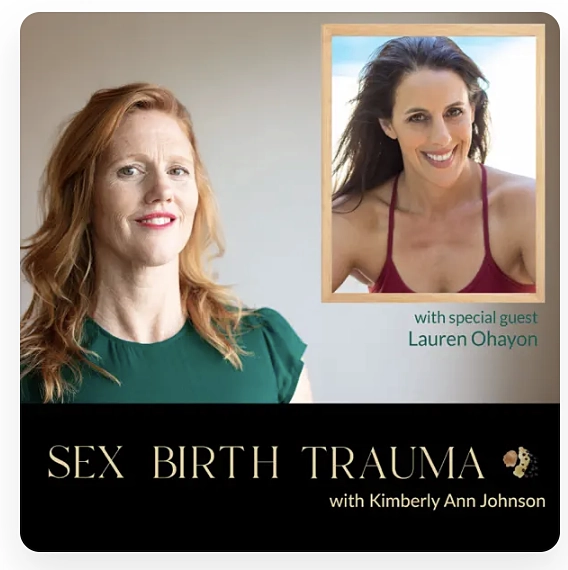
Restore Your Core®, Healing Journeys, and Mothering Teens with Lauren Ohayon
Somatic Movement Healing: Lauren Ohayon on Body Awareness, Movement Patterns, and Holistic Recovery
Kimberly Ann Johnson: Welcome to the Sex, Birth, Trauma podcast, where we ask the big questions about things that really matter in our time. We talk about sex, birth and motherhood, womanhood, relationships and power. The common thread is embodiment and all the ways that we can become more human and more humane, to love more and to love better. I’m Kimberly Ann Johnson, and I’m so happy that you’re here.
Today, I have a special guest, Lauren Ohayon. Many of you listening already know her work in reparative, restorative, female body focused exercise. So many people over the years, when I’m doing hands on work or just other colleagues that I have in the pelvic floor world or the women’s health world or supporting moms have referred to her work.
The Journey to Somatic Movement Understanding
And so I really wanted to talk to you today, Lauren, because we have these intersecting worlds. We have complementary roles in how we support women. And because it’s just day in and day out that I hear the same painful stories that you do of women’s health, which to me seems like blindfolded people throwing darts at a dartboard. And there’s so many women that have lingering effects of birth and pregnancies and fertility journeys, and then just their evolution of being in a female body over the lifespan. And you’ve really developed so many tools for women to work with their own bodies and you’re training teachers and helping them to support women in these phases. So welcome to the podcast.
Lauren: Thank you. I’m super happy to be here. Thank you. Thank you.
Kimberly: And I want to just say that I deeply dived into your Instagram, which is very educational, entertaining. You’ve really got it dialed in over there. Which is, it’s fun. I love celebrating other women business owners who are just kind of taking that platform which is filled with so much and doing good things with it. So, thanks for that.
Kimberly: And I wanted to start out. So, you know, one of the things that I saw was that there is a very holistic and integrative approach that includes the nervous system, includes anatomy, includes sexuality, and so that people are a little bit more oriented if they haven’t heard about You Are Your Work. Can you just talk a little bit how you made your way to this holistic approach? And some people, I mean, when you’re in the pelvic floor world, you don’t think of the pelvis as like a very specialized thing because it affects everything. But for people outside of the world, it’s like, oh, pelvic floor. Why is that? You know, or is that like, how would you want to just devote yourself only to that?
Lauren: Yeah, those are great, great concepts and questions. I came into it because I’ve always been a lifelong mover. My earliest memories, like my first, we moved around a lot as children growing up. So my earliest memories were kind of soothing practices that I did via movement because I was always a mover. And I saw them as movement journals. And I would, like, put in my cassette tape at night and play Madonna, like, like a virgin and just like rock out to… That should tell you how old I am. I was born in 77.
So, you know, I really just was a mover for myself. I grew up from very early on. And then my relationship with my body, of course, as it does, it had many seasons. But I had sustained… I became a yoga teacher when I went to college. I went to college in New York City at NYU. And I sustained a really… Once I started teaching yoga, I got injured pretty quickly.
And then I was injured. I was living abroad. I had a very successful kind of practice. I’d built a practice. And I was injured and it took me a year to rehab. I herniated a whole bunch of discs in my lumbar spine. And that was really kind of like, I would say, a very formative period for me because there were so many narratives coming at me. There was the narratives of the doctor, which is, if you don’t have surgery tonight, you’re doomed. Because it was… I was in pretty bad shape.
Rewriting Movement Stories: Beyond Right and Wrong
There was the narratives of… then I went to seek, like, a bazillion different healers. So I was digging many wells looking for water, which is very unsettling. And I remember at one point this… one of, like, the founders of Alexander technique, one of, like, the first teachers, not the founders, but one of the first teachers came to me and he was like, you need to stop digging this many wells looking for water. Just dig one deep well. I was like, oh, yeah.
Lauren: So I was doing a lot of Alexander and Feldenkrais, which was very somatic and a very different way for me to be in my body. And I was also reading a lot about anatomy and biomechanics because I was like, there’s got to be a root cause to this. My story about it back then was that yoga injured me. Like yoga, I was overly flexible. I overextended and I injured my tissues. And I did a lot of Pilates to heal. It took me a year. It was like a really long year of rehab, but it was very empowering.
So there were just all these narratives flying and then I healed and it was so empowering because I didn’t have surgery. And it set me off on a path of teaching a more mindful way of moving because I still believed that my way of doing yoga had not served me and therefore I had been injured. I have since rewritten that story, but that was the prevailing story in my brain at that time.
And I would say that just kind of propelled me. I was living in Israel at the time and I left Israel and moved back. I moved back to New York and had babies and just, I started kind of formulating this method once I started having children and that pushed me into like a very new season with my body and with like disembodiment. And I was doing a lot of it at that point. Again, Hannah somatics and Feldenkrais. I was studying in New York City with amazingly embodied people, people who studied like Barteneff and Laban and body-mind centering. I was doing body-mind centering around the clock. And that really changed my life. Like all of that kind of work.
And I think that the practice that I have now just infuses a lot of, so it’s like, there’s a lot of anatomy and biomechanics information there and that’s kind of bubbling under the surface of things. But what’s really like the engine that drives me is a more kind of somatic nervous system approach to it all because the anatomy approach was very shamey and blamey and pathologizing and diagnosing and something’s broken and let’s fix it. Which is very alienating and creates compartmentalization and fragmentation in the systems. So it’s like it’s a tool, but not a rule. And we take it to be this rule.
Kimberly: So what, if you don’t mind, what was the story? What’s the rewritten story now about yoga, that our bodies adapt?
Lauren: Yeah, that we are these adaptive beings. And that I’m a hugely sexual person. And more than sexual, I’m incredibly sensitive. I’m sensual. Like when cars drive by me, I can smell the inside of their car long after they’re gone. Like I have a very strong sense of smell. And I had, I was, I think it’s a product of, well, I don’t know, but I think it’s a product of moving around a lot as a child and needing to form kind of like always reorienting myself. So I have a lot of like, sense of peripheral vision. It’s why I moved to Miami, because I can’t wear jackets, because it kind of cuts me off from being able to sense. So I need to always be kind of half naked so I can feel safe and know what’s around me. As a child, I was in a home invasion. So I’m very attuned to my senses, right?
And I’m very sensual. And I think the story that I now tell myself is that in adaptation, well, first, my body sought out practices that allowed me to lean into my tissues, like allowing me just to lean into excessive sensation. I sought out excess ranges because it was where I could lean into. I don’t know how else to describe it.
And the body adapts and creates like, like one of the ways that I try to help people see prolapse and diastasis recti, for example, rather than it being like an injury that you sustained because you were so naughty and bad, and you didn’t do the right things. I see it as an adaptation. We were, there was so much pressure and so much tension on tissue that the tissue helps us and it creates space. And that space has an outcome.
So in me, the creating space, my body was like, oh, you want that? We’ll just move some discs out of the way to help facilitate deeper extension. We will just kind of help you out, but displace some discs. And so I’ve rewritten it. So instead of blaming yoga or my body or my flexibility or my tissues, I’ve just, my body was helping me. It’s not the help I necessarily then wanted to face, but it was helping me.
Lauren: And it then created a lot of teachable moments. I mean, part of me hates it when people are like, oh, injuries are a lesson, but it’s true. Actually, there’s a lesson in an injury. It doesn’t mean we should just get injured to have a lesson. And I didn’t, I ended up having back surgery two years ago, which was amazing. And so I’m like, saved me at a time that I needed it. And once again, I had this back presentation and this time the presentation didn’t heal itself and it was bad and I needed surgery. And so I’ve stopped shaming, blaming, pointing fingers and more. Everything is a story. Everything for me is a story. There’s just a story around things. I would say that’s how I’ve reframed.
Kimberly: Thank you. Yeah. I think that what I see out in the world right now is this idea that if something is quite wrong, because we’re having some kind of a symptom, for instance, and it could be something, you know, very specific or very non-specific. There’s this idea, I think it, and it’s weird because it’s coming more from the somatic movement world, than anything else. What I’m seeing is that, if you’re doing it right, you won’t have any pain. So if you’re doing the somatics, right. And if you’re doing, you know, if you’ve dialed in your nervous system and you’ve dialed in your connective tissue, then nothing quote, unquote will go wrong. And you won’t gain weight and you’ll be thin. I see that a lot too.
And it’s interesting. Cause I’m a couple of years older than you. I was born in 74. And I’m definitely right in the middle of my menopausal transition and so many things are changing. And some of them feel really alarming. Like postpartum was for me, just like what, what of these things am I supposed to allow? And what of these things am I supposed to intervene with? You know, what is the fat that’s coming on my body? That’s adaptive and protective and really super useful. And what is either laziness or like and like how dramatic do I have to be with my interventions on what I’m already experiencing?
Kimberly: And I just think that that’s, it’s probably a question for every human being, but I think it’s definitely a question for female humans that are, you know, I found myself researching body types and menopause. Like, let me see what Ayurveda has to say about that, just like different predispositions. And how you go through this time.
And so, yeah, I think it’s important for people to hear the reframes because it can sound Pollyanna-ish if you just hear it just from that point of view, and you don’t hear the evolution of what it takes to reframe something, because you might reframe it several times and you’re not doing it from your brain. You’re not deciding it means something. Your body is showing you, Oh, now I understand. I understand why I’ve been in this freeze pattern all this time. And that body understanding will allow me to thaw it, not the cognitive understanding. It can be together. The cognitive works with it, but I think that it’s really helpful for people to hear that one can be very holistic and very organic and do everything right and still need intervention.
Lauren: Absolutely. A hundred percent. I came from very, I came from, I have been part of very dogmatic healing circles. And I have, they terrify me, they feel like cults. And I have kind of set these filters, I don’t want to say boundaries, but more filters around me, where I’m no longer kind of entertaining cult mindset. And I can see it a mile away. And it usually comes with you should, you should should, you should, you should, you should, no, no, I should not, I should not, you know, I should.
And I think, you know, yes, and I think that I have always been more organic and hands off and let nature take its course. But that’s not like, it doesn’t always work. It’s not always useful. And it can also be very misconstrued, that message can come with a lot of false equivalency. And it can create alienation. Because when we are so dogmatic about what healing should look like, we are now falling into medicalized traps. We are, but we’re just calling it something else. We’re veiling it as health and wellness.
Kimberly: A quick break from this podcast with Lauren, to let you know that we’ve extended the May early bird for the Mother Circle facilitator training. The reason is because I just didn’t have the email mojo to let everybody know what was happening. And because May is kind of motherhood madness is what I’m noticing. So I wanted to give everyone a little bit more of a chance to take advantage of that $500 discount. And you can go to mothercircle.com and you’ll see it right there. Mother Circle facilitator training. It’s a two month training for three months, including Mother Circle itself. And it is Intensive training on how to lead a curriculum of the unseen arc of the motherhood journey.
To me, it’s also a response to putting everything in mental health categories for mothers in a way that we can begin to build a mother culture. So if you’re at all interested, the people that I’ve trained already are a really phenomenal group of women. And they all said that the training was so much more valuable than they even imagined, not only from a financial perspective, but also from a personal perspective of really deepening into self-understanding and who they are and who they could be as a leader.
So go to mothercircle.com. Check out the Mother Circle facilitator. And if it’s right for you, join by May 31st if you need to talk about it and suss it out. Jessica Connelly, my co-leader, is happy to talk to you about if it’s the right thing for you. And now back to my conversation.
For so many women, there’s such an outsourcing of our power. So it’s such an understandable pendulation. Because the degree of incompetence when it comes to women’s health is so high. And the medical profession itself. And I am a doula and I do births. I used to do births at hospitals. I don’t anymore. But that has to do more with my own system and what I can tolerate and the degree to which I can feel like I’m participating in something that has all kinds of veils.
But like life’s algorithm is pushing you in one direction. It’s hard to get a myriad of opinions happening or facets. But I was talking on my Instagram just yesterday about how for the first time in my life, I went on a diet, but it’s not really a diet. I’ve just been tracking what I’m eating because I felt incredibly undernourished and I wasn’t eating enough protein because I’ve never looked at labels and I’ve never… like in order to feel safe in my body, I can’t weigh myself or look at labels. I won’t.
Which is probably a sign that somebody recently was like, well, that’s a sign that you’re dysregulated. And I was like, oh my gosh, everything is a sign that everybody’s dysregulated. Like you put up a boundary and someone bashes it. But I’ve never weighed myself or looked at labels, not even when I was pregnant, never. So I don’t know how to read a label, but I was recently feeling that I’m not getting enough protein as the perimenopausal 47-year-old and I need more protein. And I don’t eat animal protein. So I needed to figure out how I was going to get all that.
And I knew nothing and it sucked. Because I’m in the health space, but I’ve made it my mission to not know about diet and calories and fat and grams of anything. And because I knew that it would make me dislike myself possibly, and I was safer in myself, just eating, just being nourished. But then I stopped being able to be nourished appropriately. So then I had to learn.
And so I went, I did, I went and really informed myself. I read a variety of different perspectives. I listened to a variety of different podcasts. I read some books. I consulted some coaches. Like, you know, I think that people think they’re getting informed, but they’re not necessarily. And yeah, I found 1500 different perspectives and I was like, well, this is mind blowing.
Kimberly: But when I got out of it was like, I now understand what I eat and I can now ditch the counting and ditch the, I had this app and I was putting everything in the app and I was like, this really sucks. But I did it for a few weeks so that I could then make a decision to come back to this other state. And now I feel better fed. I feel like I understand food and food sources and protein sources better. I’m actually feeling so much more energized. I’m not need a power nap every day. I’m not need coffee and tea all day long to keep me awake. I’m feeling better. Whatever I do is okay.
Well, oh my gosh. So I was before I was, I thought that nuts were a great source of protein and tahini turns out they’re not. So I am getting a lot more from eggs. There’s like five things that give me a ton of protein. So one of them is like eggs, tofu, which apparently is not as dangerous as we once thought it was. I’m making my own seitan out of this bean. That’s like a super high protein bean called lupini beans, making my own lupini beans. It’s like a seven day process to get the bitterness out. It’s a whole freaking process, but I’m doing it because I didn’t want to buy the processed ones. I wanted to make it myself. And like Greek yogurt and TVP.
And then some days I’m like F protein. I just want to eat fruits and veggies. Cause that’s what I’m so used to. And I don’t want to be like constantly eating TVP and soy all day long to meet this metric that some person said is better for my chemistry. That I need 120 grams of protein a day. I know there’s probably no way to get there. That’s so much.
Kimberly: I’ve been listening. I’ve been listening to Stacy Sims and I don’t know how to do stuff either. And so I just was like, okay, well, how much is in, cause okay. 30 grams, 1530, I’m like adding it up and I’m like, oh my gosh, an egg. Do you know how many grams now you have? An egg has six grams? I’m like, that’s like five eggs. I mean, some days I know for five eggs, but that’s a lot of eggs.
So yeah, the protein requirements, I mean, I was a vegetarian for 20 years and during my postpartum that was just one of the things that had to really shift was like, I need meat. And I didn’t realize how spaced out I had been for so long thinking I was spiritual. Like, I was like, oh, this spiritual state is actual blood sugar. I’m starving. And my blood sugar is like all over the place. All the fractals are actually starvation.
I ate a bison. My acupuncturist was really trying to get me to do the meat. And I was so resistant. And so he took me to lunch. And he ate a bison burger with me. And I was full for like six hours. And I was in you know, my story in my head was like, I’m gonna get sick and my body won’t know how to digest it. My body absolutely knew exactly what to do. And I was like, wow, I haven’t actually been satiated for years. I just was. I was content. I didn’t. I wasn’t still hungry, you know.
Lauren: So I wish I could eat meat. I really wish I could. And I just it’s been so many years. But I do eat fish.
Kimberly: Oh, nice. Yeah. Yeah. But yeah, we’re supposed to have like 30 grams of protein a meal, if not 40. I’m like, and there’s like protein powder I’m taking. I did all sorts of research to find like the cleanest, greenest protein powder that has like a COA. Like California is really strict about that. And that not only has a certificate of analysis, but gives it to you so you can see what kind of garbage is in it.
Kimberly: Yeah, I found that one that’s like super lean and super great. And I do that every day too. I’m like, I can’t believe I’m doing powders and stuff like…
Lauren: Yeah, well, I have considered doing powders, but I’m past the meat resistance. Like I love having meat stock in the morning, I make chicken broth. It’s like when I go travel anywhere, the first thing I do is get chicken feet and make stock in like the call. It’s just, it gets like jelly and you can see it and I can feel what it’s doing to my guts. And I’m just like, oh, this is good. But I the pea protein thing is ridiculous. Like it just it’s makes me feel terrible after I have it. And every time I think, oh, there’s a protein that’s like this and that. And then it’s like pea protein.
Kimberly: So yeah, it might be the power of the protein. What I’m doing is pea protein, but I don’t have that relationship with it. Listen, don’t forget, like my DNA is Mediterranean.
Lauren: Yeah. And from the…
Kimberly: So I do think some of it is also what our ancestors could tolerate.
Lauren: 100%. No, I was thinking about that as you’re saying it. It’s the people from like the Nordic regions where we needed to store fat. Yeah. So it totally makes sense.
Postpartum Recovery: A Somatic Movement Approach
Kimberly: If you what ideally, I mean, right now, at least where I live, and I’m pretty sure most of the US when women have babies, there’s really no postpartum recovery plan. There’s no physical therapy post surgery. So what would your ideal postpartum recovery plan look like?
Lauren: It’s a great question. I think that in my ideal world, people would be so much more embodied in their bodies way before having babies, so that their plan would be so clear to them, because they’d be listening to messages from their body, and they’d be in tune, and be moving in tune with their body. That being said, I do think they’re like finding that balance between ample rest, and then kind of starting things up again is important because life is, you know, but I do think there needs to be an honoring system.
I try to tell people to take like eight to 10 weeks with walking and gentle stuff like that. And then to like the bridge and ease into it really with a breath work centered. And tuning in. One of the things I like to tell my clients is, the thing that I love to teach people is, do you know, like, do you know what you do when you do what you do? Right?
So like, when I’m, I can move my hand like this, right? But like, am I doing it? Like, am I feeling, is it going from, it’s like putting chocolate in your mouth, and you can put chocolate in your mouth and just chomp it down and swallow it. Or you can put chocolate in your mouth and savor it and have this kind of moment of savoring the chocolate, it’ll take a lot longer. It’s like, you’re immersed.
I can hold an apple in my hand and just start chomping it, or I can hold an apple in my hand and kind of bear witness to my system starting to prepare for that moment of eating it. Because the system prepares for it. Like, you don’t feel that, but it’s happening. And you can kind of just take a moment and honor that.
Lauren: And so with movement, like, how often are we honoring the, like, how often do we know what we do when we do what we do? Because in order to survive in this world, we have to be on the road. We have to be programmed 99% of the time. We have, like, that’s the only way to survive, right?
Hypervigilance is the opposite of that. Hypervigilance is like, what’s happening? What’s going on? What should I say? What should I say? Like, that’s hypervigilance. We don’t want to be that. We want actually the nervous system to do its job of kind of muting a majority of what’s happening around us so we can be kind of in the task at hand.
On the other hand, if you can take 5, 10, 15 minutes a day to be a little bit more mindful, to feel what you feel when you feel what you feel, to smell what you smell when you smell what you smell, to know what you do when you do what you do, you start to create a toolbox that’s a little bit more expansive. So you can dip into that toolbox. In the moment of reactivity, you have a little bit of a buffer zone because you’ve cultivated various tools of experience.
And one experience that’s really lovely is, again, too. I think a lot of people don’t really know what it means to be somatic. My experience of being somatic is, do you feel what you feel when you feel what you feel when you do what you do, right?
And so with postpartum people, I think it’s important because it’s a new season. Like, on the other hand, we don’t want to spend too much time like, again, over analyzing stuff, because that can lead to analysis paralysis. But immersing, immersing in the body in a more mindful, breath centered, even if you’re moving kind of quickly, dynamically, I really love that.
Lauren: So I love a period of rest. And then I love a period where we’re bridging back into the world in a more kind of in tune with the seasons. I think part of the dysregulation that’s going on is we’re forced to switch seasons so fast. We’re forced to like, oh, your eight weeks is up. Get back to it, right? Crack on.
And I love the crack on mentality. I think it’s really important to have a crack on mentality for so many areas of our life. We get so stuck in analysis paralysis. But on the other hand, we have to honor the seasons. We have to honor transitions. We can’t just always crack on. So it’s like… You can find that balance between… it’s again, how do you find that balance? Between crack on and this is a different season. Let me take a minute here. Let me honor.
So when people are like, I need to get my body back, I want to respect them. That’s what they think they need. But deep down, I’m like, oh, be nice if they didn’t feel so pressured to get their body back. Because it just disembodies. It’s like this disembodied practice to get your body back.
Kimberly: You have three children. Was your process similar or different in the recovery from those three?
Lauren: I was similar to each of them, like relative to each other. Yeah. Yes. Yes. But I was postpartum blue each time. Severely postpartum blue. And I… yeah. Like I struggled with a lot of… Like I knew I wanted to connect with my parents, but I also struggled with that a lot. Like I just needed more space than I was getting. So my struggles were not very physical. There were many… I felt them much more emotionally with needing space. Yeah. Like I couldn’t lean in. Like I couldn’t be as selfish as I had been.
Lauren: So yeah. Yeah. I think my experience with all three was probably very similar. But with each one, it felt even heavier and heavier and harder and harder and harder. Another reason we moved to Miami. I was like, I’m doing this. Like a baby carrier, holding the hand of the other, pushing the stroller of the other. Like three kids, snowbanks, nowhere to park, New York City, Brooklyn, subways every day with like a newborn baby, taking this one to like, I don’t know, singing class. I was like, I need to be in one. I need to be in warm weather. I need to not deal with snowbanks and ice. And I needed more nature, more green.
Parenting Teens: An Embodied Approach
Kimberly: Are you parenting teens now?
Lauren: Yes. And I love it so much. Yes. I’m parenting teens and I love it.
Kimberly: How about you? What are you parenting?
Lauren: A 16 year old.
Kimberly: Okay. So I also have a 16 year old. Yeah. Do you like parenting teens?
Lauren: It’s more challenging for me than, than the earlier times. Um, I do like it. I, it’s not anything that people talk about in the culture. Like my daughter doesn’t hate me. She doesn’t want me anywhere near her. Um, you know, I think my implicit conditioning was like, I should kind of stay out of the teenager’s way a little bit. Uh, and it hasn’t been like that at all. So, but it’s called, it’s calling me into a higher level of mothering for sure. Because also, I don’t know about you, but there’s all these other things at play with them now that we can’t control, like social media, you know, and things that are in the way, but I’m similar to you. I mean, I love parenting teenagers and I am very hands off, but very hands on when they need to.
Kimberly: What do you mean by that?
Lauren: Well, I was a teenager who loved to have sex. And it’s funny because people will sometimes try to wrap it up like my whole early sexual years of being promiscuous, or you must’ve been deranged to want to have sex with people you weren’t married to, but I was like, I loved it. I loved it, I loved it. And I explored a lot of different types of sexual experiences with males and females. I was really sexually liberated by the time I was 17.
And I also loved drugs. I was like, how do I, I was going to call it plant medicine, but at that time it wasn’t really, it was just doing drugs on the golf course, but I also really enjoyed that. I loved that. And I was also a straight A student who got into NYU and was like an honor student and always had, I juggled three jobs in high school. So like, I was juggling all those things. I was juggling things like sex, drugs, jobs. And my dreams and I was all of those things were, you know, in the air.
And so like I, and I’m, and I’m fine. I came out great. And I really liked the human I am. So I like, I want my, like, if somebody told me like your 16 year old is having sex, which I don’t think she is, but, in fact, we talk about everything. I just don’t want to talk about her life. I don’t do that, but they come and tell me everything because there’s no, like. If they’re going to rebel against me, it’s going to be like, for them being virgins, like, I’m like, so how’s the master, you know, I’m like all open about everything, masturbation and sex and all of it.
You know, my big thing is just practice, like consent, communication and safety. Cause I, you know, I think those things are important. And I think that teenagers often are pretty blind to those things. They think they’re so smart and they are in so many ways. They think they know better than us and many things they do, but, it’s easy to make decisions that have repercussions later. So, yeah, yeah. I really love watching them blossom in their teenage years. It will be hard to shock me. I think.
Kimberly: A quick break from my conversation with Lauren. If you are wanting to do Jaguar sex edition, I’m not going to be teaching that in 2024. It’s possible. I’ll be teaching it in 2025. I imagine I will be. But what you can do instead is do my one month Forging a Feminine Path course that I’m going to be leading through Kripalu. It’s online.
Of course, you can always come work with me in person because it’s some version of the sex edition. It’s not just as complete of those three months. But my retreat that I’m teaching with Kendra, Apprenticing the Web will certainly be addressing both sensuality and sexuality from a practice perspective. Not just a theoretical perspective. Any time that you’re with me in person, they will be a component of that, but at the Kendra retreat, we will probably have a sexuality salon.
But back to Forging The Feminine Path, I’ll be teaching it with Kripalu in September, meaning that Kripalu is hosting. I’m teaching. It is going to be an intensive month of incremental exploration, rather than just the once a week classes. That’s often how I’m teaching jaguar. They’ll be an everyday drop in the bucket so that it’ll feel very immersive.
So if you’ve been holding out for Jaguar Sex Edition, I’m sorry that I won’t be teaching it this year. But you can catch me in September with Kripalu. And I’ve already got it lined up. I’ve already got the day-by-day interesting journal prompts, somatic inquiries ready for you. And I’m looking forward to it. You can find that on my website and sign up for the waitlist. But just put that on your radar. Save your dollars, your pennies till then. And I hope to see you then.
Core as Central Support: Understanding Movement Integration
And now back to my conversation with Lauren. What your program is, one of them is called Restore Your Core®. And you have an online program where people can do that program online. You train professionals in leading other people through that material. Can you talk a little bit more about what core means to you and then what restoring your core means?
Lauren: Yeah, it’s a great question. I would say core to me means like a central support system that receives and transmits. It is a shock absorber and a propeller. And it has this amazing role, like unlike our limbs, our limbs, which really… Pull things in, help us bring things into our body or take us out into the world, right? The core is receiving. It has this role of receiving but then transmitting.
And the shape of the structures of our core system are so different from the shape of the arms and legs. And I do see in a lot of movement systems, we try to allocate, we try to kind of co-opt, like the things that the arms can do to… Things that the pelvic floor can do or things that the core can do. I don’t really see the pelvic floor and core and diaphragm. And I don’t really see them as separate things, although it’s important, I think, to meet people where they’re at and talk about them as separate things. But the whole body is just receiving.
And I think a lot of that receiving comes through even like, you know, you’re a rolfer, you know, all these diaphragms, you know, the diaphragms aren’t just here. They’re like the top of the head and in the throat and the rib diaphragm. So I just think that for me, the core is this area of reception, conception, inception, expansion, permission, and transference. Like it’s, it helps transfer mechanical force. Like if we’re talking anatomically, it helps transfer.
And, you know, when you have a river that’s flowing and there’s a rock in the river, then the river will flow differently, right? The rock will kind of create a different flow. When there’s no rocks in the river, the river just kind of flows in a different way. And to me also, like the core or a functional core, if we want to get, use that terminology is one that helps there be possibly less rocks in the way.
Lauren: So things can flow just a little bit more effortlessly from one area, you know, it can transmit through and just keep going through and create a reverberation through and the core facilitates that, that reverberation from the hands into the wrists, into the elbow, into here, the shoulder joint, through the clavicle and ribs over to the spine and into the pelvis. And it’s just this beautiful kind of transference that can happen.
Pattern Recognition in Movement
But sometimes things are kind of stuck in like, there’s a lot of rocks in the way. So kind of the core work that we do is figuring out what’s in the way, like what are those rocks in the way and how can we create… I used to look at them as compensations. I now look at everything as a pattern. So like our body is so patterned. And when we can just explore other ways of patterning, the core can do its job of coring. The core can core.
Kimberly: And so if somebody’s listening and they’re like, okay, I mean, I’m all in, but if somebody’s listening and they’re like, yes, but I have this problem, continent, and I cannot, or I’m prolapsed and I cannot fix this. Is this a good program for them still?
Lauren: I mean, absolutely. The thing is when I made the program, I was still very in my anatomical brain teaching. Like I was very, I would say alignment and form focused, which I still am. Like I still think that there’s a… a role for that kind of work, that kind of very specific, all that specificity… of like, this is how we… I hate the word should… but this is how we should stand and this is how the pelvis should be stacked and how the pelvis over the ribs over the head over the… You know, so when I created Restore Your Core® it was very much like let’s assess, let’s have a little bit of a look at ourselves and see how we do what we do when we do. And let’s think about doing things differently…
Lauren: So it’s like being very specific. If you have a big anterior pelvic tilt, let’s become aware of that and start to do the work to be more balanced. Not because anterior is bad, because that’s a pattern, which it does. I mean, there’s no way physics are at play. There’s no way something like an anterior pelvic tilt won’t have an outcome on the rest of the system. It doesn’t mean it’ll be bad or it will always produce injury.
I think you and I may have been trained if you are, I mean, you say you’re a rolfer, I believe you. I’ve studied a lot with rolfers and I know that, and I’ve worked hand in hand with them for years. I know that, you know, there are specific presentations that are automatically trained, like your eye is trained to be like, wrong, bad pain issue. Now, maybe you don’t work that way. I’m not saying you do, but I was trained that way too. I was trained to look at a body and see all the ways it was wrong, which sucks.
It’s great for me. It’s great that I have that information because I can work with it, but it sucks for the person in that body constantly being told that their form is bad, that their posture is bad, that they have bad posture. And I was guilty of being in that paradigm. Right. So I think that like, if you came to Restore Your Core®, there is a lot of very specific and alignment kind of foundation, but then there’s also a lot of like, now we’re going to trust. So now we’re going to move, we’re going to trust and we’re going to, yeah, we’re going to try to repattern using this set of exercises.
So I do have a big consideration. I am most likely re-filming the whole program just to be more in line with where I am today because I made it 10 years ago. Right. But I think that the anatomy side, I mean, I’m curious to know what you think, cause you know, we were talking off camera before about how you still do work with bodies. And I’m curious as a rolfer you must, I mean, I’m not interviewing you, but this is a conversation, you know, I’m curious about how you, if that resonates with you, that way of kind of being trained to pick up all the bad things that people are doing in their body, something you experienced as a trainee.
Kimberly: You know, they, the philosophy is that you’re reflecting wholeness back to people, but yeah, I think that I, but I don’t even think that’s necessarily my rolfing training to look at for what’s wrong. I mean, my eyes can see a typo, like a mile away. That’s right.
Pain, Movement, and the Nervous System Connection
Right. I think that that might be beyond my rolfing training. And yeah, I guess it’s probably why somatic experiencing training and just kind of having the meta net of the nervous system is helpful language. Because I also wasn’t trained in how to talk to people. I mean, in fact, I thought talking was a waste of time. And I thought, okay, I just let my client blah, blah, blah, while I keep, you know, my elbow on their greater trochanter or whatever, and then just kind of wait till they run out of steam, you know.
So I had to learn how to have a back and forth conversation. And I had to learn how, what people are saying reflects their nervous system state. And I had to learn how that, how to work with that. So that’s, that was a whole nother skill set from just the hands on skills that I had. And the body reading skills.
But I do, you know, it’s, there’s so little actual embodied reflection for people that it makes us seem like wizards, you know, it makes us seem like we’re just freaking psychic x-ray machines. But a lot of it is very direct in terms of just looking at how things are stacked and looking at density and relative density and elasticity and all those kinds of things.
But yeah, I definitely approach things from the point of view that everything that is the way that it is, has a very good reason for being that way. And has served very well, right up to this very moment. And it’s something to take seriously when someone is having something that’s repetitive. But I also see repetition as the body’s attempts towards organization. And I think that’s also a rolfing principle. I mean, it’s not just rolfing.
Kimberly: But, and I’m not such a physics person. I know there’s physical ways to explain it. But I think it’s more just a philosophical framework that what’s happening is happening, because it’s serving something. And then at some point, it’s not. And I think that that perspective is, for a lot of people, lets them let go of a lot of shame and a lot of self blame and a lot of the what’s wrong, what’s wrong, what’s wrong, because you and I both know that when you’re in the what’s wrong attention, it’s really hard to shift any pattern.
Right. And when you’re in pain, like, I think maybe you and I might agree, but pain is not always because there’s an issue in the tissues, right? Oftentimes, the issue in the tissues is there, and the pain is there, but they’re not necessarily correlated. Because it feels like this succinct causal event when really pain is so complex and why people experience pain.
And us as practitioners have this amazing role to be able to make people feel safe. And when people feel safe in their body, what I found is their pain levels go down dramatically and their propensity to heal goes up dramatically. And when they feel unsafe in their body, and then we continue to feed the message of like, you’re doing it all wrong, they feel more unsafe and they start becoming vigilant, right? Like, oh, did I just pick up my baby the wrong way? Did I bend over bad? Oh, am I bad? Am I doing it wrong? Now we’ve got, like, that’s not, you can’t, that’s not a capacity. That’s not a good place to heal from.
Lauren: It’s hard. It’s definitely interesting. It’s pain and pain and tissue is an interesting conversation. Yeah. And when you live in the body work world and this movement world, we see that so much of the time that somebody can be in a lot of pain, but there’s nothing that’s apparent. And then people can be in no pain and you’re looking at something that you’re like, wow, I can’t believe you’re not in, you know, hopefully not saying that, but in your mind, you’re thinking, wow, I can’t believe you’re in no pain with this kind of structure presentation.
Kimberly: Yeah. And I think that that’s… It’s good for people to hear that, too, because it’s not like dismissing pain, that it’s not real. It’s just knowing that there’s so many different sources of it and so many ways of relating to it. And, you know, it took me a long time to heal after having a baby. It took me like six and a half years. And there were a lot of reasons for that, because there was a lot in my life that had to reorganize, too. It wasn’t just my body that had to reorganize. It was my life that had to reorganize.
And oftentimes, in this Anglo-North American culture that I inhabit and where my ancestry is from, it’s like… And just external go, go, go culture, just people are very resistant. They want certain to do fix it, but the larger level of like… I mean, I’ve had people have to move where they live, you know, like… Well, you said you had to move where you lived. It’s like, that was responsive, maybe not to pain, but to health, to wholeness.
Adapting Movement Through Life Changes
And, of course, not everybody can move, but a lot of people do anyway. And, you know, I’ve had people that are like, trying to get better in a city and like, just realizing like, my nervous system isn’t suited to being in this city. And I’m trying to make the best of it. And then they move to, you know, the desert or wherever it is that they’re being called… And it’s not like everything goes away. And like, everything just gets super easy. But there’s a level of relaxation that happens in the system that then allows them to be with the other things in a way that’s manageable.
Kimberly: And, you know, it was a huge change for me getting married. I got married last year. And, you know, I didn’t get married as a result of physical pain or anything, but it’s just, there’s a level of nervous system settling that couldn’t have happened any other way. It was just the only way for me to feel even a deeper layer of settling, which then led to this year where I’m taking it much more easy in my business. And I’m recording a lot less.
And, you know, that there’s a lot of things that went into it. But I think that when we have a problem, and we think we know what it is, and someone’s given us a diagnosis and a label for it, or we’ve diagnosed ourselves, which has happened a lot more since my book came out. There’s sometimes the big picture of how long it takes. Sometimes it’s not long. Sometimes things are very quick. And I find pelvic floor scar tissue often is with some hands on work, doesn’t take a long time to resolve. But then there’s some things like that.
And then I think when they come back around, and they happen again, and we think like, oh, I like it shouldn’t happen. I’m just repeating it. I’m just repeating myself again. I’m doing that thing like, yeah. Yeah, because this is just our path in our body this time around, you know, like, it’s not really going to probably be out of nowhere unless it’s some crazy, acute situation.
And we’ve been sold the idea that bodies should never hurt ever. And that when they do hurt, there’s something wrong, and we need to go and fix it right away. When it’s like, you will not live a full life without experiencing physical pain. And I see a lot of my clients who have a lot of people who hit menopause, and all their symptoms come back. And so they were doing amazing, like they had no relapse or incontinence, like in before they hit menopause, cleared it up. And now we haven’t a period or somewhere in the transition. Generally, I find it’s almost after in the years a little bit after the traffic after they’re done menstruating completely, like even a year later. Suddenly, all these symptoms come right back. There’s a real level of disappointment of like, oh, I thought I was over that. Which I get. I totally understand that. I’d be upset too, right? But it’s not that you did something wrong.
Kimberly: I could keep talking to you for so long, but I’m taking my daughter to get a driver’s permit. And that is freedom. Forget hormones. Let’s go for care. Kids driving. I love when my daughter drives me around. I’m like, this is the best high.
Lauren: That sounds fun. Yeah.
Kimberly: And where can people find you?
Lauren: I’m on Instagram, @thelaurenoyahon And then I have an amazing Facebook group, Restore Your Core® Community.
Kimberly: Yeah, there’s like 10,000 plus people that have gone through your program. And there’s training with you all over the world. So if people are interested in taking your level, like there’s a lot of somatic movement practitioners that listen to this podcast. So if you’re looking to specifically or you already do serve women, new moms, and you are seeing a lot of prolapse or a lot of incontinence or whatever it is that you might feel you need more tools for, then that would be the place to look.
Lauren: Indeed. Thank you. Thank you so much.
Kimberly: Thank you for joining me. Thank you for having me today on the Sex, Birth, Trauma podcast. The music for this podcast was created by Mikey P at Phillips and Company Entertainment. The producer of this podcast is Jackson Kroof. If there was something here for you, please do share it with your friends, your family, your students or anyone you think would benefit. We must build the world we want to belong to.
Get more actionable info, inspiration and exclusive offers delivered to your inbox.
*No spam, just quality content and support