Core & pelvic floor healing & health

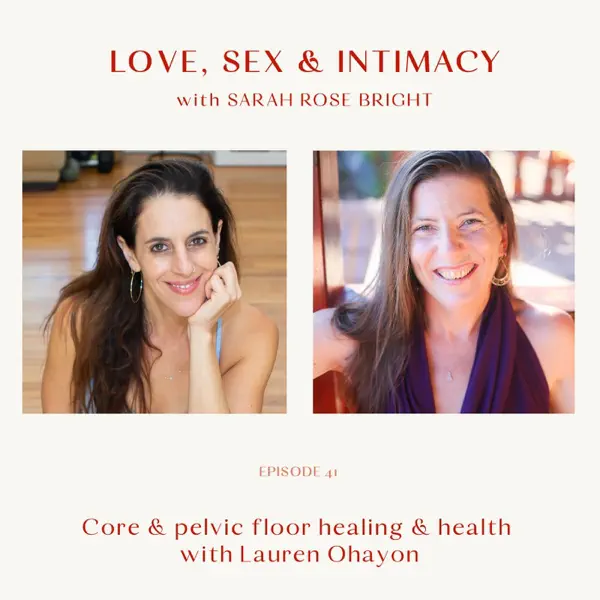
Love, Sex & Intimacy Podcast – Episode 41 Transcript
Core & Pelvic Floor Healing & Health with Lauren Ohayon
Introduction to Pelvic Floor Health and Women’s Wellness
Sarah Rose Bright: Welcome to the Love, Sex, and Intimacy podcast for women who want to experience intimate relationships and sex that are pleasurable and passionate, happy, thriving and deeply fulfilling. With my very special guest experts, guiding lights and pioneers in their specialist areas, we’ll be breaking down the myths, exploring the difficult stuff, the good stuff, and seeing what’s possible for love, sex and intimacy at this time of rapid change.
In these candid and intimate conversations, I’ll be bringing you the best of sex relationship education for the practical ways to support and inspire change in your intimate life. I’m your host, Sarah Rose Bright. Whether you’re curious about what’s possible or you’re already committed to exploring, I’m so happy you are here.
Meet Lauren Ohayon: Founder of Restore Your Core®
Sarah Rose Bright: Welcome to this episode with Lauren Ohayon. Lauren is creator and founder of Restore Your Core®. I came across Lauren’s work when I had a prolapse, and her program really helped me and I really valued her approach, which is different to a lot of what’s out there. So many women have problems with pelvic floor issues, whether that’s prolapse, incontinence, pelvic pain, all sorts of things.
And it has a huge impact on sex and pleasure and intimacy, on how you experience it, on how you feel, your sense of self. And what makes me so sad about all of this is so much of it’s preventable. So for me, having these conversations is really, really important. And Lauren shares her wisdom on what to do if you have pelvic floor problems, how to care for your pelvic floor, and how to prevent things happening in the first place.
So enjoy! Welcome to today’s episode. I’m really delighted today to be joined by Lauren Ohayon. Welcome, Lauren.
Lauren Ohayon: Thank you so much for having me.
Sarah Rose Bright: A pleasure. Thank you so much for making the time today and really looking forward to this conversation, because it’s a topic that’s really dear to my heart. So I’d love to invite you first to share what you do in this world about your work.
Lauren’s Journey in Movement and Pelvic Floor Health
Lauren Ohayon: So I’m a long time movement teacher. I began teaching movement in 1999. That’s a very long time ago. That just dates me right out the gate, which is fantastic. I like being dated. And so I started my training in yoga, but then I moved into Pilates and functional fitness. I’ve racked up a bazillion different trainings over the years, a lot of somatic movement.
And so I’m a movement teacher who helps people who have core and pelvic floor issues, low back issues, but primarily people with – I work a lot with core, but a lot with pelvic floor.
Sarah Rose Bright: Yeah, yeah.
Lauren Ohayon: And I have a rehab program. I mean, I could go on and on. I have an online rehab program, and I teach in person and all sorts of things.
Sarah Rose Bright: And you have a network of people you’ve trained around the world as well.
Lauren Ohayon: I do. I have a network of teachers. Every year we train about 80 new people, and it’s phenomenal. We’re very blessed to have those people out there doing the good work.
The Birth of Restore Your Core®: A Whole Body Approach
Sarah Rose Bright: And your method, Restore Your Core® – could you share a little bit about that?
Lauren Ohayon: So when I got into – I had been living in Brooklyn. I’m now living in Miami, but I had been living in Brooklyn and I had three children back to back, literally like one after the other. And I became very interested in this population, people having babies, pregnant people. And I began – in my interest in that, I also began to be referred to a lot by various other movement professionals, and it seemed very odd to me that our pelvic floor was being treated in a silo, like there was a big silo vacuum approach like, oh, and I think it comes from this fear of, like, this lack of understanding about the pelvic floor, about the vagina, about the vulva and that like, oh, okay, okay, there’s a problem. Let’s just tense it up, squeeze it up, do some contraction.
So people were coming to me saying, you know, I went to my PT and I have this prolapse, but you know, I’m doing all this and it’s just making things worse. What am I doing wrong? And they fell on top of feeling the shame around a pelvic floor injury. They felt doubly frustrated that the common treatment protocol was not working on them. What was wrong with me? That what everyone else seems to be doing is not working for me?
And it just seemed crazy to me that we weren’t taking into account the entire body. So I thought, okay, market research, is there an online program that looks at the pelvic floor from a whole body perspective? Okay, no, this is what I want to do.
The Blog Post That Changed Everything
Lauren Ohayon: And what really sent me off was a blog post that I read by a man, no less, a male yoga teacher who had a blog post titled “What to Do? How to Fix Your Loose Vagina,” and it infuriated me. Like, I think the anger rose out of me and I thought, doesn’t he know that vaginas can’t even be loose? Like that is also just such a logical fallacy? And it infuriated me that – and his answer was learn to get into a handstand by floating effortlessly into your handstand.
I mean, it was so outrageous. So in every way, shape and form, it was really this outrageous article, but it had a lot of comments and shares and likes, and I was infuriated. And I was like, this is so unjust. This is really unacceptable. We have these people who are so injured thinking that the root of all their issues is that they can’t effortlessly float up into this handstand.
So I actually wrote a post counter feuding that, refuting that. And the reaction to that was so positive that I thought, I need a program. I need a program to really help people understand that the root of their pelvic floor issues may not even exist in their pelvic floor.
So Restore Your Core® was born out of that desire to help people find a more whole body approach to what is going on in their pelvic floor core and beyond.
Sarah’s Personal Experience with Prolapse
Sarah Rose Bright: Beautiful. And that’s how I found you, because I had a prolapse about four years ago and went on a whole healing journey around that. And when I found your program, I was like, oh, this really makes sense, of course. And you know, your program – I’ve done lots of online programs. I think your program really is really well put together, and I love the way that the foundations build and the different options for the different sort of lengths of videos that you can follow and you just articulate it really well.
So highly recommend it. And I really felt the shift in me from using it as well, which is why I wanted to talk to you about it and bring your work to my audience and awareness. So yeah, you work a lot with people around the pelvic floor. So I’d love you to sort of speak to what are the sort of real common things that you see, your clients, your students present with?
Common Pelvic Floor Issues Across All Ages
Lauren Ohayon: Yeah, that’s a great question. Thank you for the kind words about my program. I appreciate that, and I’m glad you found it useful. So there’s a spectrum. I see so many people. I actually work with a lot of males as well. And so, but if we’re talking about more of a female population, or, you know, assigned female at birth population, I see even people who are in their very early 20s with serious pelvic floor issues.
In fact, I am helping somebody who is 15 right now. It’s really out of my – it’s not that it’s out of my scope, but I don’t work with teens so much. And as a mom to three teenagers, I’m like, if I have to see one more teenager in any capacity? No. But I understand a lot about – so people, you know, physical therapists will come to me and ask me to weigh in on their teen population. And so I am kind of co-consulting on a teen right now.
So I see people who have incontinence. I’ll see that a lot. And because people think like pelvic floor issues are, that’s what happens to you when you have a baby. It’s like actually no, that’s again just, you know, women’s health is deprioritized. It is not addressed in many ways at all. And so and when it is addressed, it’s like, oh, that’s just what happens to be expected. It falls into that bucket: just live with it.
And so I think that we’ve always thought that pelvic floor issues are for people who’ve had a baby. But actually I work with people with pelvic issues as young as 15. In fact, a friend of mine’s daughter, who’s 11, is experiencing incontinence. And it’s not – sometimes in children, incontinence can be due to constipation, but this is actually brought on by a gymnastic related injury. Very interesting. Actually, a fracture in their lower back.
So it is so interesting how the pelvic floor can be so affected by all these other injuries in the body, and it can happen at any age. So I deal with people who have incontinence, who have a prolapse, who have pain with intercourse, who have pain post-orgasm, who struggle to achieve orgasm. And I would say those are the primary things that I work with in the pelvic floor context is those areas.
There are other issues like vulvodynia that I don’t really do a lot of that work. But I do a lot of – I mean, I do a lot of the pelvic pain work, which could fall into that bucket. So yeah, but the primary things are incontinence and prolapse, I would say, and it can happen at any age. And you don’t have to have had a baby. But a lot of people around menopause and around childbirth are feeling those things very powerfully.
The Alarming Statistics on Pelvic Floor Dysfunction
Sarah Rose Bright: Yeah. And how common are these things? You know, because I am – yeah.
Lauren Ohayon: One in three.
Sarah Rose Bright: Is that for prolapse and incontinence?
Lauren Ohayon: I can’t remember off the top of my head – I think it’s for general pelvic floor issues. I’d have to check my research. But it is rampant. And I got an Instagram message from someone the other day saying, hey, I’m, you know, entering childbirth. Like I’m thinking of having a baby. I’m on the other side. You know, I’m in my 30s, late 30s. A lot of my friends have had their babies. They all have pelvic floor dysfunction. I’m terrified now to have a baby. What do I do now?
So it’s interesting because – and then this person also wrote: And when I’ve asked my doctor about it, my doctor said, that’s just what happens. Just have the baby.
So it’s like we go into it – the cultural context is so rich and I mean rich in a bad way, but it’s so deep seated. It is so embedded. I went to a gynecologist here in Miami once who tried to tell me that the pelvic floor couldn’t be hypertonic. And I was like, that is the majority of my clients is hypertonic pelvic floor, which is when the pelvic floor muscles are too tight.
He was like, no, every pelvic floor is weak. I was like, you understand that weak and hypertonic are not mutually exclusive, right? Like it was just fascinating to me that this person who – but this is what they do. They deliver babies every day, right? They deal with crises and pap smears and medical issues. So he doesn’t understand that pelvic floor is a system. It was just fascinating. I was like, but this is what our clients are coming from and going to and dealing with.
The Cultural Roots of Shame Around Women’s Bodies
Sarah Rose Bright: Yeah. And I think it’s really important to really share because I hear that so much as well. And I’ve had that experience as well when I had the prolapse, you know, this is how it is. And you know, I was just like – but I had to search so hard when I had it to find information that told me anything different. And so just to send that message out there to anybody listening to this, that, you know, this is what’s happening, but it doesn’t mean to say this is how it is and this is right. And there’s a lot that can be done.
So why do you feel this is how it is, this sort of systemic culture around this and women’s health shame?
Lauren Ohayon: I think that there is no precedent until now to talk openly about vaginas, vulvas, the clitoris. All those terms are so uncomfortable for people. You know, the word vulva comes from the word in Latin meaning shame. And I don’t know very many cultures or any off the top of my head that teaches us about our vulva in the way that they teach us about other parts of our body. Right. It’s just like – and I have so many clients and I myself, I grew up with a mother who’s very – she wasn’t sheltered or conservative, I would say, but she definitely didn’t teach me about my vulva when I was growing up.
But when I started having sex, she was like, oh, you’re having sex. You’re pretty young. Let’s get you some birth control. So that was cool, right? Like she was open about that stuff. She didn’t try to shame me for wanting to be sexual when I was 15, which is a very normal age to want to be sexual. She was cool about that. And I think that – and I’m raising three daughters and like, I think that their first word, I hope was vulva. Like for me it is just let’s normalize it, let’s destigmatize it. Let’s just – it’s just a word. It’s just a body part.
And we expect like culturally, other people to teach us about it. Like a lot of my clients had their first sexual experience with another person rather than with themselves. We farm it out on multiple levels to other people, and that’s a real travesty.
The Global Language of Shame
Lauren Ohayon: So I think that there’s just this culture of like, it’s shameful in many, many – I’ve made this Instagram post about the vulva and shame, and I got – well, that post got like 10,000 comments, but many of them across the board. But a lot of people wrote in to me to say, oh, I’m from Denmark and the word for vulva, the word for labia is “shame lips.” Even languages like – I think it was Korean or Japanese as well. Like Nordic languages, Asian languages, Germanic languages, Latin rooted – like all of these languages that had the word shame to talk about the vulva, the vagina. It’s so interesting.
So it’s obvious. I mean, we know why nobody wants to talk about – how. Even people will talk about it as “down there.” What do you mean, down there? This is practically the center of my body. There’s nothing down or there about this part of the body. Why are we referring to it? My privates. We – words create worlds, which is what Heschel said. And it’s one of my favorite quotes because we create these stigmas by refusing to talk about it or by talking about it in – or even people who talk about their – to their children, your whatever they call that, your wee-wee, your pee-pee. But no, it’s a vagina.
You’re creating a stigma when you use a stand-in name for those body parts. Why are we doing that? So I think that like we get – and then when we have a problem in that area, we’re embarrassed to go talk about it because nobody’s ever said it’s okay. It’s okay to have those issues. Hey, a lot of people have those issues. It’s okay to ask for help and it’s okay to receive help. I don’t think we also are in a culture where women are like, hey, I’d love to receive some help for that. Could you support me through this?
Sarah Rose Bright: Yeah, totally. Thank you. I’d never – I didn’t know that about vulva because I’ve heard that around the pudendal nerve, but that’s – yeah.
Lauren Ohayon: So that’s – you know the pudendal nerve. You’re right. It’s about the pudendal nerve. But it’s about the pudendal there. But labia – the word labia. So you’re right, pudendal nerve is the shame. I retract that – labia lips in many languages translates to shame lips.
Sarah Rose Bright: Wow. That’s incredible, isn’t it?
Lauren Ohayon: Wow. Incredible.
The Delays in Seeking Help
Sarah Rose Bright: Yeah. It’s just amazing. And I’ve worked with many clients who don’t even have a word. It’s not even down there. Or, you know, there’s just no word for this part. So this part of our body remains invisible. And, you know, I wanted to share about, you know, what you shared about getting help because the research shows particularly around things like incontinence and prolapse, that it can take years for a woman to get help.
And then by the time those years have passed, things have got much worse, potentially as well. And so I just really also want to name that for anyone listening who may be feeling – you know, because I started when I had my prolapse, I started very consciously talking about it in women’s circles and different things, and then people were coming up to me afterwards saying, I’ve had this going on and, you know, and the shame and embarrassment they felt to not want to go and get support.
And how do you then – here’s a question, you know, given that often it is the experience of many women they go to a medical practitioner to be told this is just how it is. How does somebody listening seek out support that can offer a different view of, let’s look at what’s possible here?
Finding the Right Support and Treatment
Lauren Ohayon: It’s really hard. I mean, it actually, when you were saying that about women getting help, I do have a client that I’m working with who’s in her 60s, who didn’t take care of it, didn’t take care of it, didn’t realize – again, didn’t have the context to know. In order to know, you’ve got to know, right? Like there was no context to know she should do something about this.
And by the time she did go ask for help, the response from her doctor was, why don’t we sew up your vagina? And that is actually a common treatment that’s offered. Like, would anyone ever say to a person, a male person, let’s sew your dick to your leg? It’s unbelievable. Or let’s chop your dick off. Why don’t we just – we’ll just chop it off.
And, you know, she worked with me for two years before she saw a lot of improvement. I won’t lie – things were very progressed with her. But still, that was the treatment that she was offered.
So back to your original question: How do we encourage people? I think what ends up happening is the happy-crappy of the internet. The happy is that people can search stuff up. The crappy is that they’re being given information like in the night, like information that has – who knows where it’s coming from. But oftentimes, if that doesn’t work for them, people don’t generally at this point stop. They’re like, okay, I’ve invested a little bit of my time, let me invest a little bit more time and see what’s going on. Like, why are these Kegel things not working for me?
So it’s hard to, you know, part of it is – this is why I love educating professionals so that the professionals, seeing as a first line of defense. And actually in Miami, I train a bunch of gynecologists. And that’s a great first line of defense. So it’s really great when the – I actually thought about getting my master’s in public health to be able to reach doctors and gynecologists and physical therapists first, because they are the first line of defense.
Training Professionals for Better Patient Care
Lauren Ohayon: So I love training professionals because then we have more conversation around, hey, are you looking at their breathing? Are you looking at their thoracic mobility? Have you checked into how their pelvis moves? Their feet presenting with anything? Do their femurs rotate? Do their thigh bones rotate? These are all important elements.
And so I think that part of it is getting the word out more amongst professionals. And another part of it is just helping people continue to have fixed ideas and not take no for an answer or not – or say, well, that’s not working for me. What else is there for me? That didn’t work. Now what? I want the curious nature of human. We are curious. This is why we’re talking on Zoom right now, because some human was curious enough to keep going and going and finding solutions. Right? Like this is why we can have technology. Is curiosity created technology.
So I’m hoping that that same innate human curiosity also leads people to be more fastidious about this stuff. But also I think that, again, destigmatizing it. I have so many people who reach out to me and say, thanks to you, I just called my 35-year-old daughter and gave her a whole lecture on her pelvic floor. No one gave me that information, but it’s not too late for my grandchildren. Yay! When you know, the more we get the message out, the more we have these conversations, the better.
Understanding Hypertonic Pelvic Floor
Sarah Rose Bright: Yeah, absolutely. So you mentioned around so women experiencing a hypertonic pelvic floor.
Lauren Ohayon: Yeah.
Sarah Rose Bright: I’d love you to speak to that. Why do you feel that that’s happening so much, and how might a woman know that that’s what she’s experiencing?
Lauren Ohayon: So if you walk into a porta potty, we can all agree it stinks. And when you smell that stink, you don’t consult yourself on how to manage it. Your body goes through this series of things to contain this thing. You hold your breath, right. So in life, we hold our breath all the time to manage the porta potty of our life.
Now, I’m not saying life is all a porta potty. It’s not. But we all – there are micro difficulties and traumas that happen all the time. Being a teenager, especially as a, you know, female – assigned female at birth is hard for anyone, but especially for those of us. So, you know, there’s just so many times in our life where we need to hold our breath figuratively, and we all do it in a different way.
We all – some of us in our jaw, some of us in our shoulders, some of us in our belly, some of us in our pelvic floor. These are easy places in our body to control, and they are coping mechanisms. And when I talk to my clients about them because they can feel so much shame around it, like, why did I do that? Why did I mess my own body up? Why did I – God, I really messed myself up. It’s like, no, your body is so intelligent. It created a way to metabolize and digest life. That’s not stupid. Your body is about homeostasis. It’s not getting specific about how functional that’s going to make you.
So I think that people grip their pelvic floor for a variety of reasons. I think that one reason is it’s a great coping mechanism. It works. It helps. I’d rather that than other extreme forms of coping. Right. And I think that also people grip potentially as muscle compensation. So when one part of our bodies are unstable, what we tend to do – our bodies don’t consult us. It happens very behind the scenes. Our bodies will tense another area to create stability.
The Body’s Balance of Stability and Mobility
Lauren Ohayon: So we – our body is a constant dance of stability, mobility, compression and tension. That is how we move. That is normal, natural, existent. But that balance can be off. We can have too much mobility in one area, and then we compensate by having too much rigidity somewhere else. And I think that what I see in my clients with pelvic floor hypertension, it often comes hand in hand with too much mobility somewhere else. Right. There’s too much give somewhere else. And the pelvic floor is looking for stability. And so it grips and it gets stuck in that pattern. And there’s a lot of that going on.
Sarah Rose Bright: Yeah. Wow. And so for people experiencing whether it’s incontinence, prolapse, pelvic pain, could you speak about the healing path for that? Yeah, I’d love to hear your perspective.
Assessing Pelvic Floor Function: Weak vs. Tight
Lauren Ohayon: You know, so you ask what people who do have hypotonic pelvic floor – how would they know that and how would they resolve it? Thank you. You would know that because a lot of these symptoms are – like leaking is very much about a hypertonic pelvic floor. People think it’s weak pelvic floor. So but weak is a funny word. Weak isn’t – is a very – what does weak mean?
If my pelvic floor is too tight, that is a weakness. So but people think weak means the muscle is somehow flaccid and it needs to get tighter. That’s not what weak means. I would say weak means non – I would like to replace the word weak with nonfunctional. So a muscle – the pelvic floor can be hypotonic, which means lacking in tone, or hypertonic, too much tone. And both of those are a quote unquote weakness.
So what we do about that is there are various kind of tests and assessments to determine what’s what in your body. Right. And to kind of determine, do your muscles lack tone or do they have too much tone. And then once we figure that out, we’re also then looking at what’s happening beyond the realm of your pelvic floor that could be influencing that.
Again, we’re looking at the feet. Do they collapse? The arches or the arches too high? Are you always standing with your feet turned out? That will affect your pelvic floor. Do you walk kind of with your hips doing a big sashay? Where some people walk with no movement in their hips? It’s got this really kind of rigid – so what’s going on? We call that gait – G-A-I-T – gait pattern. And what’s happening in your gait?
Do your – does your pelvis have adequate mobility? There’s just – and it sounds like a lot of things to look at. But really we can shoot many birds with one stone with this work when we know what we’re looking for. So part of it is just getting a zoomed out picture so we can then get a more considerate approach to the pelvic floor and take care of kind of all the other things that are happening at the same time.
Empowering Clients Through Self-Assessment
Sarah Rose Bright: And is that the sort of things, assessments, your trainers would do?
Lauren Ohayon: One hundred percent. And the cool thing about being a personal trainer who doesn’t do internal exams is it has given us this myriad of tools, non-touch based tools. You know, you go into an exam and I love physical therapists. I work with them all the time. They’re amazing. But we live in a society that doesn’t encourage us to be our own barometer and to be our own assessor.
And then we go into an exam and somebody’s hands are inside of us telling us, you’re this and you’re that. It’s very dissociating. It is the exact opposite of an experience that drops you deeper into your body. It’s like you’re hearing the terms, but they’re talking about you, but not of you. Does that make sense?
So it’s like they’re just labeling you, which might – they might be things that are real and true, but it’s really hard to find healing when you suddenly have all these labels put on you because someone else’s hand felt those things, as opposed to helping someone experience, feel and sense those things themselves.
So if like – I had a client come to me the other day and she was like, yeah, apparently my pelvic floor only does it to a level two. And I was like, who told you that? She was like, my physical therapist. And I was like, okay, what does that mean to you? She was like, I don’t even know what it means, period. And I was like, this is the problem.
Like, we are disconnecting people further and further from their actual issues because we’re utilizing terminology that works in a physical thing. Like, I can talk to my physical therapy friends that way, but if I’m talking to a client, what does that mean to them? It’s this objective speak – I would like it or this subjective speak. I would like it to be like – so we spent the entire hour helping that – I, my goal was to help that client feel the walls of her vagina, her pelvic floor, how it moves, what’s going on.
And then she could be like, now I understand my pelvic floor doesn’t quite get this move. Like suddenly it was from her perspective, rather than from a drone’s perspective. Do you live in your house or are you looking at your house from above?
Sarah Rose Bright: Yeah, wonderful.
Lauren Ohayon: To be able to live in the house of their pelvic floor, but to feel it and experience it and to define it on their own, like the defining thing is their sense of it.
Sarah Rose Bright: Yeah, yeah, yeah. And so do you guide people to do that? Would your trainers do that?
Lauren Ohayon: One hundred percent. That’s what we do. It’s like, is someone tasting the pizza for you, or is that piece of pizza in your mouth and you taste it, feel it, sense it, and understand that contextually? When someone says the word pizza, you’re like, this whole system ramps up in your brain where it understands what pizza means. But people in their pelvic floor, you say pelvic floor, they’re like, oh, I’ve no idea what that means.
Yeah, my goal is to give someone the pizza taste – taste it, feel it, experience, embody it. Like if I say ice cream, you and I know exactly what that means. But I say pelvic floor, blah, blah blah, and people immediately are like, it’s like a blank. Yeah. I want them to feel their pelvic floor from the inside.
When to Work with a Pelvic Floor Physical Therapist
Sarah Rose Bright: Wonderful. Now, I didn’t realize that. That’s fantastic. And I totally agree. And so when is it helpful for somebody to go and see a PT at the time?
Lauren Ohayon: Yeah. Great question. I think that if the PT is doing internal work, it can be great as long as there is – I mean, I was working – a PT asked me to help them one. So I did, and I went into the office to help them. And they take out their ultrasound machine and they start probing and now they’re looking – the person is lying on the bed. They’ve got the ultrasound probe on them, and the PT is just staring at the screen, talking. And I’m looking at the client. And the client is wincing. They’re in pain. They don’t even follow – it’s language they don’t get.
And I’m like, hello? Like, are you – are you looking at the person you’re touching? It’s just like, again, this probe. And they’re just talking, talking, talking. And then they finish. They’re like, right, okay. So what we’re going to do about this is – I know it’s like, wait a minute, how about you drop the client into that journey as well.
So I – and but on the other hand, many PTs are looking at their client, communicating with their client, utilizing language that is fostering relationship – client to like from the client to their body. So I do think a PT can be really – sometimes people have adhesions, scar tissue, internal work, you know, internal work that can be very valuable, even internal work with prolapse. But as long as – are you looking into their eyes and helping them feel what you feel, or are you just reading off now the data sheet that you got from feeling inside their body?
Like these are the data points. It’s like running a diagnostic and getting a print out and then reading the person, or is the person experiencing that diagnostic in real time. And so I feel like the PTs who are doing that and utilizing PT to help someone drop into their own experience is great. That’s where I really love the work.
Sarah Rose Bright: Beautiful. Thank you for that. And I’ve been working with an incredible woman who’s a PT and also trained in holistic pelvic care. Yeah, and I’ll link her work and she’s been amazing and it’s a very – it’s all very much about presence and seeing inside as well. And it’s a very different experience to some of the more functional PTs I’ve seen over the years. So I really get that.
Wisdom for Women on the Healing Journey
Sarah Rose Bright: So for people, you know, any other wisdom that you’d love to share for women out there who may be experiencing prolapse, incontinence, pelvic pain that you would love to impart around that? The healing journey.
Lauren Ohayon: I think we’re given very unrealistic timeframes about healing. And the cultural standard is get back on your feet, bounce back. There’s just a lot of bounce back, get back. And then there’s a lot of not accepting that the journey of healing is one where the switch is never off. So sometimes it’s like a light switch. It’s like a dimmer sometimes. Sometimes the symptoms are dimmed way down, and sometimes the dimmer switch is dimmed up.
And when we get into what is known as a setback, which I don’t love that term because a setback is to be expected. So it’s actually not a setback. It’s just part of the journey. It doesn’t mean you’ve messed up. Our – but we’ve been fed the idea that A, we should all live in this perfect looking body and B, that perfect looking body should be perfect all the time. And C, if it’s not, there’s a tool for everything and a surgery for those things that there’s no tool for, as opposed to just embracing that.
Also, A, the body takes a while to heal. B, the body does heal. I get people in their 70s who are like, am I too far gone? And I’m like, no, but you know, our culture has let you down by making you think that you’re too far gone. That’s ageism. That’s just classic, you know.
Normalizing the Body’s Response to New Movement
Lauren Ohayon: So the body heals. It takes time to heal. And you better expect dips in the journey. And if you try something new – so sometimes people start Restore Your Core® and they immediately get worse before they’re getting better. And they’re like, what’s going on? I thought your program was supposed to help. And I’m like, hey, listen, whether it’s Restore Your Core® or you’re getting back to Pilates or you want to join your gym again, your body is designed to react to new things.
If it’s being reactive, say thank you. Don’t think that you have failed or that your body has failed you, or that you’re this alien who was given the worst set of cards. That’s normal. So I want to normalize – I want to normalize this work. Actually, I’m not saying I want to normalize pelvic floor dysfunction, but I want to normalize the experience of it. And that anytime you start something new, please expect your body to be like, hey, Sarah, knock knock, that was new. I’m going to send you some sort of warning signals. And maybe you’re going to feel sore or pained or worse, but it doesn’t mean that that very new thing is bad.
Can you keep showing up for a few weeks, please, while we determine whether this is actually helpful for you, you’re just having a very normal body reaction. And so we need to get out of the mindset of, you know, because people always email me, they’re like, can you fix me? And I’m like, you’re not broken. But you’re not broken. Like, no, I can’t fix you because you’re not broken.
But I can help give you the tools to be in your body in a different way. Whether that will give you the outcome you’re looking for or not, I can’t tell you. There are too many factors out of my control. But the overwhelming majority of people do feel better when they drop in and connect to their bodies. And being in our body and having a physical practice shouldn’t be seen as a temporary fix.
Your Body as Your Greatest Privilege
Lauren Ohayon: I would like every person in their body to be on a physical journey because that is your privilege. Like, who am I if not of my body? And I think, again, we have been taught that, be in your body to make it skinnier, be in your body to make it fitter, be in your body to make it do performance things. How about being your body because you are. Because that’s yours. That’s the only thing in this world that really belongs to you.
So I would say those are the messages that I’d like, you know, because people dealing with prolapse and incontinence feel a lot of pain, shame, frustration and anger. And it can then make it hard to want to heal. When you’re deep into it, it’s hard to see that there will be a reward of any form.
Sarah Rose Bright: Yeah, and I’ve –
Lauren Ohayon: You’ve got to put in the work.
Sarah’s Personal Prolapse Journey as Teacher
Sarah Rose Bright: Oh my gosh, that’s been such a teacher for me with the prolapse. And I, you know, I really love what you shared about that it takes time. And for me there was so much exploration, fine tuning. What do I do in my day that impacts it? What contributes to my symptoms? And now I hardly feel it. And then a couple of weekends ago I was super, super busy and I could feel it coming back.
And I now see my prolapse as a barometer of you’re just doing too much. And you know, every now and then she comes back. But she’s been such a teacher to really track and look after my body, but also to really maintain that when I don’t feel her because I know it’s all the things that I do. I do a lot of qigong myself and, you know, different, you know, just resting my legs up at the end of the day, just these little things that I now have moved into my every day. I know that contributes not just my health and well-being, but also keeping my prolapse asymptomatic and – stress.
The Critical Role of Stress in Pelvic Floor Health
Lauren Ohayon: Yeah, those practices that you’re talking about are de-stressors. And we know for a fact that when people are under stress, not only are they more prone to disease, they don’t live for as many years, but their prolapse gets way worse. And that’s hard because when you have a prolapse, you have stress. Yeah. I mean, I have people who would like to end their life emailing me almost every other day. I get this email regularly. Yeah, yeah, yeah.
And you know, because it is so extremely disheartening for some people, it is like a shock. What? But I like to also, you know, so stress is a huge one. But I also like to talk about – you don’t have to do 45 things a day to feel better. Like it could just be lie down every day and put your legs up the wall. It could just be these little rituals that connect you and help you feel less stressed. And when you feel less stressed, your body will actually feel better.
And I like to see prolapse the way people see – people who have migraines know that something’s off in their life when a migraine comes, or irritable bowel or any of those other things that are, like you said, signposts of like, hey, barometers, hey, time to check in. Prolapse is exactly that. We all have it somewhere. For me, it’s in my back. Right?
So we all have this signal in our body that our body starts alerting us of like, hey, could you just – could you just pay a different attention to me right now? I need a different type of attention. But it doesn’t require a life overhaul. Like you said, it could just be these little rituals throughout a day that really begin to make a huge difference. The very first thing I want my clients to do is de-stress. Like what? Where is your stress coming from? Yeah, let’s minimize that.
Sarah Rose Bright: Yeah. It’s hard.
Lauren Ohayon: It’s really hard.
Why the Core Matters: Understanding Integrated Movement
Sarah Rose Bright: It’s a big one. And I, you know, and I really, yeah, really value all that you’re sharing. And so you mentioned as well around – so that time sense for people. And you know part of your approach is very much you call it Restore Your Core®. So I’d love you to talk about why the core is important particularly.
Lauren Ohayon: Yeah. It’s a great question. Again, I think we’re so used to piecemeal out the body like, oh, you have your abdominal wall. So your abdominal muscles, you’ve got your pelvic floor muscles on the bottom, the abdominal muscles on the front. And then you have the spinal muscles on the back and the glutes on the back as well. So those would be our main – I call all of those the core. But most people think of those as separate systems. They’re like strengthen your glutes, squeeze them.
But your body is a suspension bridge in its design. It’s an architect of – it’s a system of tension and compression, pulls and pushes. And if you know – so the core is one part of that system. And in our society and culture we do a lot of gripping in our core. We do a lot of trying to get our core to be flat. We do a lot of blasting the core, toning, tightening, flattening, suctioning, liposuctioning the core just so it can be so flat, which is fine.
I mean, everybody makes their own decision about what they want to do at the end of the day. But all of that will have ramifications on the pelvic floor. And likewise, what we’re doing in the pelvic floor will feed into the core because it’s all one muscular system.
The Core as Conduit: Movement From Head to Toe
Lauren Ohayon: And if you stand up and you just make a micro movement in your foot, for example, and you – I showed this on my Instagram the other day, but you twist your body and turn your body around that you can feel it from your head into your shoulders, into your chest, into your hips, into your thighs. And your foot at the end of that will twist as well. And so movement, human movement all day long is a series of twisting and propelling and propulsion and movements. And the core is kind of in the center of all of that. It is a conduit. It is designed to kind of transmit those forces from the ground up and down.
And if there is an abruption in that, if the core is tight and tense or the thoracic, the rib cage is gripping and tight and tense, the core cannot be that conduit. It cannot have that ability to transmit forces, to stabilize when needed, to be fluid and juicy. Otherwise, you know it needs to – it needs to have give, but it also needs to compress.
And it is built in and automated. We don’t tell our body to tighten and release and give. We don’t. It just does these things, but it can’t do those things effectively if we are tight and restricted and immobile. So Restore Your Core® – the core element of all of that is a few things. I mean, the core is the – I look at the core as this conduit system and this support system and the system that kind of compresses.
Like when I reach my arm out, I should have the fluidity. I shouldn’t have to feel it in my back. I should have the fluidity through my system that I can reach up for a glass high up on a shelf without my back going out on me, or feeling tight and tense. The movement will translate into my back, but it should be this kind of effortless translation through the parts rather than suddenly – because my body is not used to having this give, it doesn’t give and it tenses as well.
And in moments where we should be tightening and tensing and finding stability, like standing on a train that’s moving, and we should be kind of finding that stability to stay upright even as the body is being jostled. If we don’t have that, we end up in a place where we will grip and tighten and tense on certain body parts to try to achieve that rather than this entire – when you’re on a subway or train and the train is moving and you’re jostling, your body will be jostling, you will be in motion. But in that in motion, there should be this stability that you feel from your feet to your knees, through your pelvis, through your – everything is being jostled.
But for a lot of us, because we lack that transmission ability, that ability to kind of transmit force equally through our body parts, we’re gripping and tight and we’re kind of falling all over and we’re jerking and we’re spasming, or we need to hold on tight to this external thing because we lack – we have to hold the pole because we lack the ability to kind of be fluid or be stable in a fluid environment.
So life is about being stable in these very fluid environments or being fluid when needed. And so and the core is like again, just that conduit. It’s – but we messed it up. We, we’ve – we are too tight or we’re too gripped or we’ve siloed, we’ve partitioned the core out and done all this work to tighten it and flatten it. It’s not working cohesively with the whole system. So I hope that answers you. It was a lot.
Sarah Rose Bright: Yeah, yeah.
Lauren Ohayon: So I don’t really have one answer for that.
Sarah Rose Bright: Apparently I don’t – I know I could – I’m guessing that, you know, that your program could actually benefit lots of people, not just people with pelvic floor issues.
Lauren Ohayon: For sure.
Sarah Rose Bright: Yeah, absolutely.
Lauren Ohayon: I work with so many types. Yeah, I work with all sorts of types of people.
Pelvic Floor Health, Intimacy and Sexual Pleasure
Sarah Rose Bright: Yeah. So a couple more questions. I’d love to bring this to intimacy and sex because obviously, you know, this really can affect – like for example, when I first had a prolapse, you know, the thought of having sex was actually really scary. I was just like, you know, and I’m actually very comfortable with my body, so I can only imagine what it can be like for somebody who didn’t have that relationship prior.
So I’d love you just to speak to, you know, the relationship with our pelvic floor and pleasure. And yeah, just lovely to hear your wisdom on that.
Lauren Ohayon: Yeah, it’s a great question. You know, we’re not taught to – we’re not taught about pleasure. And, and hopefully we find – for those of us who are not taught about it or encouraged to explore pleasure on our own, you know, we learn about it either by this first experience or not. I have so many people contacting me in their 30s and 40s who have never had an orgasm and would love to experience that and have never experienced self-pleasure.
And then we add to that this whole, you know, ableism, like there’s so much conversation around a tight vagina is the best vagina. And now we have somebody who has a prolapse, right? And so we haven’t been taught, me first. I come first, right, on multiple levels. Right. And we haven’t been taught this: I come first at any – take me as I am.
Most Partners Cannot Feel Pelvic Floor Changes
Lauren Ohayon: And we also haven’t been taught that most people, if most – most people with a penis cannot feel a prolapse. They cannot feel that. They cannot feel that the pelvic floor feels different. I have talked to many, many, many partners and been told by many hundreds of men that the experience feels the same to them. But if you are the person with the prolapse, you’re thinking in the same way that people who have, you know, a diet – this is directly like, or, you know, extra abdominal fat or don’t feel safe, comfortable, at ease in their body.
Now I’m a big body positive advocate, so I’m not saying that you shouldn’t feel comfortable in your body. No matter what size you are. Right. But a lot of people at certain sizes don’t feel safe in their body. They don’t feel safe in their body with themselves in them. They don’t feel safe in their body with someone else.
So the first thing is really starting to feel safe in your body and feeling that, you know, pleasure is your birthright. You deserve pleasure and you deserve to also say no. And you deserve to also say, I don’t want to have sex right now. I don’t feel like being intimate in that way. I need a minute. Right. It’s okay to say I need a minute.
But to deny yourself pleasure because you think you’re not worthy because your uterus is no longer where it used to be is not fair to you. Like you know, A, they can’t tell. But B, who gives a shit if they can tell or not. You still deserve to have this sexual experience and intimacy. And can we be intimate with ourselves? Can we say, I’m okay with all of this?
Body Image After Childbirth
Lauren Ohayon: Because for so many people who’ve had babies and they don’t have a prolapse, they hate their bodies too because their body doesn’t meet a standard and they don’t want to have sex either. They want to have sex in the dark, and they want to have sex with their clothes on, and they want to have sex where they are not being seen because they are terrified that the way they look makes them less worthy.
And it’s about saying that how you look and how your body is doesn’t make you worthy or not of pleasure and intimacy. I mean, intimacy doesn’t have to be about that final act of orgasm. It is so much deeper than that. Intimacy is also this – I’m okay, I’m okay, and please, please see me as okay. But you have to see yourself as okay before other people can hold you as okay. You have to hold yourself as okay. And that’s a hard journey.
And that takes – I mean, I know that’s the work you’re doing with people. That is a journey. And when you can say – and you said, look, you use the words before that you’re comfortable in your skin, you’re comfortable in your body. So many people are so uncomfortable. They do not feel safe with themselves. So it’s like, you know, whether you have a prolapse or not, do you feel safe with yourself?
Self-Recognition as Foundation of Intimacy
Lauren Ohayon: I have so many clients who will not look in the mirror at themselves naked. If you can’t look at yourself in the mirror naked, I wouldn’t expect you to feel comfortable and safe in another person’s arms. It’s hard. So getting to that safe space takes work. Getting to that space where you say, I’m okay the way I am, then you are ready to receive from yourself and from others. But trying to just receive from others without that is like jumping five steps ahead.
Sarah Rose Bright: And you know, and then I’ve had – I have had clients where that’s what’s needed. And sometimes that’s been the gateway in. Right. Yeah.
Lauren Ohayon: Correct. Correct. I’m not saying don’t have sex if you don’t feel confident in your body. By all means do – yes. And you’re the intimacy expert, not me. But I would just say that, I think, again, we’ve been led to believe that intimacy is about the act of orgasm. And I think intimacy, it’s about the act of self-recognition. Yeah. And so many of us don’t have that, you know, so many of us lack that, which is okay. And we haven’t been given the tools.
Sarah Rose Bright: Yeah. And or you know, and trauma, all sorts of different reasons. You know, I hated my body when I was in my 20s. Absolutely hated it. And so, you know, change is possible, that 100%.
The Next Generation and Body Image
Lauren Ohayon: And you know, what they’re saying about our kids – do you have children? That’s a personal question. But I think you said you do. So, but they’re saying, I don’t know how old your kids are, but they’re saying that this generation that’s coming up now, they’re going to be doing Botox and fillers by the time they’re 20, like, and it’s going to be the norm. The standard is – yeah, it used to be. And people are shocked and I’m like, but why are you shocked? That’s what gyms are. What do you think a gym is?
But to most of them – not so much anymore. But at the inception, many of them were Botox and fillers, but just for your muscles. Let’s pump you up, let’s change how you look. Because then people will like you more and you’ll like you more. And so I know – I’m not against Botox and fillers. I don’t care what people do, but I’m just saying, it is so interesting that now my generation sees it as something you do in your 40s and 50s to try to deal with the lines on your forehead.
But I can tell you that I hear my daughters and their teenage friends talking about, yeah, yeah, I can’t wait to get my lips filled. That’s going to be so fun to see what that looks like. And I’m just like, wait, no, you don’t do that in your 50s. And they’re like, what are you talking about? Everyone does it. I’m like, oh, but you know, that’s what we’re up against. That is what we’re up against. It’s like here we are clawing to get people to feel more intimate with themselves against that whole you’re not good enough. Let’s just throw some injections in there. Yeah.
Sarah Rose Bright: Yeah. Absolutely, absolutely.
Lifestyle Tips for Pelvic Floor and Core Health
Sarah Rose Bright: So to finish, because I’m conscious of time, I’d really love to hear you speak to, how can people listening look after their pelvic floors and their core health? So, you know, that might be relevant if you’ve got issues. But also more if you haven’t. How do we maintain health and well-being there? What do you see as really key? I know it’s –
Lauren Ohayon: That’s a great question. Wow. That is a big question. I think that lifestyle goes into it as well. I mean, I hate to say it, but – and I’m not – again, you’ll see me wearing heels, you’ll see me straying from the lifestyle pointers that I talk about. But I like to talk about these lifestyle things as things you can start. You don’t have to throw the baby out with the bathwater and make extreme changes.
But we do know that heels are pretty damaging for the pelvic floor. We do know that really rigid shoes and – again, it’s never – you know, especially women wear heels because they want to be taller, thinner, sexier. Right. Again, these cultural standards that make us change a lot in our appearance to try to meet them. So, you know, heels are not ideal. They cast our feet, they throw off our body alignment, they throw off our posture. It’s hard to have that integrated core system that we were just talking about when heels make us tense and tight and kind of gripping.
Sitting a lot is not ideal for our pelvic floor. So I do – I always tell people, as much as you can counteract your sitting with a lot of walking. Walking is the best thing you can do for your pelvic floor. It’s the best exercise. It’s the best thing you can do for your pelvic floor. So I try to get in five miles a day, but that’s a lot. Five miles a day is a lot for most people. So can you give me ten minutes? Can you take a ten minute walk?
Simple Daily Practices for Pelvic Health
Lauren Ohayon: I like to encourage people to, if they have a desk, sitting, stand up as much as you can. Go to the bathroom 500 times a day, take a water break, set a timer, do all of that. And then, you know, movement – movement in nature is great too. Get out in nature, take hikes, vary the surfaces that you’re moving on. But also things like yoga, Pilates, fitness, you know, things that are not necessarily – I’m not against high load, high rep, high endurance activities. But we do need to balance our system out with things that are a little bit more nurturing, slow. And it’s just kind of a slow, nurturing approach.
So, you know, and then, of course, yeah, I would say those are some pretty big ones right there. It’s like, if you really want to take great care of your pelvic floor, take care of the lifestyle things, because those are the things you’re doing 300-plus hours a day more than anything – is the lifestyle stuff. Yeah. Right. So the exercise stuff is important, but the lifestyle stuff is really important. The shoes you wear, how often you sit, the walks you take and then mobility.
If there’s – if people like which one exercise – ensure that your feet are strong, that you’re not – you don’t have collapsed – if you have super flat feet, do something about that. If you have super, super arched feet, do something about that. Check into your hip mobility. This stuff is free on YouTube. Hip mobility, making sure you have good movement through your trunk, your pelvis, your feet are strong. That’s going to be amazing for your pelvic floor.
Sarah Rose Bright: And you’ve got heaps of fantastic content on your Instagram page.
Lauren Ohayon: I do and my YouTube. We’re starting to add all my Instagram stuff to my YouTube. I’ve been a little bit slow in that regard, but yeah, and we have a Facebook group. Give away tons of free – I am all about empowering and educating. So yes, Instagram is very, very rich in content.
Final Wisdom: Drop Into Your Body
Sarah Rose Bright: Fantastic. I’ll put all your details in the show notes. So any final wisdom that you’d like to share before we wrap up?
Lauren Ohayon: You know, I would love every person – I use the term drop in. I would love every person – that idea of are you looking down on yourself? My AC was broken and this guy came and ran a diagnostic. Are you living as a diagnostic of yourself, or are you living as yourself? And I would just love everybody to drop in and just start to find ways to connect and be in themselves, because it’s so easy to live as a diagnostic version of yourself.
Because when we seek help, we are often treated as an AC machine needing a diagnostic. We’re not necessarily treated as a living cellular biological being that benefits from that kind of nurturing.
Sarah Rose Bright: Beautiful. Well, thank you so much. So where can people find you online? Instagram and YouTube?
Lauren Ohayon: The web, Restore Your Core®. The Facebook group is really nurturing. Yeah. Yeah, I am – I’m very responsive to when people write to me. I’m pretty good about responding via email, all that stuff. Instagram is the most rich, kind of content-rich area that I’m occupying right now.
Sarah Rose Bright: Amazing. Yeah. There’s some fabulous stuff for people to check out. So thank you so much for sharing your wisdom and your time today. I really, really appreciate it.
Lauren Ohayon: Thank you so much. It was so nice to connect with you.
Sarah Rose Bright: Likewise.
Closing Thoughts from Sarah Rose Bright
Sarah Rose Bright: Thank you for listening to the Love, Sex and Intimacy podcast with me, Sarah Rose Bright. I support women and couples across the globe to truly enjoy sex and pleasure, and to create or deepen intimate relationships that are passionate and purposeful, happy and healthy. And I’d love to support you. You can book a complimentary call via my website at SarahRoseBright.co.uk to find out if my approach is right for you, and check out my website for information about my one-on-one coaching programs and any current workshops, group programs and retreats that I’m running.
Wherever and whenever you are listening, wishing you a beautiful day.
Key Topics Covered in This Episode
- What is pelvic floor dysfunction and who does it affect
- Common symptoms: prolapse, incontinence, pelvic pain
- Why Kegels aren’t always the answer
- Understanding hypertonic vs hypotonic pelvic floor
- The whole body approach to pelvic floor health
- Cultural shame around women’s bodies and vulvas
- How to find the right support and practitioners
- The healing timeline and what to expect
- Pelvic floor health and sexual intimacy
- Lifestyle factors that support pelvic health
- The importance of walking and movement
- Why the core matters for pelvic floor function
- Self-assessment vs medical diagnostics
- When to see a pelvic floor physical therapist
About Lauren Ohayon
Lauren Ohayon is a movement teacher specializing in core and pelvic floor health. She founded Restore Your Core®, an online rehabilitation program that takes a whole-body approach to pelvic floor dysfunction. Lauren has been teaching movement since 1999, with extensive training in yoga, Pilates, functional fitness, and somatic movement. She trains approximately 80 new teachers annually and works with clients of all ages experiencing various pelvic floor issues.
About Sarah Rose Bright
Sarah Rose Bright supports women and couples across the globe to truly enjoy sex and pleasure, and to create or deepen intimate relationships that are passionate and purposeful, happy and healthy. She hosts the Love, Sex & Intimacy Podcast and offers one-on-one coaching programs, workshops, group programs and retreats.
Resources Mentioned
- RYC® 12-Week Program: restoreyourcore.com/restore-your-core/
- Lauren’s Instagram: @thelaurenohayon
- Lauren’s YouTube channel
- Restore Your Core® Facebook group
- Sarah Rose Bright’s website: SarahRoseBright.co.uk
Get more actionable info, inspiration and exclusive offers delivered to your inbox.
*No spam, just quality content and support