Movement, Breath & the Pelvic Connection

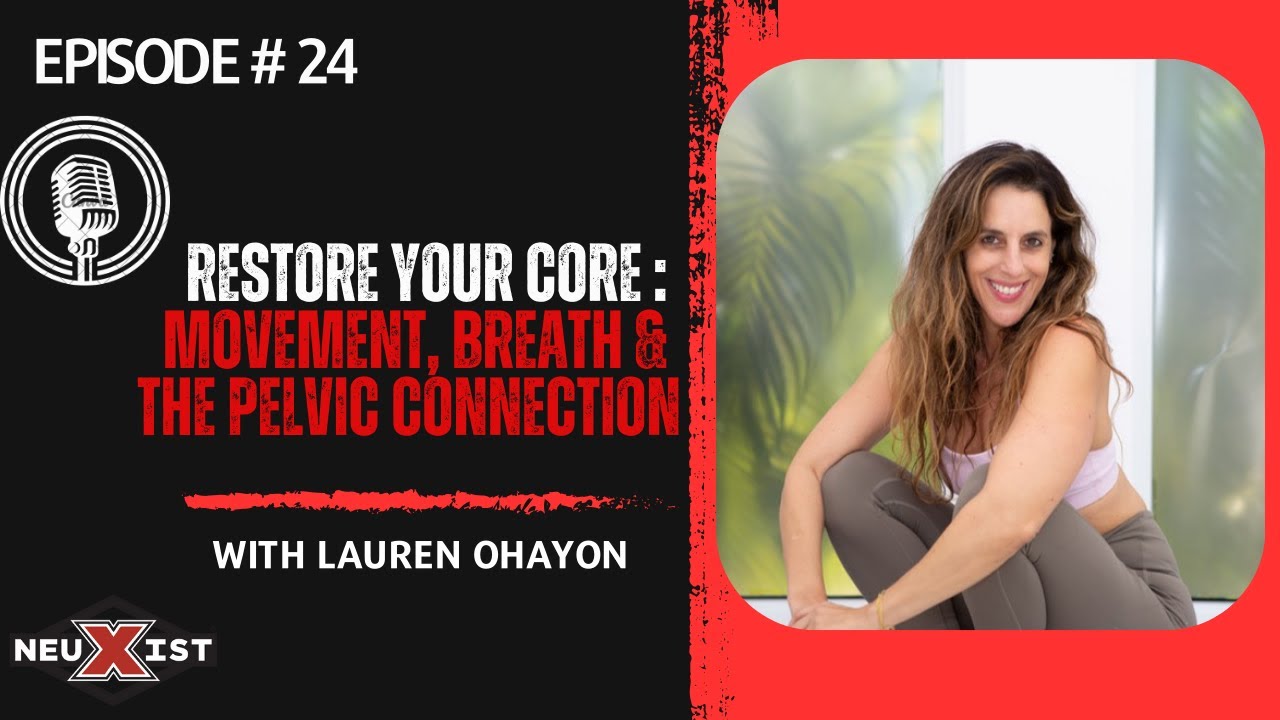
Excel Beyond Boundaries Podcast – Episode 24 Transcript
Restore Your Core®: Movement, Breath & the Pelvic Connection with Lauren Ohayon
Introduction: Meeting Lauren Ohayon, Pelvic Floor Movement Therapist
Jonathan Simos: Welcome to Excel Beyond Boundaries episode 24 with Lauren Ohayon, who is a pelvic floor movement therapist. And I’m honored to have you on today. Thank you so much for joining us.
Lauren Ohayon: Thank you for having me.
Jonathan Simos: I appreciate it. So I wanted to start with taking a way back. Where did you go for the certificate?
Lauren’s Journey: From Yoga to Pelvic Floor Specialist
Lauren Ohayon: So to start, I would say, well, my fitness journey began as a mover. I’ve always used movement as my main form of communication with my life. So between the veil between me and the outside world, the communication – all of that was always via movement. I’ve always been a mover.
Trained formally as a yoga teacher 25 years ago, and I have since done a Pilates training and a bazillion courses. But my first certification and when I first started teaching was yoga.
Jonathan Simos: Very nice. And then how did you get into the pelvic floor educating and all of that?
The Back Injury That Changed Everything
Lauren Ohayon: Yeah. Well, I started – I had a back injury in my 20s. I mean, it really started with my own injury. I was a very, very kind of hyperfle flexible yoga person. I was amazing as a yoga person. And I got my own injury. I was a very, very, very good candidate for surgery, but I didn’t want surgery. I was only like 23. And so I was like, I’m not having surgery.
It took me a year to heal. And so I was literally in bed on and off for a year. It was a really serious injury.
Jonathan Simos: Wow.
Lauren Ohayon: But I did heal myself and it was amazing. I was just – I just got very curious in that year of healing that I couldn’t really move that much. And I was like, why was I injured? I’d like to avoid this in the future. And so I was like, I really teach movement, but I don’t know very much about the body.
And everything I knew had been passed down from my teacher. My teacher said, stand with your knees like this, position your arms like this, now do this with your body. But there was no – if somebody said to me, hey, Lauren, why should I stand like that? I’d be like, I don’t know, because that’s what the teacher told me to do. That’s what I did. Somebody else told me that. That’s right. I really didn’t know.
It was terrible. I mean, it’s not terrible. I think it’s just the evolution of things. So I started by just studying a lot of anatomy and biomechanics and getting to know the body. I was super curious about all of that.
Three Babies, Three Years: The Birth of a Mission
Lauren Ohayon: And then I had three children in three years. Yeah, it was like three and a half years. Then I just kind of started working a lot with pregnant people and postpartum people. And the things that they were coming to me with, like “my physical therapist told me, blah, blah, blah.” And I was like, really? Why would they say that? That’s an interesting way to think about the pelvic floor.
And I realized that the context of the pelvic floor was just “squeeze it and everything will be fine.” And I was like, this just doesn’t make sense. When you actually think about it, when you’re a thinker and you have any even rudimentary experience as a personal trainer, you should know that that doesn’t make sense.
So I was like, okay, that really just doesn’t make sense. Why are we saying that? When we see people walking around with their biceps on in this kind of pattern all the time, we would never say “just contract it more.” There’s no way we would offer that to somebody.
Jonathan Simos: So true.
Lauren Ohayon: Why are we offering that to the pelvic floor? And I think it’s because people have very little understanding of the working of the pelvic floor. So I just got very curious to create a model of care that made sense.
Creating the Restore Your Core® Program
Lauren Ohayon: And then I started kind of dabbling – my online program I’ve had for over ten years. It’s that old, pre-COVID. And I was like, what would happen if I created a program that – because I started joining all these Facebook groups too, and again, became the person who answered all these questions for all these women. It was mostly females at that point, asking all these questions about their body and their pelvic floor. And the answers they were getting, I was like, no.
And it was a lot of confusing fit with function. You know, thinking that somebody with washboard abs has a strong core. Strength has nothing to do with what it looks like on the outside. Somebody can look very strong. But why do athletes have so many injuries? I mean, there’s no correlation between fit and function.
Jonathan Simos: That’s so true.
Lauren Ohayon: And so I created this online program and I was like, I just want to educate women, mostly women, to feel really safe in their body, not to feel broken, not to chase – you know, if you want to be 0% body fat, go for it. I’m not going to stop you, but not to think that that was going to mean strength. That’s how I got into it. That was the evolution.
Jonathan Simos: That was perfect. That was fascinating because I didn’t realize there’s such a disconnect between the industry and specifically that niche, which is so important because it is such a large population. I didn’t believe there were so many misconceptions.
The Prevalence of Pelvic Floor Dysfunction
Lauren Ohayon: One out of three females has pelvic floor dysfunction. And a ton of men contact me for work. They’re like, I think I have pelvic floor issues. One guy recently was like, I asked my doctor if I have a pelvic floor. And he was like, I think you do.
Jonathan Simos: You’re kidding me.
Lauren Ohayon: Doctors deal with emergencies, not necessarily muscles. The doctor told him, I think you should ask your physical therapist that question. And I was like –
Jonathan Simos: Okay, that is crazy though. The disconnect between the medical industry and health, wellness, physical therapy. It’s definitely – would you say it’s definitely getting better?
Lauren Ohayon: Yeah, I think there’s more awareness to it. I do think that it’s – there are certain topics that are very – that are trending, and I think pelvic floor is one of them that is trending in a way. I hope it’s getting better. One would hope.
Jonathan Simos: Well, you definitely – you’re definitely bringing awareness and education. It’s cool to have seen your journey over the years. I took that course long time ago, the Floor Core course.
Lauren Ohayon: Oh, Floor Core? Floor Core course.
Jonathan Simos: Or it was the –
Lauren Ohayon: You did. Yeah, that’s Courtney’s program.
Jonathan Simos: But you were there though.
Lauren Ohayon: I think I did. Yes, I did a guest speaking for them. Oh, okay. Yeah. Yeah.
Symptoms of Pelvic Floor Dysfunction
Jonathan Simos: Yeah, I learned so much, but then sort of following you and then I saw education and everything over the years. I definitely see demand for all of that. I’ve got to ask, what are the symptoms? You said 1 in 3 women. What can women look for to see if they have a pelvic floor issue?
Lauren Ohayon: Low back pain is one of the main symptoms that people don’t even realize. Low back pain is often a symptom of a pelvic floor issue too. Hip pain. And then if we’re talking very locally – local pain with intercourse, difficulty to orgasm, difficulty post-orgasm. Difficulty post-orgasm is a very common complaint for males as well. You know, pain post-orgasm.
Jonathan Simos: Wow.
Understanding Prolapse
Lauren Ohayon: But the male pelvic floor is practically the same as the female, so it makes sense. And I even have males who have prolapse. So prolapse is where the organs descend lower. For a female it’s the uterus – or the uterus, the bladder or the rectum. So the pelvic floor muscles – organs, sorry. They drop lower down and can end up in a female’s vaginal canal.
Some females – a lot of people don’t know this. It’s super interesting. Some females look down between their legs and they’re like, I can see my uterus in my vagina. That’s an extreme case. But we see it all the time. It’s extreme in presentation but not extreme in commonality. It’s very common.
And actually, females can have prolapse, which is again where you have either a mild amount of – the uterus is lower. I mean, the cool thing about the female body is that we can stick our fingers up it. We can get our hands right up into our vagina, which I think is very amazing. I’m excited about that. And at the top you can feel your own cervix, which – males don’t always talk about this with me, but it’s kind of a cool thing that the cervix – and a lot of females don’t spend time knowing where’s my cervix.
But if it goes lower and lower and lower and lower, it’s suddenly all the way down there. You will start noticing and feeling that your entire pelvic organ home is much lower in your vagina. So you might feel pain, pressure, incontinence. People are always like, well, but women are supposed to leak urine. I’m like, are they? Who told you that myth? Why? Why are we supposed to leak urine? Because we have more holes than men?
Additional Symptoms
Lauren Ohayon: Incontinence is another symptom of pelvic floor dysfunction. Again, all the pain with sex, difficulty to orgasm. Some people get very, very close to orgasm and then can’t get over that hump. They just can’t. And that’s incredibly frustrating. That’s another symptom. All of those.
And then with males it’s tailbone pain. Well, females do tailbone pain. Yeah. Pain around your sacrum – low back pain right around your tailbone, sacrum area. Pelvic floor issues. And then males can actually – it’s more rare but they can get a prolapse too.
Jonathan Simos: Wow. This is fascinating.
Lauren Ohayon: I know, I know. And they don’t have a hole for it to come out of. So their perineum – they’re suddenly just like – what is all that pressure on my perineum?
Jonathan Simos: So it’s painful for sure.
Lauren Ohayon: It is very uncomfortable. And we’re not used to feeling that. So then we freak out and then we get more tense, and then it hurts more.
Understanding Intra-Abdominal Pressure
Jonathan Simos: Yeah. Oh, does that all happen over time, just from sitting a lot or what would you say?
Lauren Ohayon: Yeah, it’s a great question. I think about it – I try to describe it in terms of pressure. If you take a ball and you squeeze the ball, literally just take a ball and squeeze the top. The bottom will bulge out and push out. So that’s pressure. If you take toothpaste and you squeeze the top – simple physics, the bottom makes sense. The toothpaste comes out.
So a lot of people have a lot of tightness and tension above. The core canister is literally an air-filled, pressure, volume-dominated system of organs, muscle tissue spanning from your ribcage. Even the diaphragm is right under the heart. The heart sits on the diaphragm. So we’re talking diaphragm – but if you want to think about it as starting with your mouth, because that’s where we breathe in from.
And so there’s all this pressure and the pelvic floor is the bottom. Your body is constantly modulating pressure and movement, coughing, talking. Did you know that when you talk it’s on an exhale? Most people don’t even know that. They’re like, well, if I thought about it, I guess so. But talking happens on an exhale.
The Exhale-Pressure Connection
Lauren Ohayon: Which means if you were to say a really, really, really long sentence to me now without taking any air in, you would start to feel your pelvic floor squeezing at the end, because you are tightening and tightening and tightening and tightening because you’re on an exhale. Exhale, exhale, exhale, inhale, exhale, exhale. And you’re pressing, pressing, pressing down.
Air volume and pressure work hand in hand. The lower the volume, the higher the pressure. So exhaling – you’re decreasing volume, you’re increasing pressure. And so most people who have a pelvic floor issue, it’s not necessarily the pressure caused it, but it’s not helping that they are over-pressurizing their core and pelvic floor constantly, including with speaking.
So a lot of my work is focused on – are you too tight in your shoulders and ribcage and spine and pelvis? Can we just free up the system to get better balance in this whole core system?
Jonathan Simos: Wow.
Lauren Ohayon: Which relieves pressure on the pelvic floor. Yeah. I was kind of done. No worries.
Jonathan Simos: Yeah, that’s amazing because no one speaks on this stuff. You’re literally the only one that I’ve come across who speaks on this stuff. And it sounds like everybody, a majority of people need to know this information.
The Pelvic Floor as Force Conduit
Lauren Ohayon: I would say, I mean, it’s good when your pelvic floor works. And there’s a lot of nerve endings in there. There’s a lot of tissue, there’s a lot of organs, there’s a lot of muscles. I mean, we’re so focused on the core, but it’s the bottom of the core. And when we talk about gait, every step you take, the place in your body where that force is transmitted through the rest of your body is your pelvic floor.
Your pelvic floor is literally the conduit of forces that happen every step you take. So we absorb it in our pelvic floor, and then we transmit it off our pelvic floor. It’s an important body part, but it’s so tied up with shame. So we just don’t talk about it because it’s an embarrassing area to think about for most people.
Jonathan Simos: Yeah, that is interesting. And I love how holistic it is in a sense – how you said it. In order to begin to fix it, you have to free up tension in your shoulders and sort of do a whole assessment overall. What would you say for those who are going to listen? What’s the first step? Once they identify they have those symptoms and of course coming to you. Yeah. What would the first step be if they could do something in the meantime before working with you?
The First Step: Understanding Your Breath
Lauren Ohayon: Yeah. You know, a lot of people – this is a great question. Everyone always wants to know, what do I do first? Or what are the three things I need to do?
A lot of the thing we do most, which we have no control over, is our breath. We have control over it, but it’s also not – you can’t stop, right? You can’t actually die by suicide by stopping your breath. You can hold it for a little while, but eventually you’re going to breathe. And the reason you breathe – most people don’t even know this either, factoid – the reason you breathe is because there is so much pressure from the outside world pushing down on you, that the only way to neutralize the pressure between your body, inside your body, and outside your body is to take an inhale, which increases all the volume and equalizes pressure.
Jonathan Simos: Wow.
Atmospheric Pressure and the Body
Lauren Ohayon: So breathing is – it’s so cool. We are just these cool organisms. I’m so fascinated by the human organism. So yes, we have 14 pounds of atmospheric pressure for every inch of our body. That is a lot of pressure. And so in order to equalize it, we inhale. Every time you inhale you neutralize the pressure between you and the outside world.
So the first place to look at is, I would say, breathing. And when I look at a lot of people who come to me with pelvic floor issues, they’re chronic belly breathers. They don’t expand their ribs at all. They keep their ribs locked down. I see it a lot with athletes too. Their obliques are so tight and so the tension in the obliques is pulling the base of the ribcage down.
And so every time they breathe, they’re just pushing out into their belly – a lot of pressure. And when you belly breathe, you put a lot of pressure down on your pelvic floor. So the first place I would say is learning to breathe in a three-dimensional, expansive way, using your rib architecture. If you look at the shape of the body, it tells us where the breath needs to go. But most people send – well, they send their breath into their lungs, but they do the movement of breath in their belly.
Breathing Properly: Ribs, Not Just Belly
Jonathan Simos: That reminds me – thank you for all of that. That was amazing. So interesting. Is it true that being a chest breather or – I remember reading one of the certifications that a diaphragmatic breathing – chest with your belly button rising and then your chest kind of like a cylinder filling up. Is it true that not breathing properly can lead to your ribcage changing shape and then an array of other issues?
Lauren Ohayon: Yeah, I would say that not using any part of your body optimally will lead to atrophy of that area, right? So people, for example, there’s a lot of people who don’t breathe into the back part of their rib cage. So we would call that the posterior rib cage. So the posterior rib cage back here is designed to move when you breathe.
But a lot of people don’t. So what does that presentation look like? That presentation looks like you’re stuck in an inhale. Your ribs are flared out. Actually, this is one of the most common questions I get in my DMs. People are like, do you know what to do about my ribs being flared out? And they’re stuck in an inhale shape, very kind of big barrel-chested people. And when you watch them breathing, their ribs are not moving at all.
And it goes hand in hand with this pattern of being very extended in their back. So they’re very kind of cut off in their back, very extended, a lot of tension in the thoracolumbar area. And then their ribs are kind of stuck here.
Jonathan Simos: I’ve seen that.
The Flat Belly Obsession
Lauren Ohayon: It’s a very common pattern, especially – you think about how many people want a flat belly. The fastest way to get a flat belly is to suck it all in and to pull your ribcage up. You don’t realize you’re doing that. You’re just sucking. Yeah, you’re just sucking it in.
So definitely I would say that if you are not – a lot of patterns we see in posture really could be the expression of the ribs changing – the ribs and the spine changing the same thing. When you see people really hunched over, they’re not moving breath into their ribs here at all. And so any big postural presentation, I would say, is probably also very, very related to what we’re seeing in people’s breath.
Jonathan Simos: So interesting how just breathing can literally change your life.
Lauren Ohayon: Yeah.
Jonathan Simos: Just breathing, right?
Breathing Creates Spinal Movement
Lauren Ohayon: Yeah. Think about it. The breathing – if you are using your ribs, your ribs wrap around and attach to your spine. So every inhale you take is an opportunity to actually move your spine. And it’s tiny. It’s really minute. But it happens with optimal breathing. And every exhale is an opportunity to release – flex your spine.
So breathing optimally creates a tiny bit of movement through your spinal column, which is not a tiny spot of your body. It’s a long area with a lot of joints, right? So every breath you take has the potential to move your spine, your ribs, your upper body. But if you are not doing that and you’re belly breathing and locking your ribcage down, you’re also locking down your spine.
Jonathan Simos: This is fascinating. I’ve never –
Lauren Ohayon: This is interesting.
Jonathan Simos: Yes. I’ve never gone this deep. I scratched the surface in a couple certifications – how being slumped over decreases energy levels and things like that. But that was about as far as it got. So this is – I’m definitely going to go down a Google wormhole after this. Or check out your course.
Lauren Ohayon: I’ll help you.
Jonathan Simos: No, you’ve been to it. It’s amazing.
Lauren Ohayon: You know where it is. I know it makes life easier.
What Drives Lauren’s Mission
Jonathan Simos: It does. I’m curious. Random question, kind of throw it in the mix. What is your driving force? Because I know you’ve been so committed to your business and serving others. So what drives you fundamentally?
Lauren Ohayon: You know, I got into the work because I wanted to – when I had my injury and I didn’t know what was going on in my body, that feeling of dependency on others. And then who to believe. I don’t know if you’ve ever been there, Jonathan, but it’s like I dug so many holes looking for answers, and I felt like I didn’t dig any hole going deep. It was like many shallow holes looking for water, but I just needed one deep hole. And it took me a while to find that place, which I think is part of the evolution.
Education as Empowerment
Lauren Ohayon: I want people to – I think that education is empowering. And I want people to have – especially I work with women and females, and I make that distinction because I work with people primarily who identify as women. I work with a lot of females. But if you identify as a woman and you have the cultural kind of issues that come along with being a woman, I talk a lot to that because us women who identify as women – it’s not easy, right?
We are not given basic information about our bodies. We’re not told about pleasure. We’re not told what to do when it goes wrong. My 19-year-old daughter regularly calls me. She’s like, “Mom.” She gives me the phone. She’s like, “Mom, talk to – ” And then it’s a friend. “Talk to Jody.” Let’s just say Jody’s having pelvic floor issues or Jody’s urine is brown. What does she do? Or Jody has had a boyfriend for six years and has never had an orgasm. Can you help?
It’s amazing. My daughter calls me from college. I’ve become the sex therapist of her and all her friends.
Jonathan Simos: That’s amazing.
Empowered Youth Make Better Choices
Lauren Ohayon: Oh, I love it. I love it. And they make really good, smart choices. Kids who are sexually empowered, believe it or not, don’t go chasing sex. They are so empowered that they’re like, no, they need to work to get this. This is beautiful.
Jonathan Simos: That is.
Lauren Ohayon: It is beautiful. So I’m always kind of teaching females and women about their bodies. And so I think my drive is – you should know everything there is to know about this organism. This is a beautiful biological, cellular organism. It’s so powerful and magical. You could say it’s magic and miracle, but it’s actually just this scientific wonder and you deserve to kind of know about it.
So I try to just make information that’s been kept secret more freely available. If you’re struggling to orgasm, here, let me help you. I’ll help you out. So yeah, I would say my driving force is empowerment and education, which ultimately leads people to feeling safer in their bodies.
I look at my three daughters and they are very safe in their bodies. I can just see it. They just feel safe in their body. It’s beautiful to see.
Jonathan’s Personal Experience with Injury
Jonathan Simos: I love that because you’re right, there’s – we’re not taught fundamentals that we should be taught. I remember, this is a small example, but it kind of correlates – growing up, I didn’t know how to work out. And I learned through trial and error, had imbalances, injuries, lower cross syndrome, really tight hip flexors. Glutes turned off, and no one knew what it was.
I would tell people I couldn’t feel my glutes when I’d work on my legs. No one made the connection. And so I had injuries – quad dominant, slight hamstring tear, iliotibial band syndrome. And I could not find the answers. And it’s amazing that now people like you are focusing on what needs to be shared and bringing that to light. So thank you. Seriously.
Lauren Ohayon: Thank you for sharing that too. Yeah, it sucks to be hurt and not know which direction to go. And that the answer that’s thrown at you is “take an Advil” or “have a glass of wine if you’re a woman.” “Have a glass of wine” if you’re a woman is the favorite thing that they say to us. “Take an Advil” or “here’s a surgery.”
Jonathan Simos: That’s so true. It’s so corrupt. Unfortunately.
The Problem with Surgery as First Line of Defense
Lauren Ohayon: Yeah. And it’s like, okay, I’ll have surgery. But first, could we talk about the options? Sure. Okay, maybe, but let’s talk about all the other options. You know, a friend of mine just gave birth – a cesarean birth, which is sometimes very needed but oftentimes not. And I said, oh, did you ask the doctor what your options were? And she was like, no, I didn’t even think I could.
Jonathan Simos: They didn’t even provide other options.
Lauren Ohayon: Didn’t even – she didn’t even say, yeah, do I have any options before we do this? And then when they read through her medical records, she was like, there were so many things that could have been done before a cesarean birth. But it was like that was the default. And the doctor said to do it and you’re lying in a hospital bed feeling vulnerable. Not to mention you’re in labor and you care about the baby you’re carrying. You’re not going to go against what a doctor says.
The doctor says – I have so many clients who cancel their surgery on their pelvic floor after working with me because they’re like, oh, I didn’t even know there was another option. And I’m not here to poo-poo surgery. I had spine surgery two and a half years ago. I’m so grateful I did. Thank you, surgery. Thank you, surgery. But I think that it’s not necessarily a first line of defense the way we are using it as one.
Jonathan Simos: So a time and a place, but not the first option.
Lauren Ohayon: Oh, no. No. I don’t think most people probably don’t need the surgeries we’re giving them.
Postpartum Recovery After C-Section
Jonathan Simos: Oh, yeah. I’ve heard a lot of horror stories in that sense. I’m curious – my brother and his wife, they just had a baby, and she had a C-section. I’m curious with that. Is it more – C-sections, more recovery time than natural birth, right? And is there anything that people who get C-sections can do to expedite that healing?
Lauren Ohayon: Yeah, I would definitely not expedite the healing if I were you. I am a big fan of – there are certain things in life that we just can’t expedite. But I think what you’re also saying is, what can we do to make sure she’s healing well? Yes. Yeah. I mean, because you can’t rush tissue adaptation, right?
And when you’ve had a cesarean birth, it’s a big deal combined with childbirth, which – now you have a uterus-sized wound in your body and you’ve had a C-section, which is one of the most intense surgeries out there. People don’t realize that because it’s so routine. It’s actually a really intense surgery. They – yeah, it’s intense.
So I don’t know if you’ve ever watched a cesarean birth. You can watch them on YouTube. It’s fascinating to see. But you’re like, they just did that to her. It’s amazing to see. It’s really amazing. And then suddenly they pull a baby out of the belly. It’s incredible. Yeah, it’s a great technique, lifesaving and everything.
The Importance of Walking and Rest
Lauren Ohayon: But so I would just say walking and resting are your best – what I see is that people go back to working out too fast, too hard, too soon. So I get a lot of people who are postpartum injured from working out too fast and wish that they had just taken it easy for the first three months.
So I always tell people, natural movement is actually how we evolved. Can you take a walk and pick something up off the floor and maybe, six weeks later after six weeks, clean your house a bit? That’s a workout. That’s a great way to stimulate your core and pelvic floor without suddenly throwing weights around. So I like people to start with just walking and then more natural movement type stuff.
Jonathan Simos: That’s great advice. Natural movement. Instead of rushing into the gym, I love that. Yeah. So simple. So practical.
Lauren Ohayon: Yeah. Take a walk and squat down and pick up a rock and then throw the rock – not at somebody or a car, but just do something. Play ball. Take a light ball and throw a ball with your partner for a little while. I mean, there are so many things to do that aren’t like – I just see so many people regret getting back to the gym so fast.
Jonathan Simos: Yeah.
Even C-Section Babies Affect the Pelvic Floor
Lauren Ohayon: Your tissues – even if you had a cesarean birth, you still had a baby in your pelvic floor. So people who’ve had a cesarean birth still have pelvic floor adaptation to that birth, even if the baby didn’t push out all the way. There still was a baby with its head right there and your pelvic floor was getting ready for that.
So there’s a big change in your pelvis. The shape of your pelvis changes when you’re pregnant. So postpartum, you really just want those tissues to start coming back together. And if you are stressing them and loading them, not ideal. I wouldn’t do that.
Jonathan Simos: Yeah, that’s – the body is just amazing.
Lauren Ohayon: Oh, it is amazing.
Jonathan Simos: It can do so much.
Lauren Ohayon: It is amazing. It is also amazing how much pressure we feel to make it look a certain way so fast. People who’ve had a baby feel a lot of pressure to get their body back.
Social Media Pressure on New Mothers
Jonathan Simos: Unfortunately does seem that way. And of course, being a mother, you know more than me. Is it society impressing all of that?
Lauren Ohayon: Yeah, yeah. I mean, and then you see these influencers who are like, had a baby two weeks ago. And you know, great. But some people had a baby two weeks ago and don’t look like that.
Jonathan Simos: It’s like –
Lauren Ohayon: It’s just so hard. It’s not easy.
Jonathan Simos: It’s funny you say that because all I’ve been getting is those. My girlfriend actually is pregnant, and –
Lauren Ohayon: Wow. Congratulations.
Jonathan Simos: Thank you, I appreciate that.
Lauren Ohayon: Oh my goodness. Yeah.
Jonathan Simos: Thank you. And we actually – we haven’t announced it yet. My family knows. But by the time this episode releases, we’ll have announced it. But she searches all the time and they’re all like pregnancy rules. And so I’m starting to get them in my feed on Instagram. And I see exactly what you’re talking about. It’s like these pregnant women, before, after, lifting. I understand what you’re saying completely.
The Toxicity of “What I Eat in a Day” Content
Lauren Ohayon: “What I eat in a day to gain 30 pounds when I was pregnant.” And it’s very toxic. I mean, it is. And sometimes it appears to be healthy content, but it’s actually not healthy. “What I eat in a day” is not healthy content.
Jonathan Simos: So it really isn’t ever.
Lauren Ohayon: Ever, ever, ever. I just don’t think “what I eat in a day” – if we’re talking about health, that’s not healthy. What I ate in a day is not what you eat in a day. And the hyperfocus on what I ate in the day – and it’s usually next to somebody who looks like they haven’t eaten in a week.
Jonathan Simos: That’s so true. Everybody has different dietary needs, preferences. That’s so true, so true.
Lauren Ohayon: So a lot of pressure. Well, good luck to your partner. That’s amazing.
Jonathan Simos: Thank you. That means a lot.
Lauren Ohayon: Good luck to you.
Jonathan Simos: Yeah, thank you.
Lauren Ohayon: It’s exciting. You’re going to have a 15-year-old babysitter in the house too.
Jonathan Simos: Yes. Yes. Fortunately he’s very good with kids. Yeah. He’s used to having babies, little kids around on the other side of the family.
About the Restore Your Core® Program
Jonathan Simos: But I’m curious to ask you – your course, Restore Your Core®. That is specifically for women? Men as well? Or mostly women, the 1 in 3?
Lauren Ohayon: Men do it. Yeah.
Jonathan Simos: Awesome. And that’s to help them with the pelvic floor dysfunction? So exercises?
Lauren Ohayon: Yeah, I would say it’s for anybody who has a pelvic floor and wants to optimize the system because we all have a pelvic floor and it is part of a very important system of support of the body. But I would say that specifically, it’s a bodyweight-only program. There’s no lifting weights.
I think that a lot of people – and I’m a big – I lift weights, I love weights, so I’m not against weights at all. I think women need to lift weights, but I think that a lot of people are lifting weights without a strong base and foundation.
Jonathan Simos: Yeah.
Building Foundation Before Adding Weight
Lauren Ohayon: And so I get a lot of people who are like, I started lifting weights last year and I was so proud of myself. And then I got a prolapse. And I’m like, oh yeah, because it’s pressure. If you’re not able to handle the load – again, it goes back to load and pressure and what our capacity – the capacity of our tissues is based on use.
So yeah, I would say it’s for anybody looking to optimize their core and pelvic floor in a really progressive, mindful, intentional way. There’s no shaming language. You’re not going to hear me being like “one more rep.” There’s none of that. It’s very – it’s a gentle approach, but it is a physical approach.
And I think a lot of people think of core and pelvic floor rehab as lying on your back doing dead bug exercises, but you don’t live your life lying on your back. Mostly you live your life moving around your life. So it’s a lot of lunging and squatting, but not again in this intensive way. It’s learning to do these skills with your core coming along for the ride.
Never Cue the Pelvic Floor Directly
Lauren Ohayon: And I think people always say to me, oh, should I engage my core when I squat? No. Or should I engage my pelvic floor when I squat? And it’s like, no, you should engage your pelvic floor never. Your pelvic floor will always follow your core and your breath. If you are focusing on optimizing alignment, form, posture, breath and core, you can assume your pelvic floor is going to be pulled along there. The pelvic floor is responsive to the core and breath.
So if we can just optimize and tweak the core and breathing, my focus – the focus of my work is very core and breath. And by default then your pelvic floor starts doing what it needs to do. Whereas a lot of programs are like “squeeze the pelvic floor, release the pelvic floor, do 500 more of those.” And it’s like, when you open the door, do you tell your biceps to work? No you don’t. They work. They just do their job.
So we leave the pelvic floor alone in the program. But it is a pelvic floor program. But we’re not tightening it and squeezing it.
Jonathan Simos: No, that makes sense. And I love that approach because it’s not isolated and it’s not bodybuilding. And then focusing on that pelvic floor in that sense – that needs to be integrated with natural function. And the further we get from that, it’s true, the more issues there are. So true. Yeah, I love that.
The Problem with Over-Cueing in Yoga
Lauren Ohayon: Yeah. In yoga there’s a huge focus on engaging your pelvic floor for a lot of the exercises, and you’re guided in a yoga class to keep your pelvic floor engaged the whole time. And anecdotally, a ton of my clients are long-time yoga teachers and yoga practitioners whose pelvic floors are so gripped and tight and don’t know how to be in that flow state, responsive to just natural human movement.
Jonathan Simos: Oh, yeah. Wow.
Lauren Ohayon: So yeah.
Jonathan Simos: So much to unpack. Already, about 30 minutes in and there’s so much.
Lauren Ohayon: I can talk forever.
Understanding Body Tension and Patterns
Jonathan Simos: So many directions to go. Interesting. Wow. I’m curious. Random question, but I have worked out my whole life, and I’m stiff in certain areas. I feel like I often feel like my core – and I’m saying this because many can relate, I’m sure. But I feel like my muscles are so tight that sometimes when I breathe, it feels almost like restricted in the sense that – in my head, is that actually – tell me.
Lauren Ohayon: No, no, but nothing’s in your head. But wait a minute. First of all, here’s the good news. The good news is that you’re in a feedback system with your body, where something is being felt and you’re feeling it. I work with a lot of people who wouldn’t be able to describe what you just described because they’re not feeling their bodies. They’re very dissociated, very disconnected. So the fact that you’re feeling your body while it’s doing what it’s doing is amazing. That’s amazing.
Your Body Normalizes Patterns
Lauren Ohayon: And yes, it could be that you are – a lot of what we do in our bodies are patterns that we’ve developed by going through life and patterns that your body is not necessarily mirroring back to you. It’s not like every night you get a summary of your patterns, right?
Your body does what it does best to survive. And in order to survive, what it has to do is normalize everything you do so that you are almost in robotic operation mode 99% of the day. If you walked into a chaotic house and all you were was sensing and feeling and smelling and experiencing the chaos around you, you would go crazy, right?
There’s a reason why you walk into a room when someone’s been baking banana bread, and in five minutes you don’t smell it anymore, but the smell is still there. You’re just not smelling it anymore because you’re used to it. So your body gets you used to your processes very, very quickly and stops telling you.
But then sometimes you feel that stretch and you’re like, wait, why do I feel such a big sensation or restriction? Whatever you’re feeling and you’re like, God, I feel so restricted in my core. It’s probably a pattern that you are definitely in regularly that helps you cope somehow.
Patterns as Coping Mechanisms
Lauren Ohayon: Maybe it’s a pattern because – and this is conjecture, this is not about Jonathan – maybe you sucked your belly in a lot as a kid because you were bullied. Who knows. Maybe your parents – I’m not talking about you now. Maybe Joe’s parents screamed at him all the time as a kid, and his reaction was to tighten and tense up. Maybe Joe just chose to work on his abs extensively, but not necessarily do whole body integration movements. So he has created these very isolated, tight abs, and that’s what is being experienced.
It’s so hard to know, but I would say that if you are feeling restriction, there is restriction. But I wouldn’t also say that’s a bad thing. Finding restriction in your body should be exciting because it shows you that A, you’re feeling, and B, you’re aware of this pattern that’s supposed to be kind of numbed and muted.
So if your body is whispering and then screaming, I would listen to it and just use it as this opportunity to see how you can change this pattern and be excited that you’re not just numbed out to all your patterns.
Jonathan Simos: I love the way you made me also realize – you kind of turned it around in a sense. It’s all positive about – you’re right, a lot of people aren’t body aware. So that is true. To be grateful to have that level of body awareness, to know what’s going on. And then the adaptive tightening might not necessarily be a bad thing, but to be aware of it. That’s wow.
Jonathan Simos: Yeah.
Learning New Things Keeps the Brain Sharp
Lauren Ohayon: And it’s like, you know, if I started jiu-jitsu tomorrow, probably the jiu-jitsu class would be really hard for me. And so maybe if I was a different person, I’d be like, I’m quitting. This sucks. It’s hard. But me, I’m always looking for what’s hard because I’m always like, if it’s hard today, it’s because my brain doesn’t know it.
And I know that our brains thrive off learning curves. Our ego hates learning new things, but our brains love being dumb. Our brains love not knowing, and then learning. That is how you keep your brain sharp – learn new things all the time.
So for you, it’s like, use this as an opportunity to learn something new about your body. Go down the rabbit path of what is this and why is this happening? And be excited to figure it out rather than bummed out that something is wrong with you because nothing’s wrong with you. You’re in a human body that’s giving you feedback. I mean, that’s pretty awesome.
Jonathan Simos: That mentality. Everyone needs to adopt that mentality, that mindset. I’m going to remember that.
Lauren Ohayon: Having had multiple injuries now on this journey.
Jonathan Simos: That is cool though. I’ve never thought of it from that point of view. But you’re right. We’re in a human body. Things happen. Things change.
Lauren Ohayon: Yeah.
Jonathan Simos: Oh, well, I’m going to have to rewatch this and really think about everything you shared. All this insight. So much value. Thank you. Seriously.
Lauren Ohayon: You’re welcome. Thank you.
Lauren’s Morning Rituals and Habits
Jonathan Simos: You’re welcome. Let’s jump in around a little bit. I’m curious. Do you have any specific morning rituals or mental exercises that you do?
Lauren Ohayon: Yeah, a few. I mean, my morning ritual – my biggest ritual in life is that I am a habits soldier. I am a soldier of habit. I am committed. I do not believe in motivation. Motivation gets you to the stadium, but discipline takes you to your seat. So it’s fun to be motivated, but it dies down fast.
So I wake up at 5, I have a coffee, I walk my dog for two miles and then I work out sometimes. So four days a week I do a strength training workout and then three days a week I do mobility. I do not take days off working out ever. I do not. But I also – I would say I do not take days off movement because we are sedentary. Life is a day off movement. We live our life not moving. So I try to do some form of movement seven days a week.
And so yeah, I would say my morning ritual is self-care for the first two hours, which is really privileged. I will start with that. I have designed my life having three children that I do get two hours to myself every day. But if you don’t get two hours to yourself every morning, you can get five minutes. I always tell people, one minute is perfect. I spent 20 years figuring out how to get two hours.
Jonathan Simos: That makes sense.
Lauren Ohayon: Yeah, my kids are 19, so it’s taken me 20 years to figure this out. But I get two hours to myself every day. I self-care like it’s nobody’s business.
Not Buying Into Emotional Stories
Lauren Ohayon: And then my biggest mindset thing is that I don’t believe the stories, the emotional stories that my mind wants to tell me. So I’m really good at witnessing story and not buying into hysteria. And I’m really good at just being able to witness – if my back hurts, it doesn’t mean my back is broken.
I can just witness. This morning I was doing these deadlifts and my back was pinching, so I put more weight on the fucking bar and then my back stopped pinching. And I’m not saying that if something hurts, go harder at it. But I understand pain science and I felt like my body was giving me a false feedback loop. So I wanted to test it. So I went heavier and I was right. I was testing a pain science theory that I’m pretty sure was happening to me.
But my point is, most people would be like “my back – oh my god, deadlifting is bad for me. I should never deadlift.” I had surgery two and a half years ago. I felt pinching. I felt that pinching two years ago before I had surgery. “The pinching means I’m doing something – oh my god, I need to call my physical therapist.” Hysteria. Catastrophe.
I’ve not catastrophized events in my body and I literally try to just witness things regularly. And it is my favorite life tool.
Understanding Pain Science
Jonathan Simos: That is great advice. Wow, so much there. But I’m curious. I want to pinpoint – I love how you put that, the false alarm that you got. You said you wanted to test the theory. What was the theory?
Lauren Ohayon: That pain is a warning signal, and it doesn’t mean that there’s something wrong with your tissues, or that there’s something wrong with the barbell or the move. Nothing’s wrong with your tissues, the barbell or the move. Your brain is perceiving threat. And it’s doing what the brain does, which is warn you, which is what pain is. Pain is nothing more than a warning unless you’ve just been run over by a truck.
Jonathan Simos: That makes sense.
Acute Pain vs. False Alarm Pain
Lauren Ohayon: Oh yeah. Yeah, yeah. Or you’ve been burnt. I mean, or a dog bit you or something like that. Or you cut yourself. Most people who are feeling a twinge of pain in a movement panic and think that something’s wrong. It could be. It definitely could be. I dropped a weight on my toe the other day. That was something wrong, right? I definitely did something wrong in that moment. But that’s an acute pain story.
But a pinch in a movement doesn’t always imply that the load is wrong. It could be that your brain is falsely tricking you into a pattern that it’s used to going down. Remember I talked before about how the brain creates familiar patterns?
If you ate sushi as a boy, as a young kid, and you vomited your brains out, every time you see sushi, you might feel nauseous. But how do you explain that you didn’t even eat it yet? Now you’re nauseous. This happens to people all the time. How do you explain if you’ve been in a car accident and now you’re the passenger, you start getting clammy and sweaty. There’s no threat. You’re just sitting in a car.
The Nervous System’s Warning Strategies
Lauren Ohayon: So our bodies create familiar warning strategies to protect you, because our nervous systems are amazing, but they’re not necessarily up to date with the reality of our life. So the reality of my life is that sushi is not going to make me sick. Maybe it made me sick once, but I don’t have to get nauseous when I see sushi.
So the same thing with the barbell. I was like, okay, I feel a pinch in my back because my old pattern before I had surgery, the injury that I had then would produce a pain when I bent over. So bending over to pick up the barbell, you’re bending over. And every time I would lift the load off the floor, I would feel the pinch.
So I just thought to myself, what would happen if I – I don’t know, go heavier and see what happens? So I was like, I’m just going to put 2 pounds on each side just to test. And in fact, the first three reps were hard. But by rep eight I was done. There was no more pinching.
Jonathan Simos: That is so cool.
Lauren Ohayon: The pinching had gone away.
The Benefits of Being Drug-Free
Jonathan Simos: That is so cool. I think the nervous system is – the mind is fascinating, but the nervous system – I have been drug-free my entire life, which – my point is coming from that – I feel like being drug-free, tell me if you disagree, but I feel like it’s allowed me to become more body aware. There’s so many people – and it speeds things up, makes muscles too strong, too fast, connective tissue weaker, not hitting – bodybuilders, friends in that industry who takes drugs.
But anyways, my point is that it’s amazing being drug-free because the body – I’ve never had any traumatic injuries. And I attribute that to being body aware and attribute the body awareness to that longevity, that slow progress. And I remember some situations where I’d have a pain, like you were saying, and I never looked deeper into it. So this is so fascinating what you told me.
A pain where it would be almost like a warning. And I’d immediately either adapt or kind of warm up a little better and then it wouldn’t bother me. So it’s almost like the brain was like, you know, I remember this, don’t do it. And then you kind of calm it down and then you can go.
Training the Brain vs. Reinforcing Fear
Lauren Ohayon: And I think there’s different ways of calming the brain down. One way is to be like, okay, I’ll just go lighter, but then you’re actually just reinforcing – so in the moment you calm the brain down, but you don’t break the actual association. You don’t train the brain to feel safe in that environment.
It’s like somebody who’s afraid to go in water. You could just stand at the water’s edge and look at it, and you might think that you are giving your body what it needs because you’re not scaring yourself. Or you could train yourself to build tolerance to the water. So I’m not saying go dunk your head. I’m saying, what would happen if you just let the water rush over your feet?
When I put a heavier weight on my barbell, I literally just did 2 pounds, two and a half pounds per side. We’re not talking craziness, but I was like, I know this is not about the load I’m using, and I know it’s not about the movement I’m doing. It’s about my brain being worried. And if I take more weight off, I’m going to tell my brain that that was a threat. I’m going to reinforce the threat.
And other people would be like, no, that’s self-care. And I’m like, that’s not actually self-care. That’s staying in a tight little box. If you want more resilience, you need to increase capacity. And this is nervous system too. The way you can increase capacity both in muscles and in resilience is you actually figure out the least – the most meaningful, tolerable dose, and you go from there.
So again, you get your toes wet. You then maybe three months later, get your ankles wet, maybe three months after that, get your shins wet. So I think that what people do is they think they’re self-caring when they’re like, oh my God, this hurts. So let me just do a different exercise. You actually just told your body that that move is dangerous without meaning to.
Jonathan Simos: I never thought of it that way. Yeah. Reinforcing certain patterns.
Lauren Ohayon: Yeah, yeah. Telling your brain that it was right in threatening you. And next time that threat’s going to come right back.
The Nervous System Adapts
Jonathan Simos: That’s – I love how you said pushing limits in a sense, pushing boundaries in a sense, because with lifting heavy with low reps, I love how the nervous system adapts, where if you do overload – when I was lifting really heavy in the positive phase, the third set would always be easier. Or doing like a rack pull, rack push overload.
Lauren Ohayon: Crazy, right? That’s why. Because your brain’s like, I know where he’s going with this. It’s safe. The mountain lion didn’t tear him to pieces. We’re safe here. Your brain just cares about – are we safe here? So crazy when you show it that you are.
And don’t forget, by the time you get to that third set you are amped up. Now you’ve got a cocktail of hormones helping you out. So your own biology is reinforcing the safety because your biology is like, this is freaking cool, man. I’m on my – how cool am I? This is amazing. You’re in a positive space. Everything positive is happening. So you’re not feeling pain.
Jonathan Simos: Oh yeah. So interesting how once the governing agent – it’s like, okay, you’re good. The body is like, we got this.
Lauren Ohayon: It’s the brain and nervous system, and then the mind just tries to get in the way. So that’s why I’m always like, put the mind away. Just lock it up a little bit.
Jonathan Simos: Lock it up. That is so interesting. Fitness truly is holistic.
Lauren Ohayon: Yeah.
Jonathan Simos: Oh, wow.
Movement vs. Fitness
Lauren Ohayon: That’s why I like talking about – I like the word fitness, but I prefer the word movement.
Jonathan Simos: More holistic in a sense in that word itself.
Lauren Ohayon: I just think movement – not all fitness movement is fitness, but all fitness is movement. So to me, movement encompasses a lot more. There’s a lot more possibility within the word movement as fitness is very targeted. I like it, but it feels limiting in a way.
Jonathan Simos: That’s a good point. And you’re offering so many new perspectives. To be honest, I’ve never met someone who has so much insight and perspective because I’ve loved fitness growing up in it. But I’ve never thought about these things in that light, in any of those perspectives you provided.
Lauren Ohayon: So thank you.
Jonathan Simos: It’s very – it feels like a paradigm shift for me. This is very fascinating.
Lauren Ohayon: I appreciate that.
Gym Pet Peeves and Body Comments
Jonathan Simos: Oh, absolutely. This question is not a very deep question, but it’s a funny question. And we’re sort of reaching the end. Yeah. What is your biggest gym pet peeve? In a gym setting, maybe a commercial gym. Do you have any specific pet peeves that you –
Lauren Ohayon: It’s a good question. I work out in a really small boutique gym with like three people. I would think that I would probably be grossed out by having someone’s sweat all over a machine that they didn’t wipe down. I would assume that that would probably be a pet peeve of mine.
Or someone commenting. I get – you know, sometimes at the gym I’m at, people will try to comment on either “you look like you’ve lost weight” or – I’m not big on body comments. And so – yeah, this guy last week was like, I think you’ve lost weight. And I was like, I was like, I don’t know, I don’t weigh myself. He was like, oh yeah, your face looks thinner. And I was like, okay. But in my mind I was like, why are you – like, why? Why are we –
So we’re so trained to comment on something, especially looks, especially someone’s body. You look thin. You look good. Oh, you look thin. You look good. You look thin and good.
So that would be a – and I find it happens in a gym setting often where people obviously are commenting on each other’s bodies because there’s this assumption that you’re at the gym to change your body. I go to the gym to reinforce to my body that it’s a body. I’m not there to change things. It’s nice having adaptation, but I go for very different reasons than most people. So I think all the commenting is definitely a pet peeve.
Jonathan Simos: That was a deep answer and another perspective change for me.
Lauren Ohayon: What is your pet peeve?
Jonathan Simos: Started with a shallow – no, no, no. It’s all about going deep with this. I appreciate that. That is a more fun question, but I’m glad you took it there because that also changed my perspective. You’re right. Most people go to the gym for superficial reasons. Yeah. And therefore their interactions are superficial. But we all should have a deeper reason. And then it wouldn’t be as aesthetic-focused if we had a deeper reason to be there.
Lauren Ohayon: Yeah. You’re just exercising your human power. You’re just putting your human in a new environment and giving it some tasks. It’s like walking the dog outside. It’s just doing something new with your human.
Jonathan Simos: Yeah. No, you definitely put a lot of thought into all of this. Seriously. That’s interesting. Next time I go to the gym, I’m going to be looking at everything differently.
The Coolest Gym: Obstacle Course Racing
Jonathan Simos: What is the coolest gym you’ve ever been to, would you say?
Lauren Ohayon: I used to go to an obstacle course racing gym and I loved it. It was so much fun, like American Ninja style. And it was really amazing. Climbing nets and swinging on ropes and jungle gym and swinging across things. And the guys who owned it had created this incredibly unique environment. And a lot of people there ran the Spartan races also. So it was very much American Ninja training style.
But I went there just being like, I’m just going to use my human in a different way. And it was fun. I just loved – I had never been a runner. They’ve made us run. I had to run. I would never choose to run. So there was just a lot of fun. It was – it made working out interesting and fun.
Jonathan Simos: That’s cool. What was the name? Do you remember the name?
Lauren Ohayon: It was called – they closed. Well, they closed down that iteration. It was called Focused Movement Academy here in Miami, FMA. And then now it’s called I think Warrior Kids and it’s mostly a kids – my daughter is actually about to start coaching there.
So my kids were there because I believe that the best exercise for kids is human movement exercise. So climbing things, swinging off things, jumping into walls, jumping off of walls. My daughter is going to start assistant coaching this week.
Jonathan Simos: That’s amazing. Yeah, I hope it works out. We’ll see. That’s great. Congratulations. Following in your footsteps in the industry.
Lauren Ohayon: Maybe there’s –
Jonathan Simos: I’m always looking for gyms like that. Because you’re in – I’m in Sarasota. I love this city. Beautiful city. If you haven’t been, it’s everything. But there’s so many commercial gyms. I have friends who have a couple smaller and more flexible places, but there was one gym that had obstacle, Ninja Warrior stuff, about 30 minutes away.
Lauren Ohayon: Yeah.
Jonathan Simos: But it’s hard to find. They don’t really have anything like that around here, and it’s so cool. It’s very functional. I love that stuff for sure.
Lauren Ohayon: I think it’s a hard sell because people are used to a gym workout format.
Jonathan Simos: 100%. When I was coaching there, it was a very small class for the OCR classes and the Ninja Warrior classes.
Lauren Ohayon: Yeah.
Jonathan Simos: And it’s fun, but very small.
Lauren Ohayon: Yeah, I think it’s amazing. I love – they almost shut down a few years ago. Super bummed out. I don’t work out there myself anymore. But it was amazing for my kids.
Lauren’s Approach to Nutrition
Jonathan Simos: That is cool. Yeah. Yeah. This is also – two more questions for you. One is for nutritional side. Do you have any specific diet that you follow or like Mediterranean diet or –
Lauren Ohayon: No, I haven’t. I don’t. I used to be a strict vegetarian and now I eat fish. But I am someone who has been – I don’t want to say anti-diet, but I didn’t grow up in a house with a scale. I never weighed myself. My mom never weighed me. My mom never made weight an issue. My mom never counted calories, my mom never read labels.
So I kind of went through my whole life avoiding all of that. And my kids too. My kids are very sensitive to being around girls who read labels. And I totally understand the other side of it, which is here in America, we have a crappy diet, and it’s a really good idea to know what you’re putting in your body. But when you’re putting edamame in your body, I don’t really need to be reading a label. You only need to read labels if you’re actually eating food that requires label reading. That should tell you something already about what you’re eating.
So I’ve always just – yes, had a very – I am Mediterranean by background. I’ve always had a very Mediterranean diet, if you put it that way, but I’ve never actually had a diet or weighed myself or none of that. It’s kind of against what I do and believe in.
The Harm of Diet Culture
Lauren Ohayon: I do believe that diet culture has made a lot of people feel very unsafe in their body, and I do believe that a lot of people dish out health advice based on how the human body should look, or how they believe the human body should look. So I think that – and I just work with so many people who have disordered eating patterns.
I see my daughter’s friends – 99% of them have disordered eating by age 12.
Jonathan Simos: Terrible.
Lauren Ohayon: Any sort of restricting food is disordered. Your relationship with food changes when you count calories, restrict – all of that. I get why people do it. I fully understand, but I did macros tracking for two weeks because I was wanting to see my protein intake and it took me months and months to heal from the trauma of it. I was like, oh my God, this cup of cottage cheese that I would normally just shovel down, followed by bread, followed by this – suddenly all I could see it in was that’s 200 calories, that’s 400. And it was awful.
I love food. I don’t want to think of it that way. I actually love eating. And so – and again, maybe I have privilege because I am on the thinner side. But I don’t try to be thin. I just live a lot and I move a lot and I don’t drink too much, I don’t do nothing too much except for maybe move.
So I think that for me, my relationship with food has always just been – I don’t want to taint it. And those two weeks of just writing down everything I ate and then seeing it reflect in how many calories – I was like, this is wrong, this is wrong. This is so wrong for me. For me, it’s wrong for me.
Jonathan Simos: Yes.
Living in Balance and Rhythm
Lauren Ohayon: So I definitely don’t have a diet or follow anything besides the fact that I eat a lot of protein and veggies. I don’t really crave Chick-fil-A, no offense to people who do. Yeah, it’s not – I didn’t grow up in America, so I didn’t grow up on fast food because I didn’t grow up in America. So I just grew up with maybe a very different diet that I’m just not drawn to. Me and my sister, neither one of us is drawn to a junk food American diet.
Jonathan Simos: I was going to say, I agree with you 100%. I’ve actually never tracked anything either, because I feel like your body tells you. I feel like when you’re hungry, you eat. If you’re craving something salty, maybe you need some more sodium. I feel like your body tells you. But I know there’s a time and a place for it for people who are – but it does develop certain bad habits because my girlfriend was telling me how she did a bikini competition, and she got so used to tracking everything, and it was so hard to break free of that. And she was saying the same things – it messed with her. And it was hard to break that pattern. So I agree 100%. There’s a time and a place, but generally if it’s not needed, your body tells you.
Lauren Ohayon: Yeah, balance. Just live in balance. Just be – when you are well-balanced in all the systems, right? Emotional, nervous system, sleeping – when it’s all dialed in and tracking is a great way to mess up your nervous system and be dysregulated. And stress is the number one killer.
Jonathan Simos: Interesting.
Lauren Ohayon: When you are tracking – some people, it makes them happier because they like to know. Knowing how many calories they eat makes them happier, but it doesn’t really make you happy. Maybe in the moment it makes you feel better. But that is not a natural way to be. There’s nothing natural about that. There’s nothing natural about obsessing over every calorie in your body. That’s not right. And that you don’t trust that you don’t trust that you can live without that app, that you can just make choices for yourself that are right and healthy.
Again, I’m not judging anybody. I’m just saying for me, I’m like, this is counterintuitive to health.
Jonathan Simos: That’s a good point because, you know, 50 years ago nobody tracked that. They were just active, they ate less of certain foods. I agree, the closer you get to nature and how it should be, the better off we are.
Lauren Ohayon: And the more you live in balance with nature. You wake up with the light. You go to bed with the light. When the sun goes down, you go to bed. You don’t eat – I don’t go to bed at 5, but I certainly don’t stay up past 10 most nights, which again, no judging. My daughter is a total night owl. She was born to be up all night long. No judging.
But I think that when you live in rhythm – so if night owl is your rhythm, great, but be in rhythm. Do the same. Be regimented. Put everything into balance. Have routines. Have a habit. Be disciplined and try not to eat food that has a bazillion labels on it that you need to worry about the label. What ingredients are in here? If you’re wondering what ingredients are in here, you shouldn’t be eating it.
Jonathan Simos: You make it so simple.
Lauren Ohayon: It is simple.
Jonathan Simos: I agree. I agree. It ultimately is so simple. But we overcomplicate things sometimes.
Lauren Ohayon: Yes we do.
Lauren’s Background: A Global Journey
Jonathan Simos: But before I get to the last question, I’m curious – where did you grow up? Where was your background?
Lauren Ohayon: Yeah. So my father is – I grew up with – my father’s from Morocco, and then we grew up in random places, and one of them was Haiti, the island of Haiti, the island country of Haiti. And then another part of the world in Asia, in Hong Kong. And then moved back to Boston for high school and then went to NYU in New York for university.
And then when I was like 21, I left the country as well and kind of went back out into the world for quite a few years before returning back to the States in my late 20s to have my first child. So I’ve been nomadic most of my life. But yeah, it was mostly Hong Kong, Haiti, international father. So it was like, you know, just spent a lot of my life kind of in other people’s countries too.
Jonathan Simos: That is so cool. Yeah, quite a background.
Lauren Ohayon: Yeah.
Jonathan Simos: My dad is from Greece, and so we’re neighbors. So cool in that sense, and love the Mediterranean diet. But that’s so cool that you traveled so much.
What’s Next for Lauren: Excelling Beyond Boundaries
Jonathan Simos: Last question. What is next for you? How are you going to excel beyond boundaries? I know you’re already doing so, but what is next?
Lauren Ohayon: I’ve thought about writing a book. Well, see, I have my program that I’ve had for ten years, which we have over 15,000 members in our program, and we have not raised the price in ten years or changed the program. So we are about to do a big change to the program. So I’ve been working on it for a year. We’re about to change the program, make the prices more relative to today and not ten years ago. And that’s a big deal.
And I am – you know, I’m also entering a phase where I’m going to be an empty nester in the next four years, which is crazy to think about because I feel like my life has been dominated by raising three daughters. So maybe I’ll write a book in my empty nest years.
Jonathan Simos: That’s exciting. Wow. New chapter coming up. And please write a book. You have so much knowledge to share. And from what I know, there’s no information on what you have to share or very little.
Lauren Ohayon: Yeah, I just don’t know what I want to write a book about yet.
Jonathan Simos: Oh, okay. So it won’t necessarily be industry specific?
Lauren Ohayon: I don’t know, maybe. Yeah, it would be. But it’s like, what do people want to read about? We’ll have to see.
Jonathan Simos: Interesting. Okay. Well, I’m excited to see what direction you go from social media.
Closing Thoughts: The Power of Curiosity
Lauren Ohayon: Thank you, thank you. I appreciate that. It’s been so lovely talking to you. Your curiosity is beautiful. You’re so curious, and it’s really lovely.
Jonathan Simos: Thank you, Lauren. I appreciate that. I love to learn and these are exciting times to live in because resources are at our fingertips. But I love meeting new people who are experts in their field. And honestly, I’m so grateful that you took time for my new podcast that’s just getting started. Yeah, really appreciate it.
Lauren Ohayon: Yeah.
Jonathan Simos: Thank you. You’re welcome.
Key Topics Covered in This Episode
- Lauren’s journey from yoga teacher to pelvic floor specialist
- The prevalence of pelvic floor dysfunction (1 in 3 women)
- Common symptoms: low back pain, hip pain, incontinence, prolapse, pain with intercourse
- Understanding intra-abdominal pressure and its effects
- Why “just squeeze” (Kegels) isn’t the answer
- The importance of three-dimensional breathing
- How rib mobility affects the entire body
- The core as a pressure and volume system
- Atmospheric pressure and why we breathe
- Why belly breathing increases pelvic floor pressure
- Postpartum recovery and the problem with rushing back to exercise
- C-section recovery: walking and natural movement
- Social media pressure on new mothers
- The Restore Your Core® program philosophy
- Why you should never directly cue the pelvic floor
- Over-cueing in yoga and its consequences
- Understanding body tension patterns and coping mechanisms
- Pain science: warning signals vs. actual tissue damage
- Training the nervous system vs. reinforcing fear patterns
- Morning rituals and the power of habit over motivation
- The problem with diet culture and food tracking
- Living in rhythm with nature
- Movement vs. fitness as concepts
- Gym culture and body commentary
About Lauren Ohayon
Lauren Ohayon is a pelvic floor movement specialist and the founder of Restore Your Core®, an online program for people with core and pelvic floor dysfunction. With over 25 years of experience in movement education, starting as a yoga teacher and expanding into Pilates and functional fitness, Lauren has developed a unique whole-body approach to pelvic health.
After healing from her own serious back injury in her 20s, Lauren became passionate about understanding anatomy and biomechanics beyond what traditional training provided. Following the birth of her three children in three years, she began specializing in pre- and postnatal populations and recognized the problematic “just squeeze” approach to pelvic floor dysfunction.
Lauren’s program, which has been running for over ten years, serves over 15,000 members and has trained teachers worldwide. Her approach focuses on optimizing breath and core function, allowing the pelvic floor to respond naturally rather than being directly cued. She emphasizes education and empowerment, particularly for women who have been given limited or incorrect information about their bodies.
Lauren grew up in Morocco, Haiti, and Hong Kong before settling in the United States. She is a mother of three daughters and is passionate about body autonomy, sexual education, and helping people feel safe in their bodies.
About Jonathan Simos and Excel Beyond Boundaries
Jonathan Simos is the host of Excel Beyond Boundaries, a podcast dedicated to featuring experts who are pushing the boundaries in their respective fields. The show focuses on practical wisdom, paradigm-shifting perspectives, and actionable insights from leaders in health, wellness, fitness, and personal development.
Resources Mentioned
- RYC® 12-Week Program: restoreyourcore.com/restore-your-core/
- Lauren’s Instagram: @thelaurenohayon
- Lauren’s YouTube channel
- Restore Your Core® Facebook group
Get more actionable info, inspiration and exclusive offers delivered to your inbox.
*No spam, just quality content and support