What is Diastasis Recti?
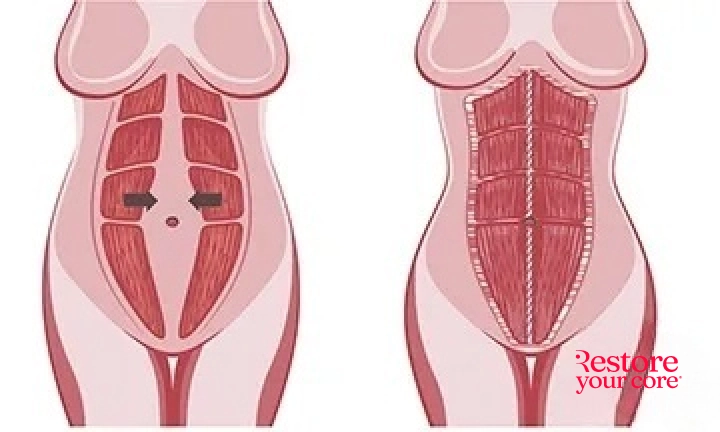
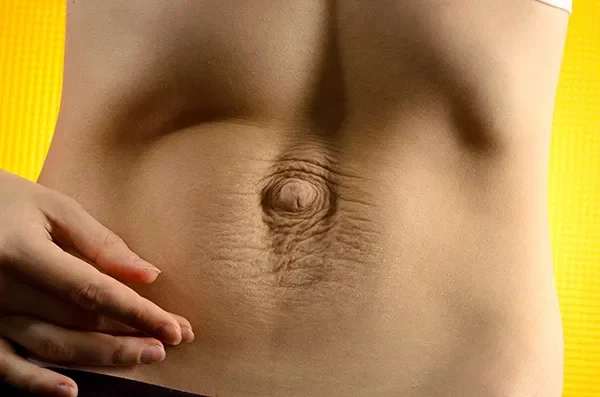
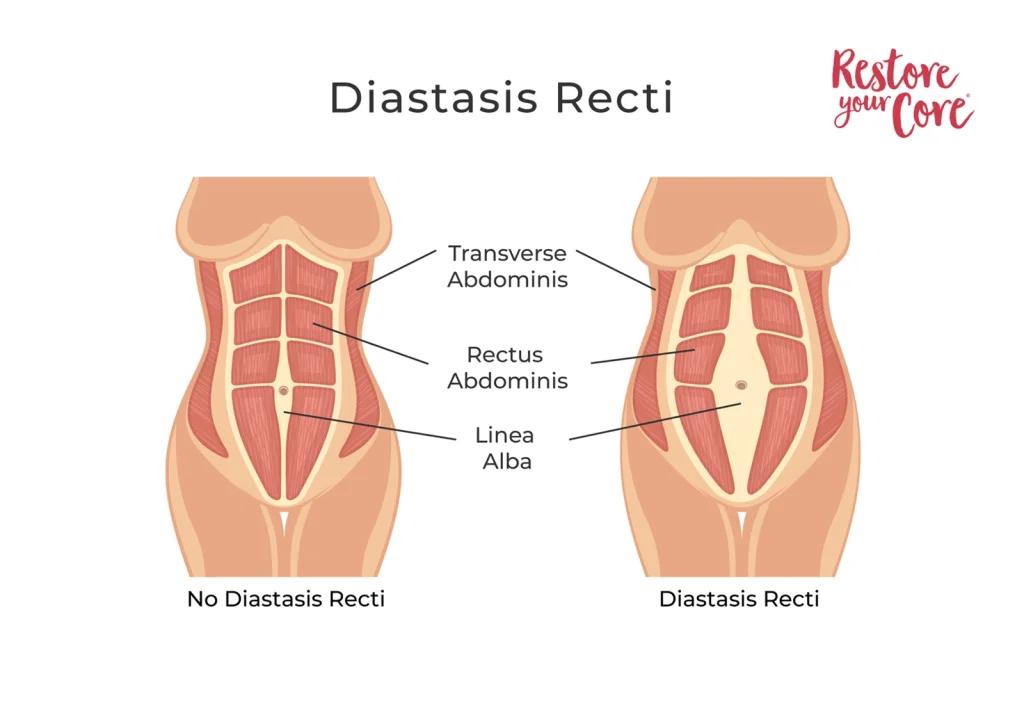
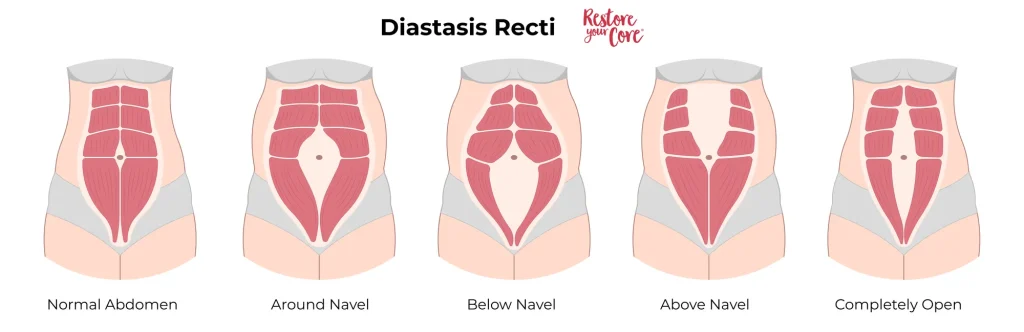
Diastasis recti is a common core injury. Many people working to heal it refer to trying to “close the gap,” since there can be a noticeable or subtle separation visible at the center of the abdomen. Running down the center of the abdomen, from ribs to pelvis, is a band of connective tissue called the linea alba. On each side of the linea alba sits one half of the rectus abdominis muscle. When this centerline tissue becomes stretched, torn, or weakened, a gap forms between the two halves. Understanding what exercises support that healing – and why – is what this article is about.
When it comes to healing diastasis recti, the exercises themselves are only part of the picture, and what influences outcomes is breath mechanics, pressure management, and load during movement.
Exercises that support healing allow the core to respond without pushing outward through the midline or creating downward pressure. With practice and consistency, this builds the kind of internal coordination in which strength, support, and function reorganize in a way that carries over into daily life. Breathing, alignment, and core engagement strategy each play a significant role in the process – and understanding them is a good place to start. The goal of healing diastasis recti is not just to close the gap – it is to restore function, coordination, and confidence to move well in daily life.
At Restore Your Core®, we approach diastasis recti recovery as a whole-system process – one that goes beyond exercises to address how the body moves, breathes, and manages load in everyday activities.
Signs and Symptoms of Diastasis Recti
Diastasis recti is most commonly associated with pregnancy. Most women who carry a pregnancy to term will experience some degree of abdominal separation. For many, this resolves naturally postpartum, but for a significant number, it persists and requires focused recovery. Postnatal exercises for diastasis recti are one of the most searched topics in core recovery for this reason. However, it is not exclusively a postpartum condition – men and women who have never been pregnant can also develop it through excess intra-abdominal pressure, significant weight changes, or heavy lifting without proper core engagement. Men looking for more specific guidance can find it in our diastasis recti exercises for men article.
Common signs include:
– A visible or palpable gap along the centerline of the abdomen
– Doming, coning, or ridging at the midline during movement or exertion
– A feeling of weakness or instability in the core
– Lower back pain
– Pelvic floor symptoms such as leaking or heaviness
– Difficulty with everyday loaded movements like lifting or carrying
If you suspect you may have diastasis recti, our article Self Testing Diastasis Recti can give you some initial information. A pelvic floor physiotherapist or physician can give you a more complete picture. Many cases go undetected (sometimes for decades) during routine exams, so seeking out a specialist who specifically looks for them is worthwhile.
Why Traditional Ab Exercises Often Don't Work for Diastasis Recti
Most traditional ab exercises are designed to produce muscle output – how hard the core can contract, how long it can hold, how much it can fatigue. For a healthy, intact core this can be effective. For diastasis recti, it often isn’t.
The problem is pressure. Exercises like crunches and sit-ups generate significant intra-abdominal pressure, which pushes outward through the midline rather than supporting it. This unmanaged pressure can worsen the very condition you are trying to heal.
The core is not a single muscle to be isolated and trained – it is a system. The diaphragm, pelvic floor, abdominal wall, and deep spinal muscles all need to work together to manage pressure and support the midline effectively. When that coordination is missing, even exercises that feel challenging may be moving you in the wrong direction.
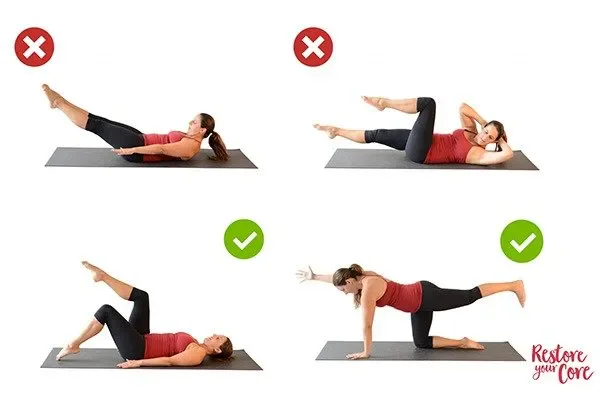
Exercises to be aware of:
– Crunches and sit-ups
– Any movement that causes doming, coning, or bulging at the midline
– Exercises that encourage over-bracing or gripping
– Movements that create downward pressure on the pelvic floor
The goal is not to avoid movement out of fear, but to choose movements your body can actually use. Understanding why certain exercises don’t work is the first step toward finding ones that do.
What Makes the Best Exercises for Diastasis Recti?
Not every core-challenging exercise is appropriate for diastasis recti. The ones that tend to support healing share a few key qualities.
Breath-driven movement: The exhale initiates and supports each movement, managing intra-abdominal pressure rather than increasing it.
Pressure management: Load is distributed through the system without pushing outward through the midline or downward into the pelvic floor.
Alignment and posture: A neutral spine allows the core to recruit and respond effectively. Without it, even good exercises can create compensation patterns.
Coordination over output: The goal is a core that responds and integrates, not one that simply contracts hard. This requires the diaphragm, pelvic floor, abdominal wall, and deep spinal muscles to work together.
When these elements are present, the core can begin to reorganize in a way that carries into real movement and daily life.
How to Know if an Exercise is Helping Your Diastasis Recti
As you move through abdominal exercises for diastasis recti, a feeling of support across the midline – rather than strain or pressure – is a good sign your body is managing the demand well.
If you notice doming, coning, bulging, bearing down, pain, or an increase in pelvic floor symptoms, that’s useful information about how your system is currently responding to that load. It often means the movement is asking for more than your body can organize right now, and adjusting the setup, reducing the load, or choosing a different variation can help you find a version where the core can respond with more coherence.
Signs that your approach is working:
– Doming and coning are reducing or disappearing during movement
– The midline feels more stable and evenly tensioned
– Daily tasks – lifting, carrying, getting up from the floor
– feel easier and more supported
– Pelvic floor symptoms are settling rather than increasing
Progress in diastasis recti recovery is more about feeling than forcing. If you find yourself bracing, holding your breath, or pushing through discomfort to complete an exercise, that is useful feedback. The body heals more effectively when movement feels organized and manageable, not effortful and strained.
A Note on Healing
Healing will look different for each person. The time it takes to heal depends on the severity of the injury to the linea alba and connective tissues, and for some people, it can take years to fully restore function. That is worth knowing, not as a discouragement, but because healing is possible and progress is real even when it is gradual
When measuring progress, the width and depth of the gap are only part of the picture. How the body manages pressure, distributes tension through the midline, and organizes load in daily movement matters just as much – often more.
Healing diastasis recti is not just about the exercises you do – it is about how you move, breathe, and load your body consistently throughout the day. The whole system is involved, and the whole system is what needs to be addressed.
The body adapts when given the right input. That means consistency matters more than intensity, and working with your body rather than forcing it tends to produce more lasting results. You do not need to push through discomfort or brace against movement to make progress – in fact, that approach often works against healing.
This is the philosophy behind Restore Your Core® – a 12-week program designed to give your body the right input, in the right order, so that strength and function can rebuild in a way that carries into real life.
Best Exercises for Diastasis Recti
The phrase “best exercises for diastasis recti” often comes up, and in practice, what that tends to reflect are movements your body can return to consistently, where breath, alignment, and load are working together, and where the system can respond without shifting into patterns of compensation.
Start Here: 3 Foundational Practices for Diastasis Recti Recovery
1. 3D Rib Breathing
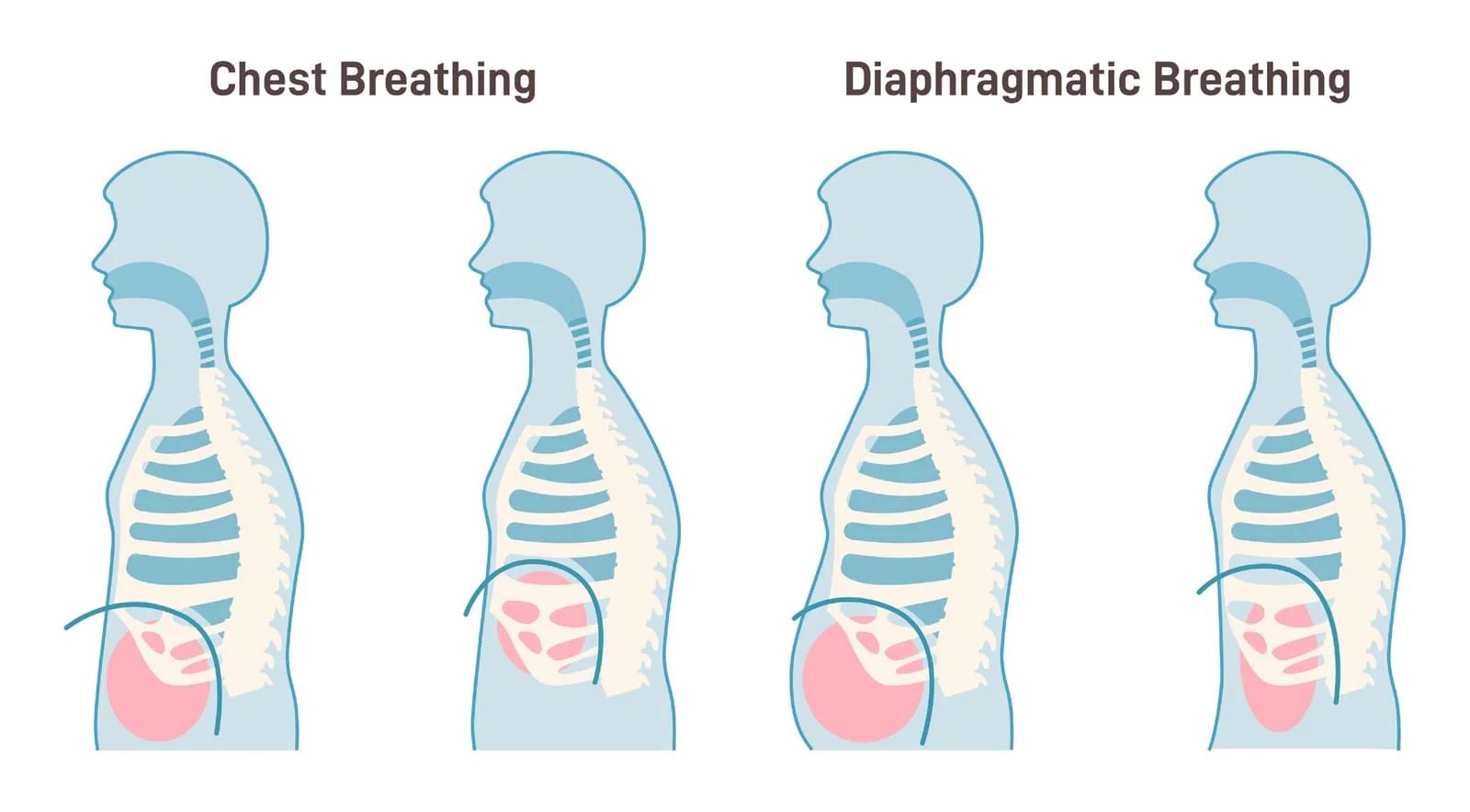
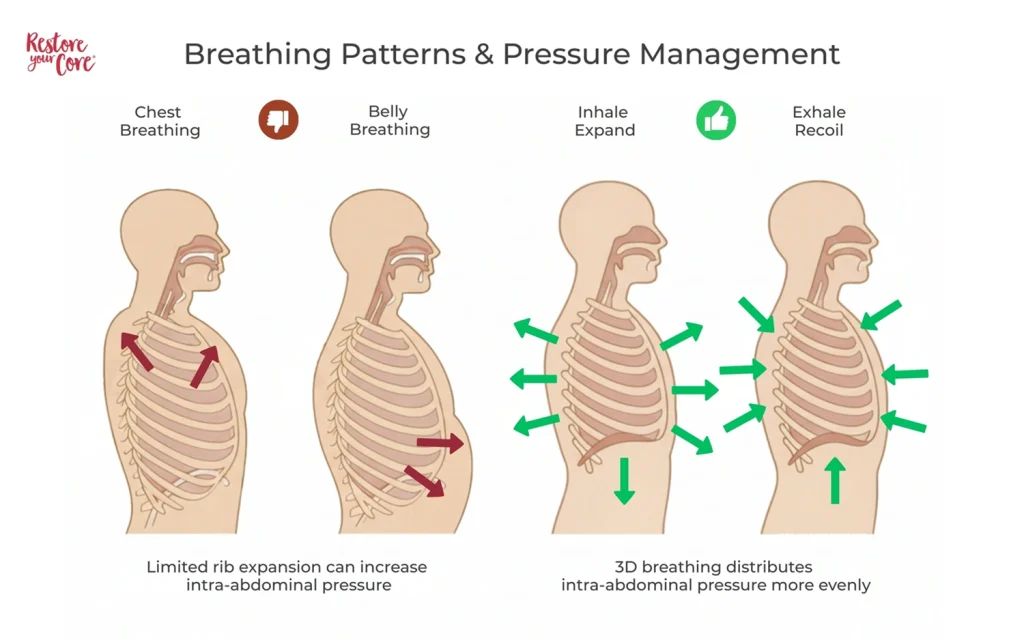
Breathing mechanics are foundational when healing diastasis recti. One of the main contributors to symptoms is excess intra-abdominal pressure, and breathing patterns are a key part of managing that.
3D rib breathing – expanding the ribcage in all directions is generally more supportive than belly breathing, which tends to push pressure outward and downward, adding unnecessary load to an already compromised midline.
What to focus on:
– Inhale into your ribcage, allowing it to expand to the front, back, and sides
– Avoid letting the belly push outward on the inhale
– On the exhale, let the ribs soften down and inward naturally
2. Alignment for Diastasis Recti Recovery
Posture and alignment play a significant role in how effectively the core recruits and strengthens during diastasis recti exercises. Positions that take the spine away from neutral make it hard for the core wall to respond effectively under load.
Positions to avoid:
– Ribs pushed forward and up (think gymnast posture)
– Shoulders and upper back rounded forward
– Pelvis untucked or lower back excessively arched
What to aim for:
– A neutral spine, where the ribs sit over the pelvis without gripping or thrusting
– Abdominals that are relaxed and responsive, rather than constantly braced or held in
– A sense of length through the torso
3. Core Strategy for Diastasis Recti:
Not all exercises are appropriate for diastasis recti. Some increase pressure, create tension, or compromise midline integrity. A core that tightens or grips during an exercise is not necessarily responding well – this can look like engagement while actually working against healing. The RYC® 12-Week Program is built around exactly this principle, helping you develop a core strategy that carries into real movement and daily life.
What to look for in a good core strategy:
– The core activates in response to movement, rather than locking down or bracing in anticipation
– Breath and movement work together
– No doming, coning, or bearing down during exercise
– Movements feel manageable and controlled, not forced or strained
Once these foundational practices feel familiar, the following exercises will be more effective – your body will already know how to breathe, align, and engage before the movement begins.
5 Exercises for Diastasis Recti Healing
1. Core Engagement for Diastasis Recti: The Candles Exhale
Come to sit tall or stand. Inhale, and on the exhale, imagine you are blowing out 100 candles. As you blow, you should feel your core draw inward and upward.
This breathing technique can be used during any workout, loaded movement, core exercise, or moment where you need core support. With practice, it trains the core to respond reflexively rather than requiring conscious thought.
2. Seated Side Bend for Diastasis Recti:
Sit tall on a block or folded blanket. Hold a yoga strap or belt overhead with elbows slightly bent to reduce tension in the neck and shoulders.
How to do it:
– Inhale to prepare
– Exhale, blowing candles, feeling your core draw in and up
– Side bend to the right, on an inhale, return to center
– Exhale again and side bend to the left
– Repeat 3x each side
– Your core should not bulge, brace, or push out at any point
This exercise supports upper-body mobility, torso length, and core coordination without straining the midline.
3. Seated Twist for Diastasis Recti:
Sit tall on a block or folded blanket. Hold a yoga strap or belt in front of you with both hands.
How to do it:
– Inhale to prepare
– Exhale blowing candles, feeling your core draw in and up
– Rotate your chest to the right, inhale and return to center
– Exhale again and rotate left
– Repeat 3x each side
– Your core should not bulge, brace, or push out at any point
This exercise supports upper-body mobility and rotational strength while keeping the load off the midline. A mobile, supple upper body is an important and often overlooked part of diastasis recti recovery.
4. Supported Side Plank for Diastasis Recti:
Begin with your right knee and right hand on the mat, hips lifted, left leg extended straight, and left arm extended toward the ceiling.
How to do it:
– Inhale to prepare
– Exhale blowing candles, feeling your core draw in and up
– Hold the position or 4-5 breaths, feel your core respond to every exhale
– Your core should not bulge, brace, or push out at any point
– Repeat on the other side
5. Bird Dog for Diastasis Recti:
Begin on hands and knees with your wrists under your shoulders and knees under your hips.
How to do it:
– Inhale to prepare
– Exhale blowing candles, feeling your core draw in and up
– Without your body shifting, slowly extend your right arm and left leg, keeping your spine neutral
– Hold the position or 4-5 breaths, feel your core respond to every exhale
– Alternate sides 3-5 times
– Your core should not bulge, brace, or bear down
To modify, extend the arm or the leg only until you feel ready to combine both.
This exercise builds shoulder stability, spinal control, and core coordination – making it one of the most effective abdominal exercises for diastasis recti.
Final Thoughts
Healing diastasis recti is a whole-system process – one where breath, alignment, pressure management, and movement build on each other with every repetition. The five exercises here are a starting point, and as your coordination between breath, alignment, and engagement improves, they become more effective. When the exhale initiates movement, and the body is well organized, the core is better able to respond – and that is when real change begins to take root.
Progress may be gradual, and that gradual progress is meaningful. Reduced doming during movement, a midline that feels more evenly tensioned, daily tasks that carry a sense of ease and support – these are the markers that matter, and they tend to arrive before any measurable change in gap width.
The exercises in this article reflect the same principles that guide the Restore Your Core® 12-Week Program – a self-paced, home-based program that moves you through a clear progression, from foundational breath and alignment work through to full-body functional strength. If you are ready to take that next step, the program is designed to meet you where you are and give your body the consistent, organized input it needs to heal.
FAQ
Diastasis recti describes a change in the connective tissue along the midline of the abdomen – the linea alba – where it becomes more stretched or thinned. Pregnancy is one context where this can happen. Excessive intra-abdominal pressure – whether from pregnancy, chronic gripping, breath patterns, heavy lifting, or significant weight shifts – can all stress this connective tissue. It’s often talked about in postpartum bodies, and it also relates to how the whole system manages load and pressure.
The midline will usually tell you what it can and can’t manage – you just need to know how to look. If you notice doming, coning, or a ridge along the center of your abdomen, that’s useful information. It often means the pressure being created in that moment isn’t being well distributed. You might also feel bearing down, increased pelvic floor symptoms, or strain in your back or neck. This kind of response can be understood as feedback. Small changes in position, breath, or load can completely change how a movement feels in your body.
Here is a video about why your core exercise may not be working
For some bodies, things shift naturally in the early postpartum phase as hormones settle and tissues begin to recover. For many others, especially when symptoms persist, coordination becomes an important part of the picture – how breath and movement are working together to manage pressure throughout the day. The body needs repetition, time, and progressive challenge to adapt and make lasting changes – and that is where a clear program becomes valuable.. Restore Your Core® is built around exactly this – a 12-week program that guides you through that progression in a way that’s self-paced, accessible at home, and designed to create changes that carry into real life
Yes – and what makes an exercise appropriate for diastasis recti recovery has less to do with the movement itself and more to do with how your body is managing it. Exercises that allow the core to respond without doming, coning, bearing down, or pushing outward through the midline tend to be the most supportive.
Breath, alignment, and load distribution all play a role in whether an exercise is working for your body or against it. A movement that works well for one person may not be appropriate for another, depending on where they are in recovery.
In the RYC® 12-Week Program, you’ll move through exercises progressively – starting with foundational breath and alignment work before building into more challenging movements. This graded approach helps increase awareness, so you can feel what’s happening in your core and move with more confidence, and from there, strength builds in a way that carries into real life.
Most core training focuses on muscle output – how much you can contract, hold, or fatigue. Diastasis recti recovery is centered on coordination instead. Rather than isolating and loading individual muscles, the focus is on how the diaphragm, abdominal wall, pelvic floor, and spine interact with each other in real time – especially under load. That often means the movements can look simple and feel very different. You’re working in a way your body can use – building the kind of integrated strength that carries into daily movement.
Diastasis recti and hernias are not the same thing, though they can sometimes be confused. With diastasis recti, the connective tissue along the midline has become widened or thinned. With a hernia, there is an opening in the abdominal wall that allows tissue to push through. Diastasis recti and hernias can coexist, and sometimes feel similar. A hernia may require a different approach to recovery; it’s important to be assessed by a physician if you are unsure what’s happening in your body.
Breath and posture influence pressure – and pressure is something your core is managing all day long. If your breathing pattern consistently pushes pressure downward or outward, or if your alignment makes it harder for your core to respond efficiently, even simple movements can feel harder. When those patterns shift, the whole system often responds differently – and that change is often where diastasis recti recovery begins to feel different in daily life, which is why in RYC®, breath and alignment are the foundation of every movement.
Restore Your Core® is a 12-Week Program that works with the whole system – not just the abdominal gap. You’ll move through a clear progression that integrates breath, pressure, alignment, and full-body movement so your core can respond more effectively in real life. The goal is to restore how your body functions, so you can move, lift, and exercise with confidence and return to the activities you love.