Lauren Ohayon is the creator of Restore Your Core® (RYC®), a comprehensive and sustainable whole-body fitness program that empowers women to achieve ideal pelvic floor / core function and be strong, long, mobile and functional.
Hi! I'm Lauren.
Nice to meet you
Lauren Ohayon is the creator of Restore Your Core® (RYC®), a comprehensive and sustainable whole-body fitness program that empowers women to achieve ideal pelvic floor / core function and be strong, long, mobile and functional.
When most people think about the pelvic floor, they think about how to support the musculature via focused, spot treatment exercises like Kegels. This lens only gives us a small fraction of the whole picture. Your pelvic floor is intimately connected to the rest of your body and body systems via fascia and is highly responsive to mental and emotional stress as well as the state of your nervous system.
This article will explore the interconnectedness between your pelvic floor, fascia and the nervous system. We will look at what nervous system regulation really means and how to support your pelvic floor (and entire being) with tools that address not just the muscles themselves, but your whole system.
Start your healing today with this free workout
Table of Contents
The Foundation: Pelvic Floor Basics
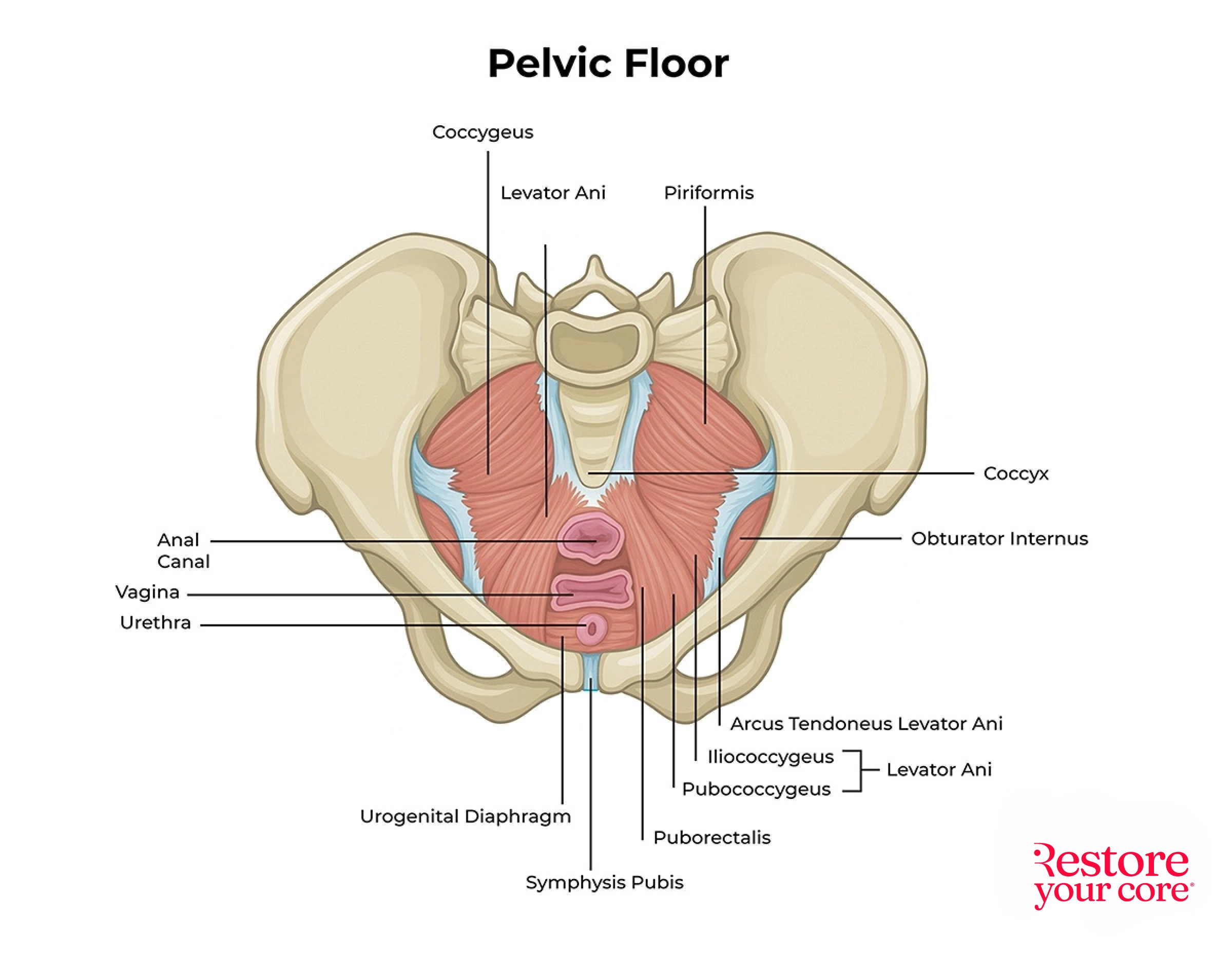
Your pelvic floor is comprised of hammock like bands of muscle and fascia that span from sitz bone to sitz bone and from pubic bone to tailbone, forming the base of your pelvis. Your reproductive organs, internal pelvic organs and elimination pathways all rely on the pelvic floor to function well. Along with your core and breathing diaphragm, your pelvic floor helps to regulate pressure in your abdomen and supports movement. A strong pelvic floor is a responsive pelvic floor – able to contract and release as needed whether that be using the restroom, keeping a tampon in place, or birthing a baby!
This idea of responsiveness is key. It means your tissues are ready to meet the moment, to perform as needed, neither chronically too tense nor too lax. When the pelvic floor is too tense (hypertonic) or underactive (hypotonic), we often experience symptoms such as incontinence, painful sex, pelvic pressure, incomplete emptying and so forth.
Your pelvic floor does not operate in isolation, however. These muscles are surrounded and supported by fascia which connects them to all other parts of your body and creates a continuous feedback loop of information between your tissues and your autonomic nervous system.
All About Fascia
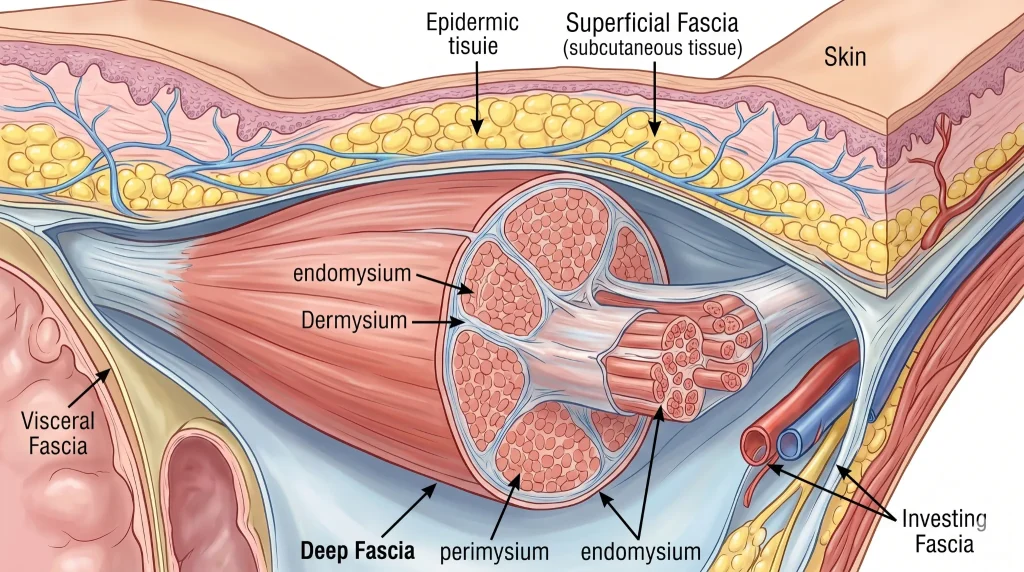
Fascia is body wide connective tissue made up of collagen fibers and a gel-like water matrix that allows tissues to slide and glide, providing fluid movement to all tissues, joints and organs. Research continues to reveal fascia’s role in pain, mobility, tension, and the connection between sensation, tissue tone, emotional experience and nervous system state.
Fascia is the most innervated tissue in your entire body. Fascia houses 25% more nerve endings than the skin, and 1000% more than the collective innervation of muscle, so fascia could very well be considered our richest sensory organ (1). Healthy fascia supports movement, having a sense of your body in space (proprioception), having an internal sense of your body’s state (interoception) as well as overall nervous system balance.
It also helps explain how seemingly distant parts of the body are connected – for example, how you stand can affect tension patterns in the head and neck. Fascia is highly adaptive to how you move most often and will lengthen and shorten accordingly to help shape your body to fit not only your lifestyle, but how you think and feel most often. This is due to its seamless connection with your nervous system.
Fascia surrounds everything in your body down to the smallest cell. Every nerve fiber, nerve cell, muscle, organ and body system is held in place and surrounded by fascia, even your brain and spinal cord. Due to it being so highly innervated, your fascia and nervous system truly work as one coherent system; we could think of it as the ‘neuro-fascial network’.
This network sends a vast amount more information (80%) to your brain than your brain sends to the rest of your body. This body-brain communication includes information about your environment, your body’s position, sensation, touch, sound, pH, metabolism, pain and even internal states of your organs. With this information, your autonomic nervous system sends out signals in response to help guide your body to organize and adjust appropriately.
This ongoing, two-way communication between body and central nervous system creates a continuous feedback loop of information and response. It’s how your soft tissues influence your nervous system and how your nervous system, in turn, shapes your tissues.
For example, persistent muscle tension, like what can happen in the pelvic floor, can send signals of stress, effort, or even a subtle “threat” to your autonomic nervous system. This can shift your system toward a more activated, sympathetic (fight-or-flight) state. That state then reinforces the tension, since the nervous system naturally increases muscle tone under stress. (2)
On the other hand, when tissues are more lax or underactive (hypotonic), the signals sent are more along the lines of instability or lack of support. In response, the nervous system may recruit other areas to step in and compensate – creating more effort and increased tone elsewhere in the body to provide a sense of stability. Your neuro-fascial network plays a central role in regulating tissue tone, sensation, and how your body responds to stress.
Try 18 minutes of healing, nourishing movement – the RYC® way
Nervous System Regulation
When your body feels ‘stuck’ in a looped state of chronic stress, how do we interrupt the cycle? You may have heard the term ‘nervous system regulation’ before, but what does that even mean? Many misinterpret ‘nervous system regulation’ to mean calm all the time, but that is misleading.
Your autonomic nervous system has two main branches: your parasympathetic (PNS) and sympathetic nervous systems (SNS). The PNS governs rest, relaxation, digestion, feeling responsive instead of reactive as well as calm and open. The SNS activates fight, flight, protect mode as well as action and activation. During any normal day, your body is ideally moving between states of rest/relax and activation with ease, responding appropriately to what’s happening around you.
You are not supposed to be ‘calm all the time’ and true regulation is the ability to shift between states, to respond and recover with flexibility. This mirrors how the pelvic floor and core are meant to function: responsive, adaptable, and dynamic.
Research shows the autonomic nervous system is constantly adapting, helping us navigate between states of safety and challenge. There’s no such thing as a “bad” response, only responses that were, at some point, adaptive. The goal isn’t to override these patterns, but to build the capacity to move through them with more ease and awareness.
This concept of building capacity comes down to cultivating a felt sense of safety in your body over time (3). The safer your body feels, the more your nervous system can move fluidly between states and the more your pelvic floor and core can respond appropriately, contracting and releasing as needed rather than staying chronically tense or persistently under-engaged. If you resonate with feeling “stuck” in ongoing activation and stress, or on the flip side, feeling unsupported while also experiencing pelvic floor or core dysfunction, you’re not alone. This is why including nervous system support in any core and pelvic floor rehabilitation approach is so important.
Moving Forward
There are many ways to support your fascia, nervous system, and musculature. Movement, breath, and bodywork are three of the most potent ways to cultivate a sense of safety and create balance in both your nervous system and soft tissues over time. This is because each of these pathways offers new input to your neuro-fascial, autonomic communication loop, giving your body fresh information to reorganize and adapt around.
Your body is always working for you, even if it doesn’t feel that way at times. Both your nervous system and soft tissues are highly adaptable. The more you offer your body new experiences through breath, movement, and touch, the more it can update and respond to that input, gradually shifting toward the state you’re aiming to experience.
How you move, how you feel as you move, and how you breathe are all key in providing your body with new input that can help you shift gears over time. When your goal is to cultivate a felt sense of safety, moving more slowly at first–while building strength–and incorporating a long exhale (like the RYC® candles breath) can be especially supportive. Moving slowly allows you to feel more of what’s happening in your body, and feeling more builds capacity over time.
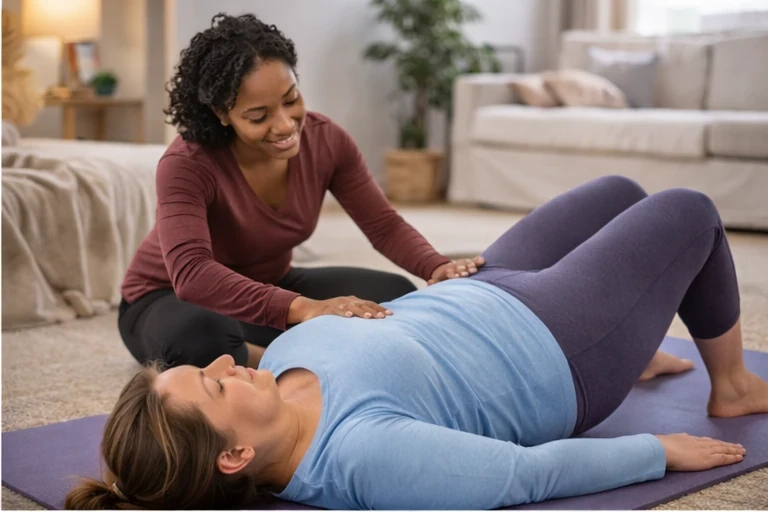
This is where self-massage or working with a skilled bodyworker can be incredibly supportive, especially as you explore new patterns of breath and movement. Slow, intentional movement also gives your nervous system a clear signal that you are not in immediate danger–after all, you’re not running from a bear if you’re moving with steadiness and control.
Building strength in the body further reinforces a sense of safety, support, and resilience. The same is true with a long, slow exhale. Research has shown that longer exhales than inhales can help shift your system out of chronic stress patterns. Breath is one of the most direct access points we have to the autonomic nervous system.
Moving slowly during exercise is a great place to begin. From there, you might start to notice your pace throughout the rest of your day. Do you rush from one task to the next just to get through? Do you find your breath is shallow or constricted as you move through your day?
When we begin to support the nervous system in this way, the pelvic floor and core often start to respond differently, not because we are forcing them to change, but because the system, they’re a part of feels safer and more supported. Over time, this allows for more natural coordination, strength, and release to emerge.
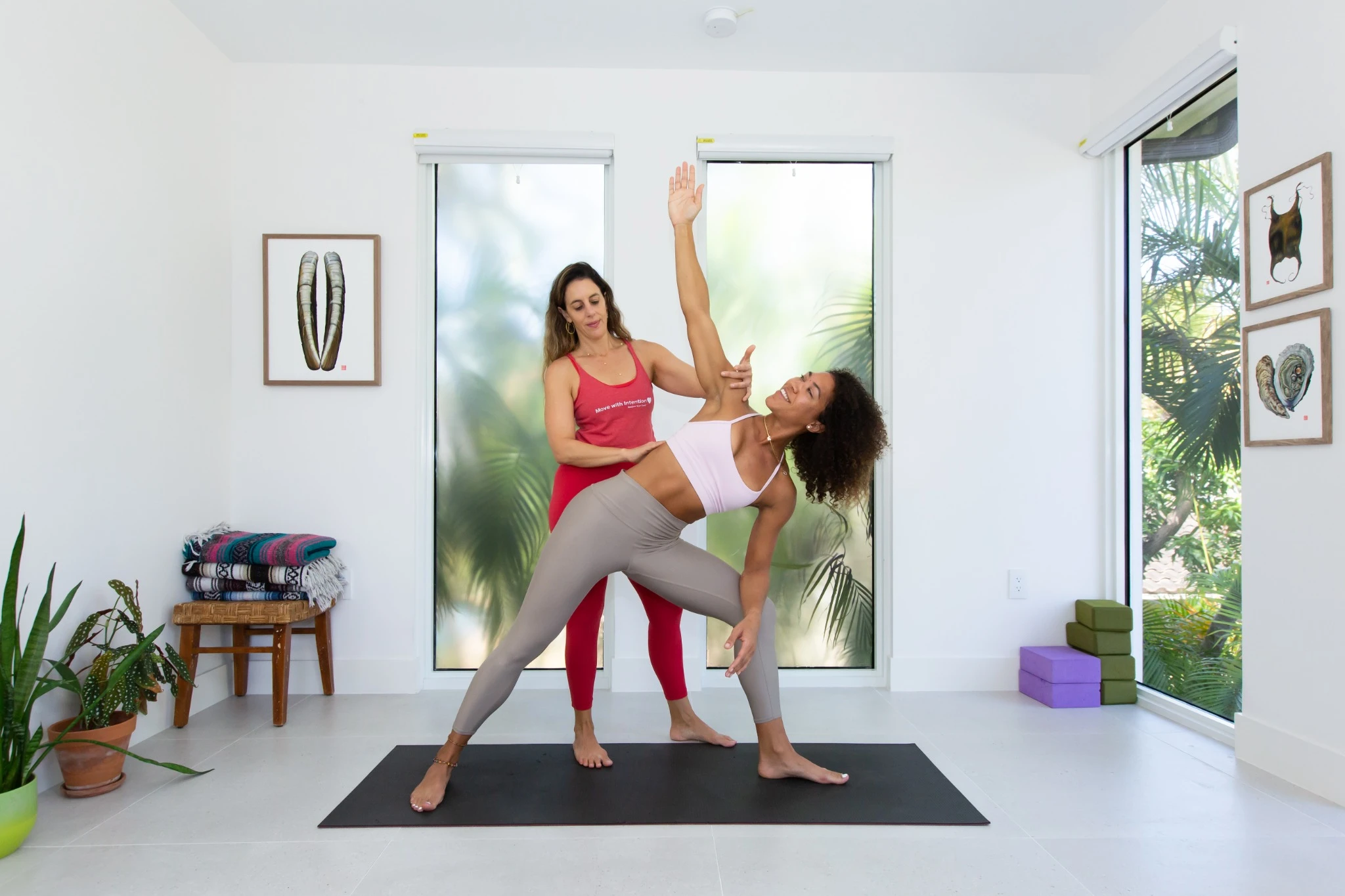
This is the approach I take as a Restore Your Core® (RYC®) teacher who also works 1:1 with clients. RYC® supports the connection between pelvic floor, core, fascia and nervous system – offering a truly integrated approach to pelvic floor and core wellness.
Access your free workout and start healing your core and pelvic floor today
References
[1] Fascia as a regulatory system in health and disease Allison M Slater, Jade Barclay, Rouha MS Granfar, Rebecca L Pratt
[2] Fascia and The Nervous System Anatomy and Conditions Explained, Feb 6 2026. Written by Theodore Levarda
[3] Polyvagal Theory: A Science of Safety: Stephen Porges Review Article, Frontier Integrated Neuroscience 09 May 2022 Volume 16 – 2022
“There is no thank you big enough for Lauren Ohayon existing and thinking and helping so many of us. Every time I do something I never thought I’d do again she is part of the reason why.”
Laura Gregg
Strengthen, heal & nourish your pelvic floor & core
If you are experiencing pain in the region below your navel and in the deeper tissues around your hips and above your thighs, you may be experiencing pelvic floor pain....
Learn how to strengthen your pelvic floor with safe, effective exercises that improve core function, reduce symptoms, and support lasting pelvic health—without relying on Kegels....
Pelvic floor muscle exercises are often very diverse and provide a variety of information regarding the styles and methods you should pursue when seeking to build pelvic floor strength. Some...
Pelvic floor repair surgery is the most common surgery for pelvic organ prolapse. Pelvic floor repair is a broad term used to classify a variety of simple, surgical procedures for...
Learn what a pelvic floor specialist does, common symptoms of dysfunction, and how therapy can relieve pain, incontinence, and restore core strength....
Relieve pelvic floor pain with effective stretches, breathing techniques, and gentle exercises designed to reduce tension, improve core function, and support long-term recovery and comfort....
Pelvic floor pain can be debilitating; a large number of runners experience some form of pelvic pain and pelvic floor dysfunction. This article outlines the causes of pelvic floor pain...
Your pelvic floor muscles play an important part for many bodily functions, including sexual health and orgasms. In this article, I’m debunking common myths about your pelvic floor and highlighting...
Learn how to tell if your pelvic floor is tight or weak, key symptoms to watch for, and what to do next. Understand causes, signs, and safe steps to restore...