Resources
- How Stress, Fascia & Your Nervous System Affect Your Pelvic Floor
- How Do I know If My Pelvic Floor Is Tight Or Weak?
- The Connection Between Exercise and Bloating: What Every Professional (and Their Clients) Need to Know
- How to Strengthen Pelvic Floor Safely
- Pelvic Floor Exercises for Constipation: Awareness, Movement, and Nervous System Relief
- High-Tone Pelvic Floor Dysfunction: Symptoms, Causes & Relief Tips
- How Menopause Affects the Pelvic Floor: Symptoms, Support & Hormonal Impact
- Tailbone Wagging for Tailbone Pain Relief and Pelvic Floor Mobility
- The Power of Tremoring: How Tension Release Exercises Support Your Nervous System
- Pelvic Floor Postpartum Exercises for Faster Recovery
- Navigating Coccyx Pain in Pregnancy: A Trimester-by-Trimester Guide
- Understanding Coccyx Pain: Symptoms, Causes, Healing and Prevention
- Pilates and Pelvic Floor Dysfunction: Is It the Solution You’re Seeking?
- 5 Pilates Pelvic Floor Exercises You Don’t Want to Leave Out
- Pelvic Floor Massage: A Comprehensive Guide
- Does Pilates Strengthen Pelvic Floor Muscles? A Comprehensive Guide
- Hypermobility and Pelvic Floor Health: What You Need to Know
- The Foot to Pelvic Floor Connection: A Whole-Body Approach to Movement and Health
- Understanding Pelvic Floor Pain After Running: Causes and Solutions for Professionals
- Top 5 Exercises to Strengthen the Pelvic Floor
- Do Squats Strengthen Pelvic Floor Muscles? Insights for Movement Professionals
- How Pelvic Floor Health Is Related to the Process of Moving from Arousal to Orgasm
- 5 Things I Wish People Knew About Your Pelvic Floor & Orgasm
- Pelvic Floor Tension: Everything You Need to Know
- How Running and Pelvic Floor Health Are Interconnected: What Every Runner Should Know
- Does Running Strengthen Pelvic Floor Muscles? Myths vs. Facts
- Understanding Urine Leakage Causes: Why It Happens and How to Manage It
- How to Strengthen Your Pelvic Floor: The Ultimate Guide
- Strengthening and Restorative Yoga Poses for Full Body Health
- Understanding Queefing: Causes, Symptoms, and Simple Prevention Tips
- How Do You Know if You Have a Weak Pelvic Floor
- What Does Pelvic Floor Pain Feel Like?
- How Can I Strengthen My Pelvic Floor Without Kegels?
- Pelvic Floor Stretches | 5 Quick Ways To Relax Your Pelvis
- Pelvic Floor Specialist | Finding Help To Heal Your Pelvis
- Is Pelvic Floor Repair Major Surgery? | Pelvic Health Guide
- Pelvic Floor Exercise
- How to Strengthen Pelvic Floor
- Is Pelvic Floor Repair Major Surgery? | Pelvic Health Guide
- Pelvic Floor Therapy | Improving Your Pelvic Health
Resources
- How Stress, Fascia & Your Nervous System Affect Your Pelvic Floor
- How Do I know If My Pelvic Floor Is Tight Or Weak?
- The Connection Between Exercise and Bloating: What Every Professional (and Their Clients) Need to Know
- How to Strengthen Pelvic Floor Safely
- Pelvic Floor Exercises for Constipation: Awareness, Movement, and Nervous System Relief
- High-Tone Pelvic Floor Dysfunction: Symptoms, Causes & Relief Tips
- How Menopause Affects the Pelvic Floor: Symptoms, Support & Hormonal Impact
- Tailbone Wagging for Tailbone Pain Relief and Pelvic Floor Mobility
- The Power of Tremoring: How Tension Release Exercises Support Your Nervous System
- Pelvic Floor Postpartum Exercises for Faster Recovery
- Navigating Coccyx Pain in Pregnancy: A Trimester-by-Trimester Guide
- Understanding Coccyx Pain: Symptoms, Causes, Healing and Prevention
- Pilates and Pelvic Floor Dysfunction: Is It the Solution You’re Seeking?
- 5 Pilates Pelvic Floor Exercises You Don’t Want to Leave Out
- Pelvic Floor Massage: A Comprehensive Guide
- Does Pilates Strengthen Pelvic Floor Muscles? A Comprehensive Guide
- Hypermobility and Pelvic Floor Health: What You Need to Know
- The Foot to Pelvic Floor Connection: A Whole-Body Approach to Movement and Health
- Understanding Pelvic Floor Pain After Running: Causes and Solutions for Professionals
- Top 5 Exercises to Strengthen the Pelvic Floor
- Do Squats Strengthen Pelvic Floor Muscles? Insights for Movement Professionals
- How Pelvic Floor Health Is Related to the Process of Moving from Arousal to Orgasm
- 5 Things I Wish People Knew About Your Pelvic Floor & Orgasm
- Pelvic Floor Tension: Everything You Need to Know
- How Running and Pelvic Floor Health Are Interconnected: What Every Runner Should Know
- Does Running Strengthen Pelvic Floor Muscles? Myths vs. Facts
- Understanding Urine Leakage Causes: Why It Happens and How to Manage It
- How to Strengthen Your Pelvic Floor: The Ultimate Guide
- Strengthening and Restorative Yoga Poses for Full Body Health
- Understanding Queefing: Causes, Symptoms, and Simple Prevention Tips
- How Do You Know if You Have a Weak Pelvic Floor
- What Does Pelvic Floor Pain Feel Like?
- How Can I Strengthen My Pelvic Floor Without Kegels?
- Pelvic Floor Stretches | 5 Quick Ways To Relax Your Pelvis
- Pelvic Floor Specialist | Finding Help To Heal Your Pelvis
- Is Pelvic Floor Repair Major Surgery? | Pelvic Health Guide
- Pelvic Floor Exercise
- How to Strengthen Pelvic Floor
- Is Pelvic Floor Repair Major Surgery? | Pelvic Health Guide
- Pelvic Floor Therapy | Improving Your Pelvic Health
Finding Relief from Pain During Sex: Pelvic Floor Exercises That Work
By Lauren Ohayon 10/14/2025
4 Min Read
If you’ve ever felt sharp pain, burning, or discomfort during sex, you know how painful and distressing it can be. Many women describe painful penetration as something they never expected and often feel ashamed or afraid to talk about. And while it’s incredibly common, it’s not something you just have to accept as “normal,” and you don’t have to learn to “get used to.”
The hopeful news? With the right blend of breath, resistance, and whole-body movement, you can shift these patterns and begin to feel more at ease.
Table of Contents
Why Pain Happens: Looking Beyond the Surface
Pain during sex is rarely about one thing – it’s usually a response to a combination of factors.
Pelvic floor muscles that hold on too tightly
A common but often overlooked cause of pain during sex is pelvic floor tension – when these muscles stay clenched and contracted instead of softening and releasing.
Daily habits like holding your breath, tensing your abs, or clenching your glutes can quietly train the pelvic floor to stay “on guard.” Over time, this gripping can become your body’s default setting, making intimacy feel tender, restricted, or even painful.
Hormonal and tissue changes
During perimenopause, menopause, or postpartum, hormone shifts can affect vaginal tissues, reduce elasticity, and decrease lubrication, which can contribute to painful intercourse. Additionally, your body may respond by gripping more, which only adds to the discomfort.
Nervous system patterns and trauma
Your pelvic floor is highly sensitive to the state of your nervous system. When your nervous system is on high alert – whether from trauma, chronic stress, long-standing protective patterns, or even movement patterns – the pelvic floor often reacts by gripping. Over time, this tension can become the body’s default response, layering strain on muscles that are meant to move between contraction and release.
Healthy sexual function depends on the body, mind, and emotions working in harmony – which is why approaches that incorporate breath, awareness, and whole-body movement are often more effective than focusing on one muscle alone [1].
Signs Your Pelvic Floor May Be Too Tight
Sometimes your body speaks in sensations before you have language to describe them. You might notice discomfort during intimacy, changes in bathroom habits, or a constant feeling of tension without knowing exactly why. These are all ways your body asks for attention.
Common indicators include:
- Pain during penetration
- Burning or stinging sensations during sex
- Difficulty inserting a tampon
- Persistent pelvic floor tension
- Low back or hip pain
- Pressure, heaviness, or pulling in the pelvis
- Difficulty starting or finishing urination or bowel movements
If any of these sound familiar, it’s not a sign you’re broken. It could be a sign your muscles are working overtime, trying to protect and stabilize you. Research shows that many women experiencing painful penetration have pelvic floor muscles that stay too active at rest – a state of constant tightness that can contribute to both pain and reduced natural lubrication [2].
Even recognizing this pattern can bring relief. There’s comfort in knowing your symptoms have a name, and that there are ways to shift them. From here, movement and breath can begin to guide your body back toward balance.
Finding Relief Through Gentle, Purposeful Movement
If you’re wondering what you can actually do to relieve pain and tension, the answer often starts with intentional movement. Pain during sex – what doctors sometimes call dyspareunia – has been shown to improve when the pelvic floor is gently retrained through targeted exercise.
Research shows that women who practiced pelvic floor rehabilitation experienced both less pain and better sexual function [3]. These findings echo what so many in our community experience firsthand: with the right kind of movement, real change is possible.
Exercises to Release a Tight Pelvic Floor
Release isn’t about stretching harder – it’s about teaching your muscles to respond with flexibility instead of tension. These movements, informed by the RYC® Method, integrate breath, movement, and awareness to help downregulate the nervous system, enabling your pelvic floor to yield and support you with ease.
1. Resisted Windshield Wipers
How to do it:
- Sit on the floor with your hands supporting you, your knees bent, and your feet flat on the floor.
- Don’t let your pelvis tuck under. Use a folded blanket for support if needed.
- Actively press one thigh outward, then bring it back in with slow control. Alternate sides.
Why it helps:
Tight inner thighs often pull on the pelvic floor, reinforcing gripping. By engaging and releasing with control, you send your pelvic floor the message that it’s safe to soften.
Try this cue: Imagine your thighs moving through heavy honey instead of “flopping open” and closed.
2. Mermaid or Z Sit Side Bends and Twists
How to do it:
- Sit in a “Z sit” with your right leg in front. Add a blanket under your hips if support is needed.
- Inhale to reach your left arm overhead and side bend to the right, opening the left side of the body.
- Exhale back to center, and gently twist to the left.
- Repeat 6–8 times per side.
Why it helps:
When your ribs and spine move freely, your breath does too – and your pelvic floor follows. This exercise helps release the downward pressure that adds tension to the pelvic floor.
Try this cue: As you create length on the one side of the body, think of shortening the waist on the other side, like you’re trying to squeeze a lemon between your ribs and pelvis.
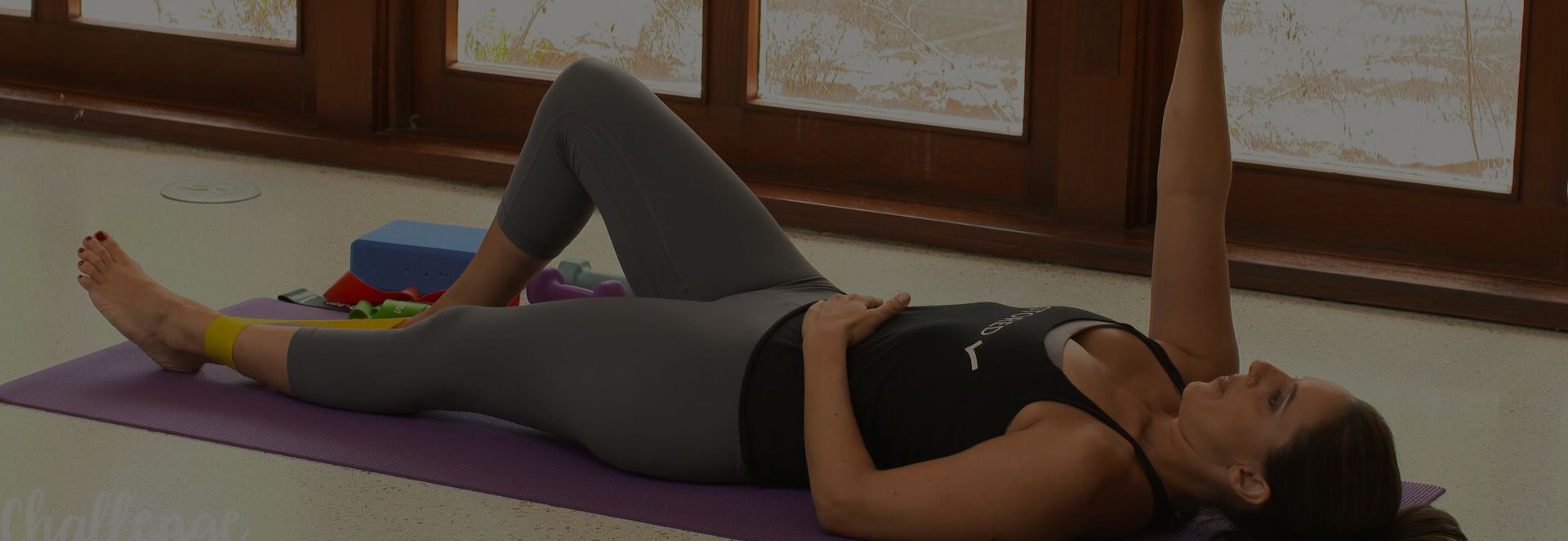
3. Supine Leg Press with Stool
How to do it:
- Lie on your back with a folded blanket under your head. Place your heels on a stool.
- Press your thighs outward against resistance, then draw them back in with resistance.
- Let your pelvis gently tuck and untuck with the motion of your legs.
- Repeat 6–8 times.
Why it helps:
This integrates your inner thighs, core, and pelvic floor. It balances effort with release, helping to retrain the gripping pattern in the pelvic floor.
Try this cue: If your legs tremble, welcome it. Trembling is your nervous system learning it’s safe to let go.
4. Inner Thigh Lengthening – adding on
How to do it:
- Lie on your back with a folded blanket under your head. Place your heels on a stool.
- With your legs in external rotation, bring your right knee towards your armpit on the outside of your body.
- Extend your right leg, feeling a stretch in the inner thigh.
- Bring the foot back to the stool and, with resistance, draw the knees together.
- Repeat 6-8 times on each side.
- Sync your movements with your breath, exhaling on effort and inhaling on release.
Why it helps:
Pairing breath with all our movement retrains your pelvic floor to be responsive, not rigid. It teaches your system that letting go is just as important as engaging.
Daily Tips to Support Release
Healing from painful penetration isn’t about a single “fix.” It’s about giving your body steady reminders that it can move, release, and trust again. Here are a few ways to bring that into daily life:
- Practice consistently: A few mindful minutes most days are far more effective than one long session every now and then. Think of it like brushing your teeth – small, steady inputs that keep your system balanced.
- Breathe on purpose: Your breath is a built-in regulator. Let inhales feel like expansion and release, and let exhales be a cue for your core and pelvic floor to support you. Over time, this becomes second nature – your pelvic floor responding to the breath.
- Reset your nervous system: Engage in practices that promote nervous system regulation. Rhythmic movement, deep exhalations, and subtle shaking patterns activate your body’s natural relaxation response and help discharge built-up tension.
- Get guided support: The Restore Your Core® Program guides you through step-by-step progression to increase strength and mobility and restore balance to your core and pelvic floor. And if you want personal guidance, a Certified RYC® Teacher can help you fine-tune the movements to your body.
Conclusion
Painful penetration may feel overwhelming, but it doesn’t define you – and it doesn’t have to last forever. By addressing the root causes of pelvic floor tension – chronic gripping, hormonal changes, or nervous system stress – you can create space for healing.
These exercises are a starting point. If you’re ready for a deeper, more structured plan, the Restore Your Core® 12-Week Program offers step-by-step guidance to release tension, strengthen your whole system, and feel safe and confident in your body again.
FAQ
1. Why do I feel burning pain during or after sex?
Burning pain can happen when the pelvic floor muscles stay clenched, limiting blood flow and increasing sensitivity. It’s also common during times of hormonal change, like menopause or postpartum, when vaginal tissues become thinner and drier. Stress or nervous system tension can make the muscles grip even more. Focusing on gentle release, breath-led movement, and good lubrication helps reduce irritation and restore comfort.
2. How do I know if painful sex is pelvic floor-related?
If you notice pain or burning during penetration, a constant sense of clenching, or difficulty relaxing during bathroom trips, your pelvic floor may be part of the story. Gentle movement is often a good “test” – if it brings relief, that’s a sign your pelvic floor is involved.
3. Can trauma or emotional stress make pain during sex worse?
Absolutely. Emotional stress and past trauma can keep the nervous system on high alert, causing the pelvic floor to tighten in self-protection. Over time, this guarding can turn into pain during intimacy. Practices that calm the nervous system – like mindful breathing, gentle movement, and grounding exercises – help the body feel safe again, allowing the pelvic muscles to release and ease discomfort.
4. Can exercises help relieve pain during penetration?
Yes. Gentle, targeted movement can make a real difference. When the pelvic floor stays tight, blood flow and flexibility decrease, which can intensify pain or burning sensations. Exercises that combine breath, awareness, and controlled resistance help the muscles release and rebalance. Paired with lubrication and medical guidance, this approach supports healing and greater comfort over time.
5. Are Kegel exercises helpful for relieving pain during sex?
Not always. For someone with a tight pelvic floor, repetitive Kegels can make gripping worse. The goal isn’t more contraction – it’s teaching the muscles to release and respond. In this case, less squeezing and more balance are what bring relief.
6. How long before I feel less pain during sex?
Some people experience a shift in just one session, while others require weeks of steady practice. You’re teaching your muscles and nervous system new patterns – and that takes practice. Trust the process and keep listening to your body.
7. What’s the most effective at-home approach to healing pain with penetration?
The Restore Your Core® 12-Week Program is one of the most effective options because it doesn’t just target the pelvic floor – it retrains your whole system. Using breath, resistance, and functional movement, RYC® helps release chronic tension while building strength and resilience. It’s recommended by physiotherapists, movement professionals, and trusted by thousands of women who’ve experienced painful penetration, prolapse, or pelvic floor tension. For more personalized guidance, you can also connect with a Certified RYC® Teacher for one-on-one support.
References
[1] Rosenbaum, T. Y. (2008). The role of physical therapy in female sexual dysfunction. Current Sexual Health Reports, 5(2), 97–101.
[2] Dias-Amaral, A., & Marques-Pinto, A. (2018). Female genito-pelvic pain/penetration disorder: Review of the related factors and overall approach. Revista Brasileira de Ginecologia e Obstetrícia, 40(12), 787–793.
[3] Ghaderi, F., Bastani, P., Hajebrahimi, S., Asghari Jafarabadi, M., & Berghmans, B. (2019). Pelvic floor rehabilitation in the treatment of women with dyspareunia: A randomized controlled clinical trial. International Urogynecology Journal, 30(11), 1849–1855.